

MISSISSAUGA, Ont. -- The war on modern pitching is being waged in the batter’s box, in the video rooms, in the hearts and minds of flummoxed hitters and, more and more, in a single-story commercial strip building in suburban Toronto.
Thanks to the work done in the offices of Trajekt Sports, big league batting practice has been revolutionized -- a rare technological advancement that favors the swingers, not the slingers.
The data-driven pitching robot made by Trajekt and used by nearly every MLB organization is taking over baseball behind the scenes, with the hope that it can make a dent in the armor of today’s wicked pitching arsenals.
“If [batters] could play 100 games or get 100 at-bats in a day against their opponents, that would be better than Trajekt,” jokes Rowan Ferrabee, the company’s chief technology officer. “But Trajekt, one could argue, is better than some guy throwing you lobs and you knocking them out of the park.”

Traditional pregame batting practice, with said lobs, is still taking place on fields across MLB.
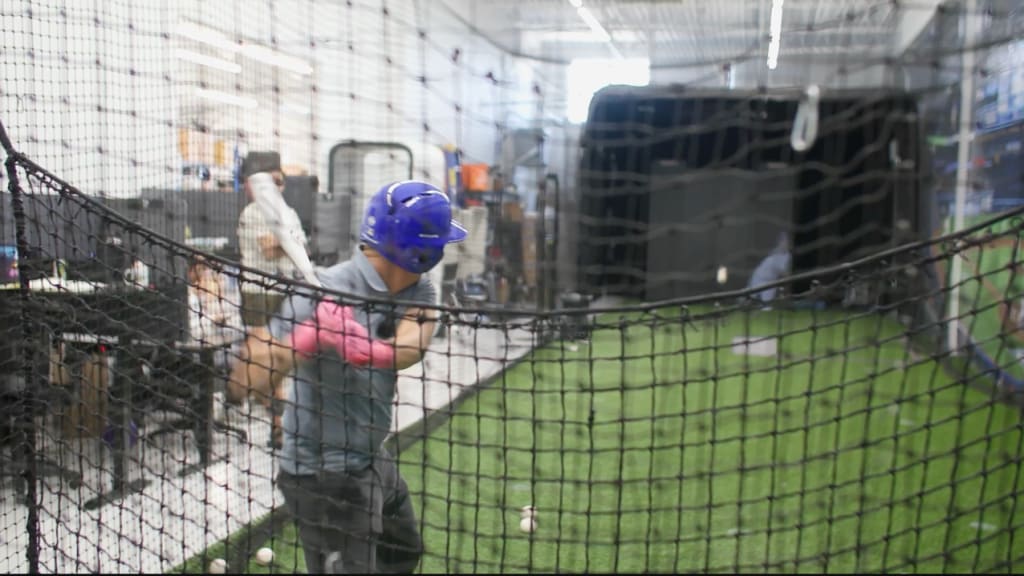
But the BP that better prepares players for what they’re facing in the real game – the high-velocity, high-spin stuff that has cratered batting averages – takes place in the indoor cages, where the cutting-edge Trajekt Arc machine lives.
“People say, ‘Oh, it doesn’t feel the same [as facing a live pitcher],’” said Guardians second baseman Travis Bazzana. “Yeah, maybe it doesn’t feel exactly the same. But we hit flips and we hit someone throwing 45 mph to get ready for a game in a cage. [Trajekt] is close-ish [to the real thing], and it’s a challenge. I think a challenge is good.”
Quantifying the success of the machine across the league is tricky, but step inside the cage and the advantage becomes obvious.
Here’s how it works:
The 6-foot-wide, 4-foot-deep Trajekt Arc sits atop a track, allowing it to shift from side to side and mimic a given pitcher’s placement on the rubber.
Trajekt’s video screen depicts the actual windup of the opposing pitcher of choice, and the hole in the screen from which the ball emerges can be adjusted to project that pitcher’s precise arm slot.
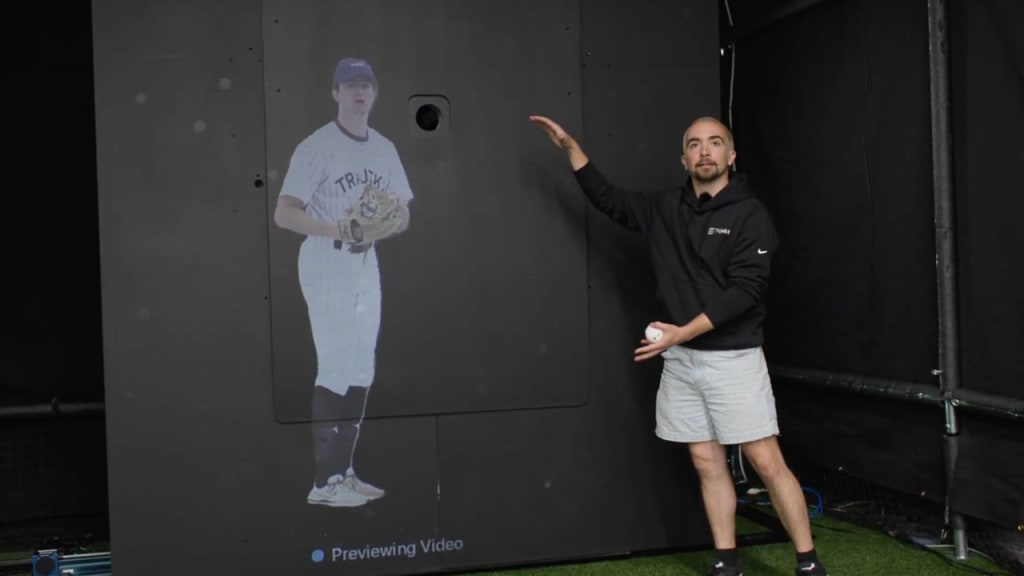
Teams input data from Hawk-Eye data and/or Rapsodo and TrackMan devices to accurately reflect the spin, shape and speed of opponent pitches.
Essentially, you can face a finely tuned and eerily accurate hologram of a pitcher in the cage before you face him in real life.
“Pitchers are releasing the ball, so they have a direct result on the outcome, and we have to react,” says Braves slugger Matt Olson. “But with the Trajekt, it’s not perfect, but to be able to kind of see the shapes and stuff is helpful.”
Where Trajekt separated itself from prior pitching machines was in its ability to replicate gyro spin, or the effect that causes a slider to “fall off a cliff” as it approaches the plate.
“It's always been really important for us to do everything with a level of exactness,” Ferrabee says. “You could put a video of a pitcher on a screen and then shoot a ball out of it. That's been done. But we know exactly all the ways that these pitches are unique and special and how they vary.”
The Trajekt Arc shifts to either side of the rubber, seamlessly adjusts release slots, reaches velocities even higher than what we’re seeing from Jacob Misiorowski, and mirrors the shape of the game’s nastiest breaking balls.
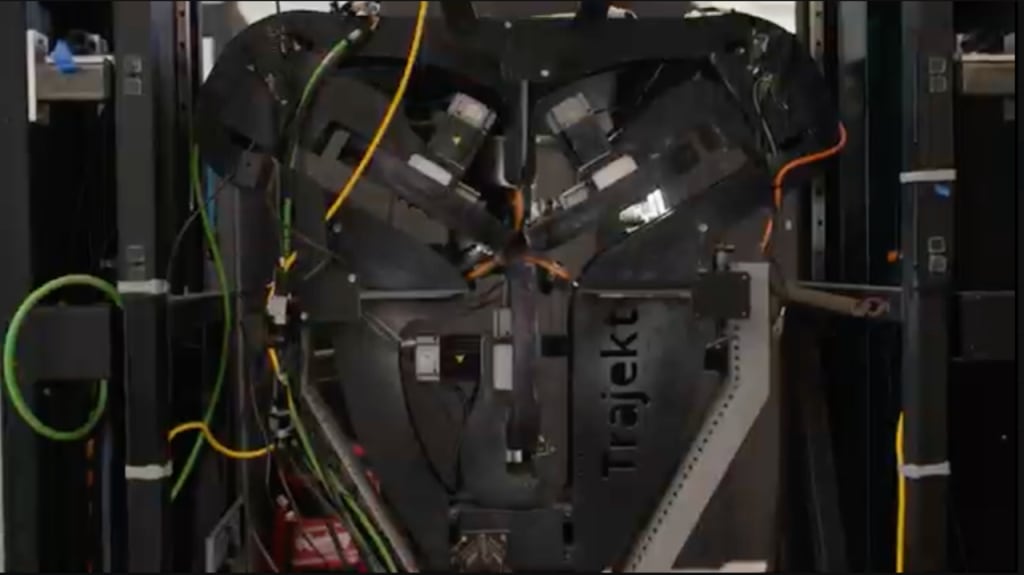
“There are some very unique pitches, the way they combine orientation with spin rate to be able to create this asymmetry,” Ferrabee says. “So we want to be exact about everything.”
Dynamically replicating both spin and release points was a game-changer that caught on quickly. And moving from standard leather game balls to specially designed, lower-weight foam core balls gives hitters authentic seam orientation and movement without the hand sting or risk of breaking bats in practice.
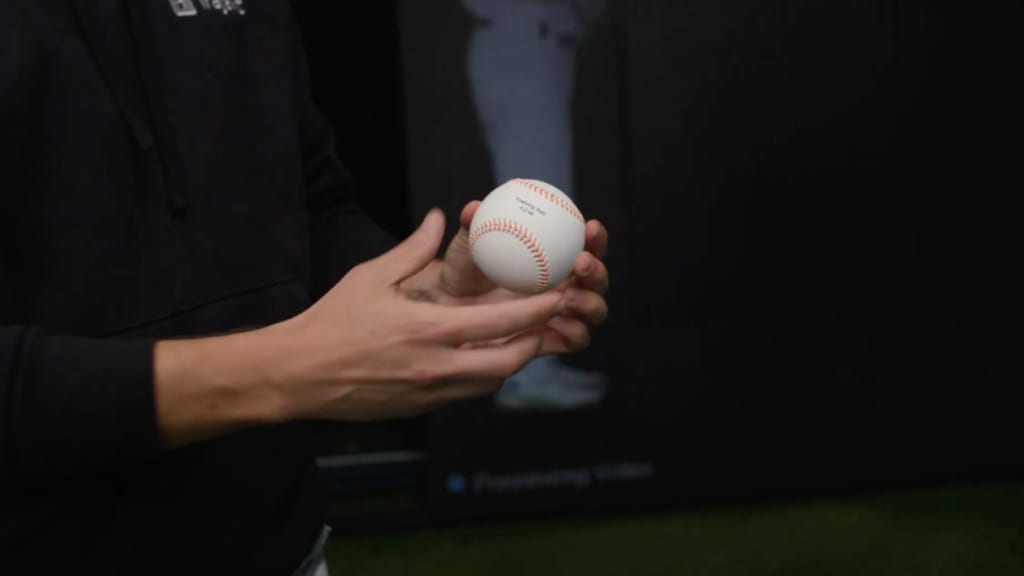
From the time the Cubs became the first team to use a Trajekt Arc at their Spring Training site in 2021, the popularity of the device has exploded. In 2024, when a modification was made to the device to allow it to be used offline, MLB granted approval for players to use it during games. Trajekt also worked with Rawlings to design a ball with a softer core.
The result is an explosion in usage, which has doubled every year since 2022. The average MLB team has three Arc machines, spanning its home ballpark, Spring Training site and Minor League affiliates. The Dominican Republic is the company’s fastest growing segment, and Trajekt expects roughly 10 NCAA programs to have a machine up and running by the end of October.
Even new Padres owner José E. Feliciano used Trajekt earlier this week to take some hacks against closer Mason Miller’s stuff.
There are inherent limitations that come with facing a two-dimensional image of a pitcher instead of a live arm. While updates to the machine have fine-tuned the way the ball comes out of the chute, the ball is naturally going to look different coming out of a human hand than a hole in a screen.
Oh, and then there’s the sheer size of the thing. Teams can’t pack up their 1,500-pound Trajekt machine and lug it with them on the road.
But in home parks, they’re lining up before games to take on Trajekt.
“There are guys who have had their routines pretty consistent without [Trajekt] for a long time, and they’re not in there,” Bazzana says. “But a pretty consistent core of the roster uses it. … Sometimes it can be [crowded].”
Statistically, Trajekt has not exactly sparked a league-wide offensive explosion. When the Cubs first adopted the machine in 2021, the MLB slash line sat at .244/.317/.411. Through Friday, it remained nearly identical at .244/.318/.400 -- even with the 2023 rule changes that were primarily aimed at pace but were also hoped to boost traffic on the bases.
Then again, we don’t know what we don’t know, i.e. what percentage of the player population is using Trajekt and for what specific purposes. Even if the device’s impact can’t be measured in broad statistical strokes, teams didn’t invest in it as a training tool as a lark, and the anecdotal evidence is accumulating.
For instance, when Cubs first baseman Michael Busch was asked by Marquee Sports how he’s managed to produce a nearly 100-point jump in OPS against lefty pitchers this year, he cited Trajekt.
“Using the Trajekt was a big key thing for me of just having game at-bats without being in the game,” he said. “So getting a lot of spin in practice that looks like a game, just being able to see that and feel that over and over and over again while also being able to feel some of my misses and learn from them and practice -- that was definitely helpful.”
Use by MLB hitters pregame and in-game only scratches the surface of the machine’s potential.
Consider these uses:
Prospect development
We can use the Statcast data available at Baseball Savant to gain a deeper appreciation between the pitching that batters face in Triple-A vs. what is seen in the big leagues (all stats entering Friday):
| Pitch Metric | Triple-A | MLB |
|---|---|---|
| 4-Seam/Sinker Velocity | 93.3 mph | 94.5 mph |
| Curveball Vertical Break | -8.3 in. | -10.3 in. |
| Breaking Ball Usage | 31.1% | 30.1% |
The gap is even greater the further down the Minor League ladder you go. Prospects with access to Trajekt can get a better feel for the quality of pitching at the highest level than they can get in their actual games.
“What people don't really understand is that while the [Trajekt Arc at MLB stadiums] is the real bread and butter of our business, it's the Minor Leagues, the training centers, the Spring Training facilities that are really blowing up the usage,” Ferrabee said. “It’s great for those really hungry players that want to get better.”
Accelerated rehabs
Time is literally money when it comes to star players on the injured list. And while position players returning from injury are allotted up to 20 days for a Minor League rehab assignment, the aforementioned gap in quality of pitching can make it difficult to assess a player’s true readiness to return.
Trajekt can augment -- or even stand in for -- a traditional rehab assignment. That was the case, for instance, when Guardians superstar José Ramírez came back from surgery to repair a fractured hamate bone in less than six weeks, without even going out on a rehab assignment.
“I would 100 percent say it's changing rehabs throughout the league,” Twins manager Derek Shelton said. “In terms of velocity and seeing the shapes or pitches, you would be hard-pressed to say, especially the way Triple-A baseball is, that it wouldn't be better for a Major League player to just do Trajekt instead of going and having rehab games. It's not live, but it's better stuff than what you see in Triple-A.”
Catcher and umpire training
The speed and movement of modern pitching that has made hitting even more difficult has also upped the challenge presented to catchers and umps. Because the work of home-plate umpires is scrutinized all the more by the presence of the ABS Challenge System, the Trajekt machine is a useful tool for preparing the eyes for the nuances of the game.
Offseason maintenance
If a player or prospect was on the shelf a good chunk of a given season, Trajekt is a way to get meaningful at-bats against superior stuff without playing winter ball.
None of the above was imagined when Trajekt essentially began with its CEO, Joshua Pope, wondering aloud as a teenager how many swings it would take him to make contact off the Blue Jays’ Marcus Stroman. Eventually, Pope and Ferrabee drew up a proof-of-concept paper for a sports engineering class at the University of Waterloo, and their professor backed the project with some lab space.
Now that the concept has come to robotic life, it is taking over baseball training like no tool before it. Hitters might never fully win the war against pitchers who hold all the cards and the ball in hand. But with Trajekt, at least they aren’t going in unarmed.