

Jacob Misiorowski is the hardest-throwing starting pitcher in the hardest-throwing season on record, which means we can start right off here with the big, flashing premise: Misiorowski is (probably) the hardest-throwing starting pitcher of all time, and you get to see him, right now.
That’s good news for you, the present-day baseball fan, since you can see history being made. It’s worse news for the Cubs lineup, which has to face him on Tuesday night at Wrigley Field in a series that’s going to have a lot to say about the fate of the NL Central.
It’s a lofty title to put on a 24-year-old, to say likely the hardest-throwing starter ever. And yet: It’s easier to prove than to disprove. More than 3,600 pitchers have started at least 20 games in their careers, dating back to the beginning of time. Point to one. Misiorowski throws harder than him. Yes, harder than him, or him, or even him.
It’s not just that he throws hard, though of course he does. It’s how much harder he throws than every other starting pitcher in a baseball world already obsessed with velocity. So far this year, Misiorowski’s average fastball is 99.6 mph, and you already know that's going to top the leaderboard. But "being first" isn't really even the big selling point here; it’s that he’s clear of second-place Bubba Chandler and his relatively tortoise-speed 98.5 mph by more than a full mph, which is a wide margin.
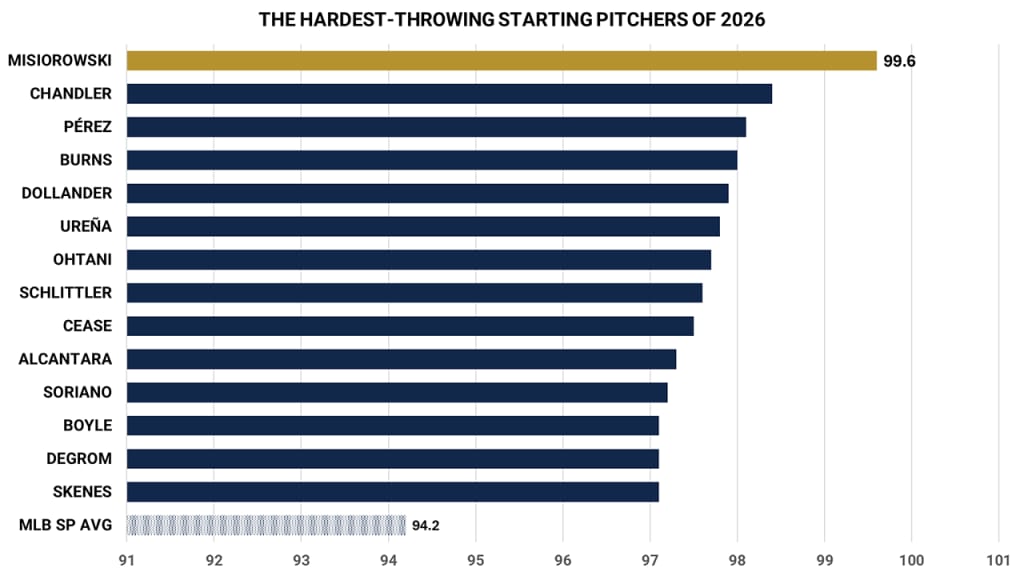
Second, if you choose to round up that 99.6 and say that Misiorowski’s average fastball is 100 mph -- that the triple-digit mark forever seen as a legendary mark of elite velocity is just "a regular Tuesday night" for him, incredibly -- we won’t stop you. After all:
100+ mph pitches by starters, 2026 (entering Monday)
- 233 Misiorowski
- 149 every other starting pitcher in MLB combined
He’s got the eight hardest pitches ever tracked (dating back to the advent of the tracking era in 2008) by a starter. He’s got 19 of the top 23. He is, quite likely, going to break the record for most triple-digit pitches by a starter in a season by June. (The Reds' Hunter Greene set that, with 337 in 2022, putting Misiorowski almost 70% of the way there already.)
Put another way, 39% of Misiorowski's fastballs in his brief career have been triple digits. The next highest career rate since 2008 from a regular starter – setting aside openers – is Greene, at 17%. Chandler is close behind at 14%, which is still barely more than a third of Misiorowski. No one else is even over 10%, and that’s not just “this year.” We’re talking about anyone on record.
But, just maybe, in a world in which even throwing 100 mph isn’t that special – 46 pitchers have done it already this season – we need to bump up that threshold. What about, say, 102? In the previous 18 seasons of pitch tracking, including postseason, we've seen only 39 such pitches from starters, excluding what Misiorowski himself did last year. This season alone, he’s done it 45 times. It’s mid-May. He’s topped every starter over the last nearly two decades, in just six weeks.
On a completely related note, Misiorowski’s fastball has collected a 46% swing-and-miss rate. It’s the highest of any starter this year. It’s the highest of any starter in any year. His 35.5% strikeout rate overall is the highest by a starter in the history of baseball, among those with 100 innings thrown. He leads all starters in FanGraphs’ “Stuff+” metric, which uses velocity, shape, movement and related factors in an attempt to get to nastiness – “stuff,” as it were – and the names behind him are Greene, Crochet, Ohtani, Burnes, and deGrom. It’s a good place to be.
All that, and yet some still wonder why batting averages go down as strikeouts have gone up. Throw hard, and good things will happen – while also understanding it just might increase your injury risk somewhat.
So … does all this make him the hardest-throwing starter ever?
It is, of course, unknowable for certain. No reliable database exists prior to the advent of the pitch-tracking era in 2008. While one-off accounts exist – a scouting report or news clipping here, a video clip there – full velocity data was simply not tracked for most of baseball history. You can’t know how hard Sandy Koufax, Bob Gibson or Walter Johnson threw. Since 2008, there have been about 12.5 million regular season pitches. Before that? An untold number of millions upon millions of untracked pitches.
But if not knowable for sure, it’s a pretty easy thing to infer, too. The reason we can say that Misiorowski is almost certainly the hardest-throwing starter ever is because we’re now going on nearly two decades of reliably-tracked, on-the-same-scale velocity that shows the velocity trend steadily increasing, and there’s no reason to think it was ever at a higher level in the decades before – when strikeouts were far, far lower.
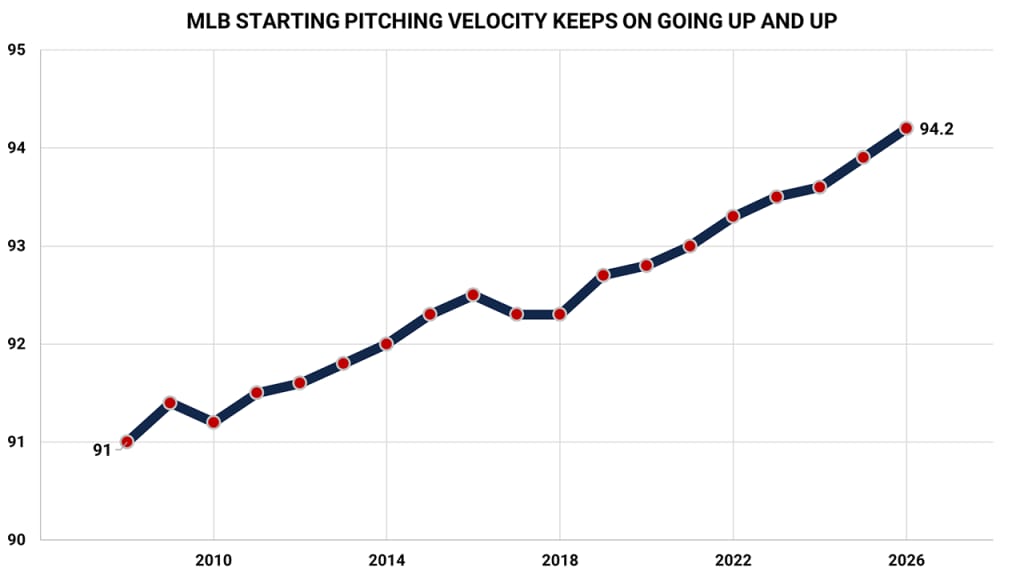
It’s because we know pitchers are openly training to throw harder, because legendary hitters like Mike Trout and Aaron Judge openly talk about how much more velocity they’ve seen even just since they entered the league. In every sport, records fall as athletes continue to improve conditioning, talent and training over time. NFL kickers regularly connect from distances long thought unthinkable. Baseball is no different.
This isn’t the same thing as saying no one ever threw hard before, because surely they did – they didn’t call Bob Feller “Bullet Bob” because he was a soft-tosser.
Even if you do have a pitch that showed a triple-digit velo reading (like, for example, Robb Nen supposedly hitting 102 mph in the 1997 World Series), there’s so much unknown context there. Which brand of radar gun was it? The hot gun or the slow gun? Where exactly was it pointed? Was it calibrated correctly? All that means that trying to do the popular conversion of velocity tracked out of the hand, as Statcast does, to nearer the plate, as some radar guns did, simply won’t work, because there’s not enough information about the initial measurement to do so.
(Yes, that means that the story that keeps going around which says Nolan Ryan would have thrown 108 mph if clocked under today’s measurements is almost certainly untrue, because the initial measurement of 101 came from a one-off 1974 public relations stunt that led to an unreliable number, one even Feller doubted. No one doubts Ryan threw hard, but what made him great was that he threw extremely hard in an era where most of his peers didn’t – and that he continued to do so for 27 years. For that matter, the secondary myth that at 46 he suffered a career-ending elbow injury, then threw a 98 mph warmup pitch, is apocryphal and not supported by any real evidence. In reality, he’d injured his elbow in his previous start, then was so ineffective in his final start he faced six batters and got zero outs.)
What we know, for sure, is that pitchers throw harder now than in any year on record, which almost certainly means that they throw harder than they did at any point in baseball history. We know, for sure, that Misiorowski tops the chart in fastball velocity. It would take some serious mental gymnastics to try to pretend that he’s not the hardest-throwing starter of all time, which he almost certainly is.
Good luck, Cubs hitters. You’ll need it.