

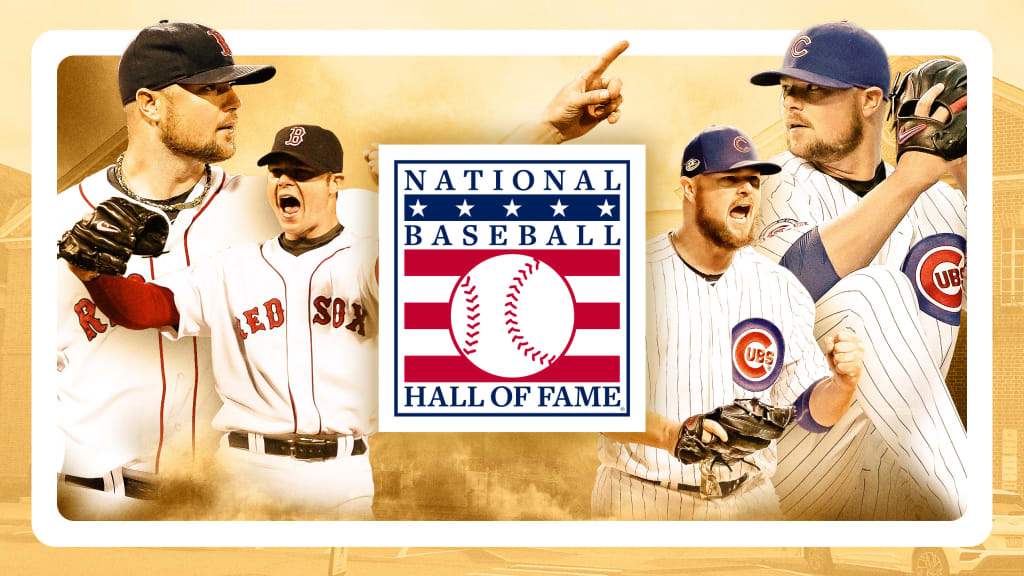
Over the past year, those three magic words (Hall of Fame) became pleasingly familiar to lefty Jon Lester, a durable force during his impressive career, spent mostly with the Red Sox and Cubs.
In May, Lester was officially inducted into the Red Sox Hall of Fame. At the end of August, the Cubs gave him the same honor.
Sensing a theme? Well, it continued on Monday, as Lester was part of the Baseball Hall of Fame’s 2027 ballot for the first time, results of which will be announced on Jan. 19.
2027 Hall of Fame coverage
• Here's the full 2027 Hall of Fame ballot
• Posey, Lester headline 14 ballot newcomers
• Hall of Fame case for: Arrieta | Gardner | Lester | Posey | Wright
• Everything you need to know about Baseball Hall of Fame voting
• Complete Hall of Fame coverage
A player needs to be selected on 75% of the ballots submitted by Baseball Writers’ Association of America members to gain entry into baseball’s most exclusive club. As long as Lester receives at least 5% of the votes, he can remain on the ballot the following year for up to 10 years.
On the mound, Lester prided himself on staying in the moment and not getting caught up in individual accolades. And you can be sure he will take that same approach with this.
But there was one moment this past summer when Lester did allow himself to daydream just for a bit.
“My middle son, he got to play in the All-Star Village up there this summer,” Lester said at his Cubs Hall of Fame ceremony. “One day, we went to Cooperstown and it was incredible. Until that day, I didn’t really care. And then when we left, and my son went and rode with another family back to where we were staying, and I’m sitting in the car by myself driving 30 minutes back to the All-Star Village, and I was like, 'It’d be pretty freaking cool.' It’s such a special place. If it happens, great. If it doesn’t, will I be disappointed? Yeah, probably a little bit.
“But at the end of the day, I didn’t play for that reason. I wanted to start Game 1 of the World Series. I wanted to be the Opening Day starter. I wanted to win baseball games. I feel like I accomplished that, and so, if that honor comes to me, great. If it doesn’t, I still feel like I did pretty good.”
Lester accomplished everything he wanted and more. He started his journey by overcoming cancer in his rookie season of 2006, continued it by winning the World Series clincher for Boston the next year, and had one of the best Octobers by a starting pitcher in the history of the Red Sox in 2013. His 2008 no-hitter at Fenway Park against the Royals is the last by a Boston pitcher.
After he signed with another tradition-laden franchise in the Cubs, Lester’s storybook ride continued in 2016 as he helped the Cubbies win their first World Series since 1908.
His successes in October -- three World Series rings accompanied by a 2.22 ERA in 22 starts during baseball’s most pressurized time of year -- represent the brightest lights of Lester’s career.
But what set him apart was his consistency. For example, Lester’s 3.64 ERA in 242 appearances with the Red Sox was exactly the same as in 171 starts for the Cubs.
In Lester’s 11-year peak -- 2008-18 -- he logged 200-plus innings eight times. During that impressive span, he never went below 180 2/3 IP.
A bulldog with a sturdy frame, Lester took joy in posting start after start, season after season, for more than a decade.
It added up to a career record of 200-117, a 3.66 ERA, 2,740 innings and 2,488 strikeouts. For pitchers with at least 2,000 innings, his 117 ERA+ ranks tied for 66th since earned runs became official in 1913.
That ERA+, by the way, is right in the neighborhood of current Hall of Famers Bert Blyleven (118), Tom Glavine (118) and Gaylord Perry (117).
At a time when standards for what makes a Hall of Fame starting pitcher are being reconsidered due to the five-man rotation and increased dependency on relievers lowering career totals for starters, Lester presents a most interesting case for voters.
Félix Hernández, who had 169 career wins, a Cy Young Award and six career All-Star nods, received 46.1% of the votes last year, his second on the ballot, making a jump of more than 50% from his first year. Cole Hamels, a 163-game winner, who got 23.8% of the votes in his first year, could make a jump similar to Hernández in the upcoming election.
If Hernández, Hamels or some of the other bubble starting-pitcher candidates (Mark Buehrle, Andy Pettitte, etc.) get in over the next few years, it could create a pathway for Lester. The opposite could be true if Lester were to be elected first.
“I played the game because I loved it. I loved to compete. And at the end of the day, if that validates [the Hall of Fame], great, and I’ll be probably one of the most excited people you’ll ever see if that happens,” Lester said.