

Aaron Judge was widely expected to be one of the primary beneficiaries of the new ABS system, and we know that because it was all anyone could talk about at Yankees camp this spring. Due to his 6-foot-7 frame, umpires had long struggled to identify the bottom of Judge’s zone, and the ability to rectify that seemed like it might be interesting.
“I’m excited for it,” Judge said back in February. “I think it’s going to be a little weird, because I’m not an umpire. I’m a hitter. I’ve never been in the box trying to think about, ‘Is this a ball? Is that a strike?’ If I feel like I can hit it, I feel like it’s a strike.”
“He’s one of the most miscalled zones in baseball. Being so tall, he’s getting calls below his knees all the time,” echoed catcher Austin Wells. “That’s tough. It might be harder for him because that’s how he’s been called for so long, but I know he’s going to benefit from it.”
Two months into the season, that’s been true – just not in the way you might have expected.
Judge has indeed been effective when challenging, getting six calls overturned in seven attempts. That’s an 86% overturn rate, which is excellent, yet also rare. Through Thursday, seventy-five other hitters had challenged as many or more times than Judge, who has used the system sparingly, challenging once in March and three times apiece in April and May.
But at the same time, there’s more to this than just challenge rate, as we’ve detailed a few times. Not every challenge is created equally, because you need to take into account pitch location and game situation. You need to take into account opportunities not challenged, too. Going a hypothetical 5-for-5, for example, would get you a perfect 100% success rate, yet may also result in dozens of missed opportunities.
That’s where Statcast’s overturns vs. expected model comes in. By this view, Judge is actually accruing the second-most ABS value in the game among batters, behind only Washington’s CJ Abrams.
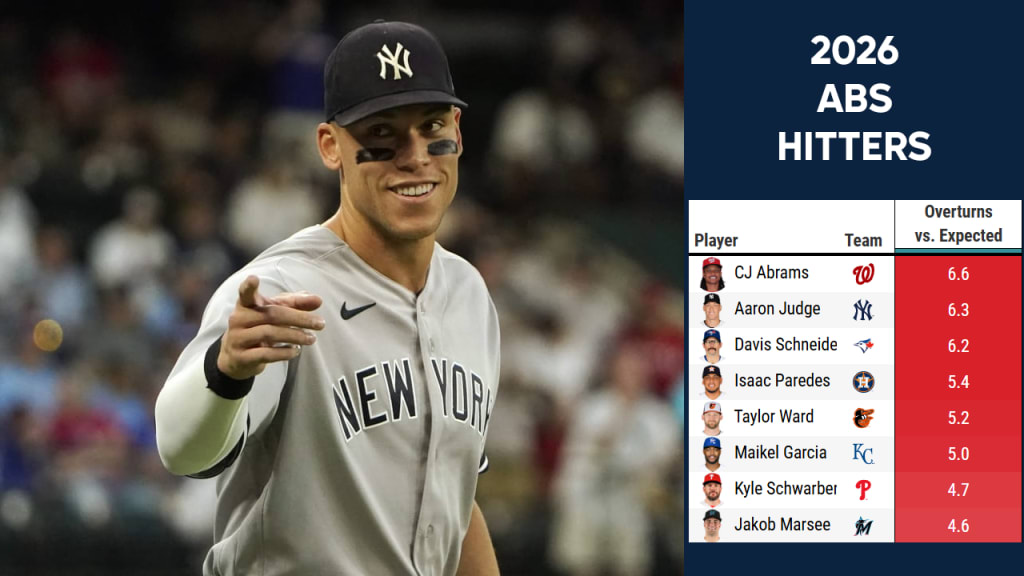
What this is saying is that based on the opportunities Judge has seen – pitches he’s challenged and also those he has not – the average Major League hitter would be expected to offer 10 challenges, having gone 4-6. Judge has been slightly less aggressive than that, but he’s also, again, 6-1. He’s won two more than the average hitter would have; he’s lost five fewer. That’s a net of plus-seven, which, if you can forgive some decimals and rounding, gets you to second overall.
What, then, does that look like? You can accrue obvious value by challenging and winning, as he did on a called third strike well beneath the zone in Baltimore earlier this month.
Based on the pitch location (1.3 inches below the zone) and the game situation (a potentially game-ending strike three), that’s a pretty valuable challenge. He gets +0.64 in that ‘expected win’ bucket, because that’s how often the average hitter challenges that pitch in that situation: 64% of the time, and always for a win.
You can do that for every challengeable pitch he’s seen this year, all 139 of them. Let’s focus on the ones he didn’t tap the hat on.
Not challenging this called strike from Ranger Suarez in April? No impact at all, because it was a clear strike, and no one challenges that. A 0% challenge rate means zero impact to the batter.
What about not challenging this third strike from Jeffrey Springs in the Bronx for the final out of an inning?
Well, 36% of the time that pitch in that situation does get challenged, and 100% of the time they’d be wrong, because that was a correctly called ball. Toss +0.36 into the ‘expected loss’ bucket, because that's a loser of a challenge. Now you’re seeing how he gets ahead of the pack, because he properly did not challenge – and lose -- here, while many others have, and did.
It works in both ways, of course. On May 3 against Baltimore’s Rico Garcia, Judge chose not to challenge this third strike, off the outside corner. This one was clearly (to us, at least; we’re watching television, not standing in the box) a ball, and 53% of the time, batters have asked for the challenge on that pitch in that situation. Since it would have been overturned, toss +0.53 into the ‘expected win’ bucket, and that’s value Judge did not realize, since he didn’t do it.
Put another way: There have only been 17 pitches this year that Judge A) didn’t challenge and B) would have been correct on, had he done so. Some of them, like the Garcia example above, were damaging to the Yankees. Most of them weren’t. Who’s losing any sleep, for example, that Judge didn’t challenge an incorrectly called Reid Detmers first-pitch strike with two out and no one on? Only 5% of batters bother to tap there, and so Judge loses a very, very small bit of value.
Only two of the non-challenges really cost meaningful value – the Garcia one, and a similar non-challenge on a full count against Dylan Cease on May 19. The rest? Take them or leave them, really. You’re just not going to see a first pitch in the first inning challenged, like this call that Clay Holmes got in the Subway Series.
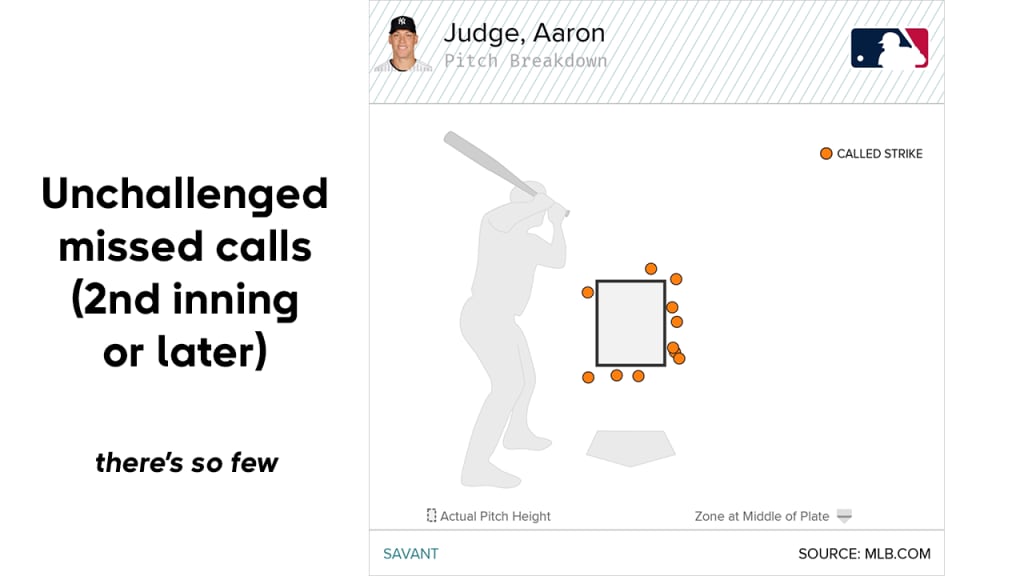
If “17 could-have overturns” doesn’t sound like a lot, given the expectations that most had entering the season, we agree. (Mike Trout has the most, at 30. It’s even fewer for Judge if you just assume he’s simply not going to risk one in the first inning, which cuts his rest-of-game “missed” pitches down to a measly 11 across two-plus months of baseball.)
Given that Trout has seen more than 800 pitches after the first inning this year, that’s really not that many. How, then, given the expectation that this would be a massive game-changer for Judge? Part of it can be seen in this image, showing those (non-first-inning) misses. They’re not all at the bottom of the zone. They’re all around it. Some are even high.
Some of this, we think, was clear back in February, when we reviewed 2025 Triple-A data and came away with the realization that at least in the Minors, it wasn’t the biggest players who benefitted the most from ABS. It was the shortest.
Looking so far in the Majors, that’s held up – at least looking at overturn rate, because here we care more about how accurate they are, not how aggressive they are.
- Short (5-foot-9 or under): 48%
- Medium (5-foot-10 to 6-foot-2): 46%
- Tall (6-foot-3 or higher): 45%
This isn’t all because fellow 6-foot-7 outfielder James Wood has been really poor at this (3-10, 23%), though it doesn’t hurt – and adds to the idea that simply having a big strike zone does not make this a sudden boon.
Judge, as it turns out, really hasn’t had that many poor calls to contend with. Sure, there’s been one or two you wish he’d been more aggressive on, and there is a case to be made for saying, "You’re Aaron Judge, do not save challenges for teammates." Yet there’s been more potential challenges that he wisely passed on initiating.
It’s been a mostly accurately called strike zone for Judge. He’s been mostly on target about not only which pitches to challenge, but which ones not to. Even when he’s not challenging, he’s collecting challenge value. It’s not like we didn’t already know he was great, obviously. Being great at not doing something is a new way to describe it, we think.