

A lot of baseball dads tell their kids to hit line drives right back up the middle. Not Kevin McGonigle's.
"Growing up, my dad always taught me to pull the ball down the line," McGonigle said. "The whole contact thing came as I grew older in the game."
And that's how one of the most well-balanced young hitters in the big leagues built his foundation.
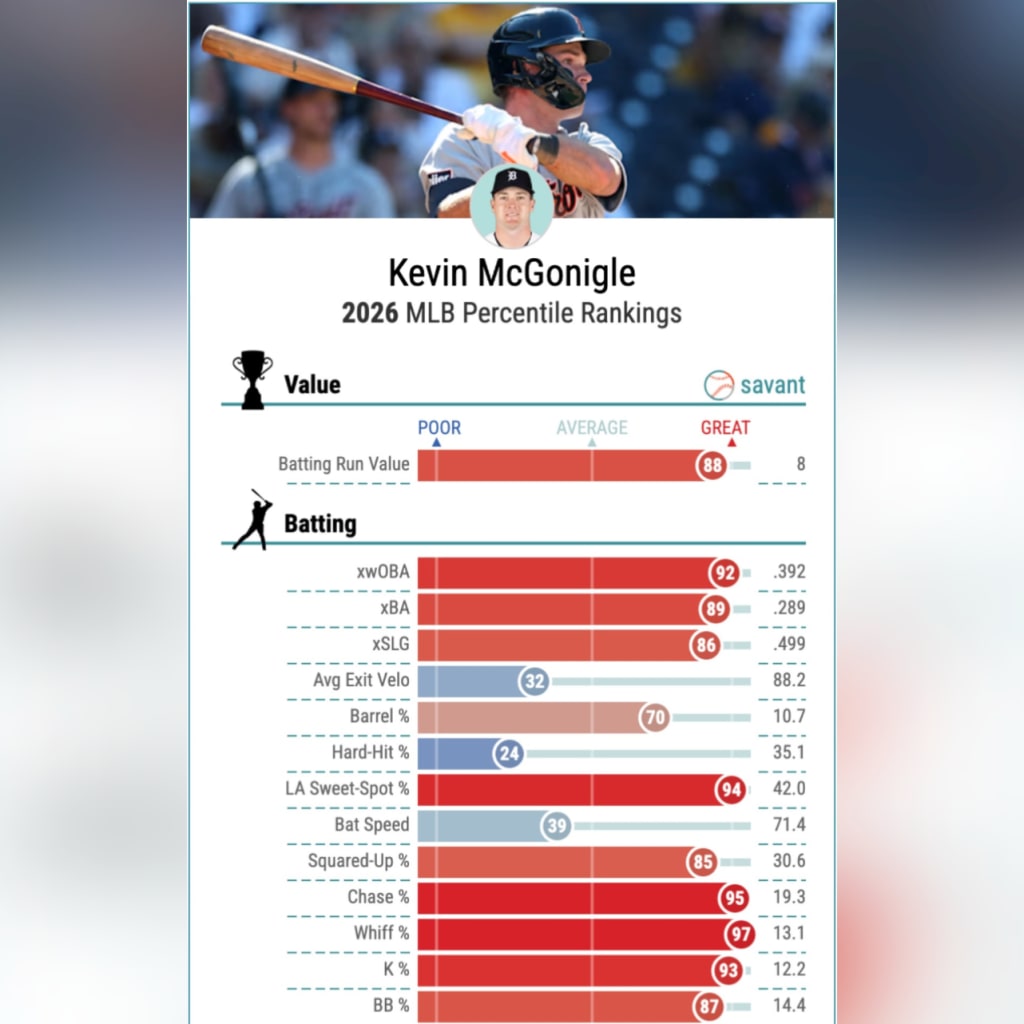
The Tigers' star rookie has a hitting profile in the mold of a Mookie Betts or Alex Bregman. McGonigle has elite bat-to-ball skill, contact ability and plate discipline -- as a 21-year-old, he has one of the lowest strikeout rates, swing-and-miss rates and chase rates in the Major Leagues, and one of the highest walk rates. He's walking more than he strikes out, a Juan Soto-like talent. And he's great at squaring the ball up on the barrel of the bat.
But that came second when McGonigle was learning how to hit. Pull power came first.
And that's what's interesting. The 5-foot-9 McGonigle doesn't have the size of a prototypical slugger. But what he lacks in raw bat speed and exit velocity, he makes up for with the approach that's become the trademark of undersized power hitters today, the Bettses and the Bregmans: He pulls the ball in the air.
McGonigle uses the bat-to-ball skill he's developed to get right on top of the pitcher and challenge him to throw the ball by him. Most can't. Then he turns on the ball and rips it to right field.
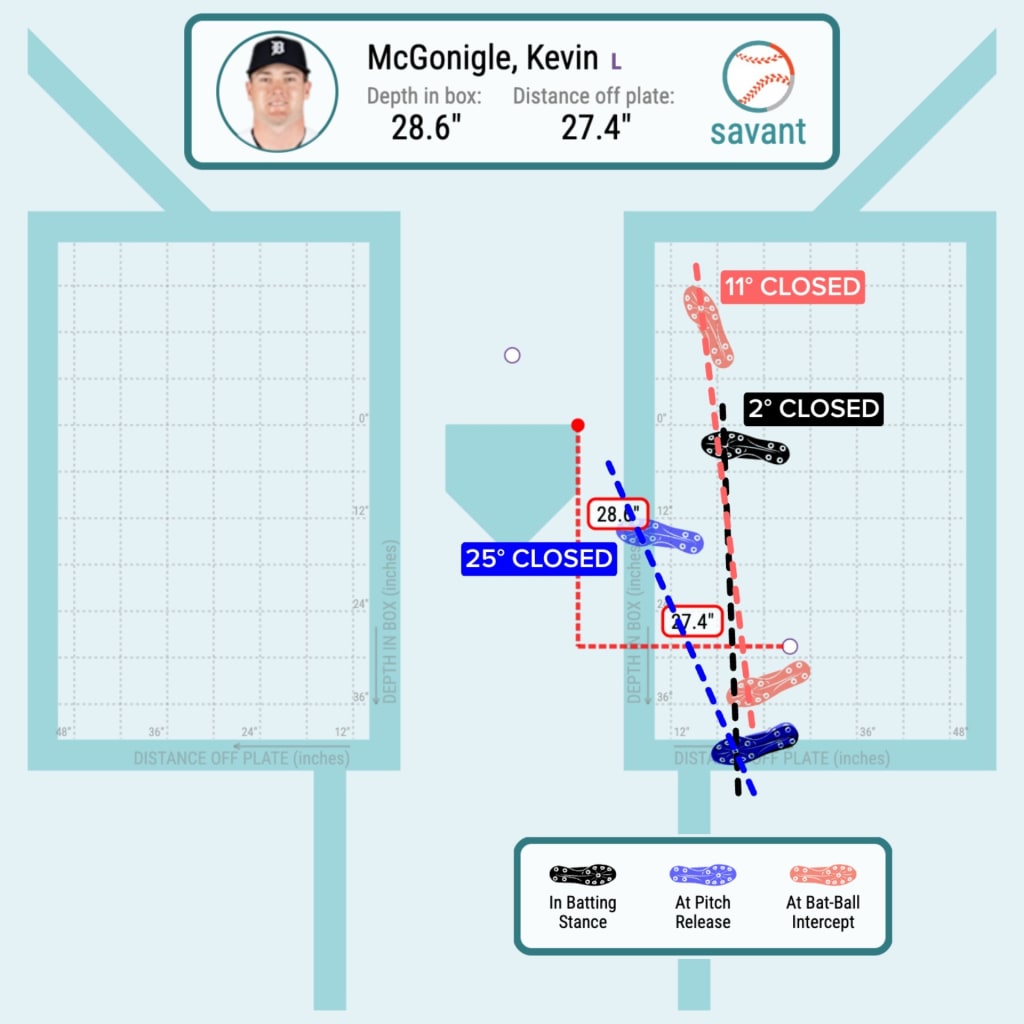
It all starts with his setup in the batter's box. McGonigle digs in with one of the widest batting stances among left-handed hitters -- his feet are 37 inches apart. He also has one of the most closed batting stances -- in other words, his front foot is angled toward third base, and his front shoulder is "closed" to the pitcher. And he stays that way throughout his entire swing, from starting stance to pitch release to the moment of contact. (And there's almost always contact.)
When he steps into the box, McGonigle's batting stance is 2 degrees closed. When he moves into his toe tap as the pitcher delivers the ball, his stance is 25 degrees closed. And when he makes contact, his stance is 11 degrees closed. His front foot often lands on the inside line of the batter's box. He's right on top of the plate.
There aren't a whole lot of hitters who stay closed like McGonigle throughout the entire swing (the Padres' Jackson Merrill is probably the best comparison), and there are even fewer who get so close to the plate to attack the baseball.
"I think that just naturally happened," McGonigle said. "Throughout high school, I always landed closed. I don't think about it. I know I do it. I just let it happen, and I don't try to overexaggerate landing closed. I just do it naturally."
It just works so well for how McGonigle approaches hitting. The whole thing screams "compete" -- battle, don't strike out, get on base any way you can. Which McGonigle does. Like his idol Chase Utley, who he modeled his whole game after, including his hitting style.
Utley didn't have the closed batting stance, but he did have the competitive fire in the batter's box that McGonigle inherited. And Tigers manager A.J. Hinch -- who played with a young Utley in 2004 and now watches an even younger McGonigle every day -- notes that while Utley started his stance open toward first base, he would frequently finish his swing closed.
Utley also got right on top of the plate and dared the pitcher to beat him. Just look at his hit-by-pitch numbers -- he was hit 204 times in his career, and led the Majors three straight seasons in his prime from 2007-09. That was no accident.
"Obviously [McGonigle] patterns himself after Chase," Hinch said. "Chase was the ultimate 'hold-your-ground' type of player in the box."
McGonigle is a hold-your-ground player in the box, too. He's already worked three 10-pitch at-bats this season, as many as any player in the Majors this season.
The results of those three 10-pitch at-bats:
- A go-ahead single with the bases loaded in the 8th inning on March 27
- An RBI double off the wall on April 22
- A walk drawn in a comeback win over the Braves on April 30
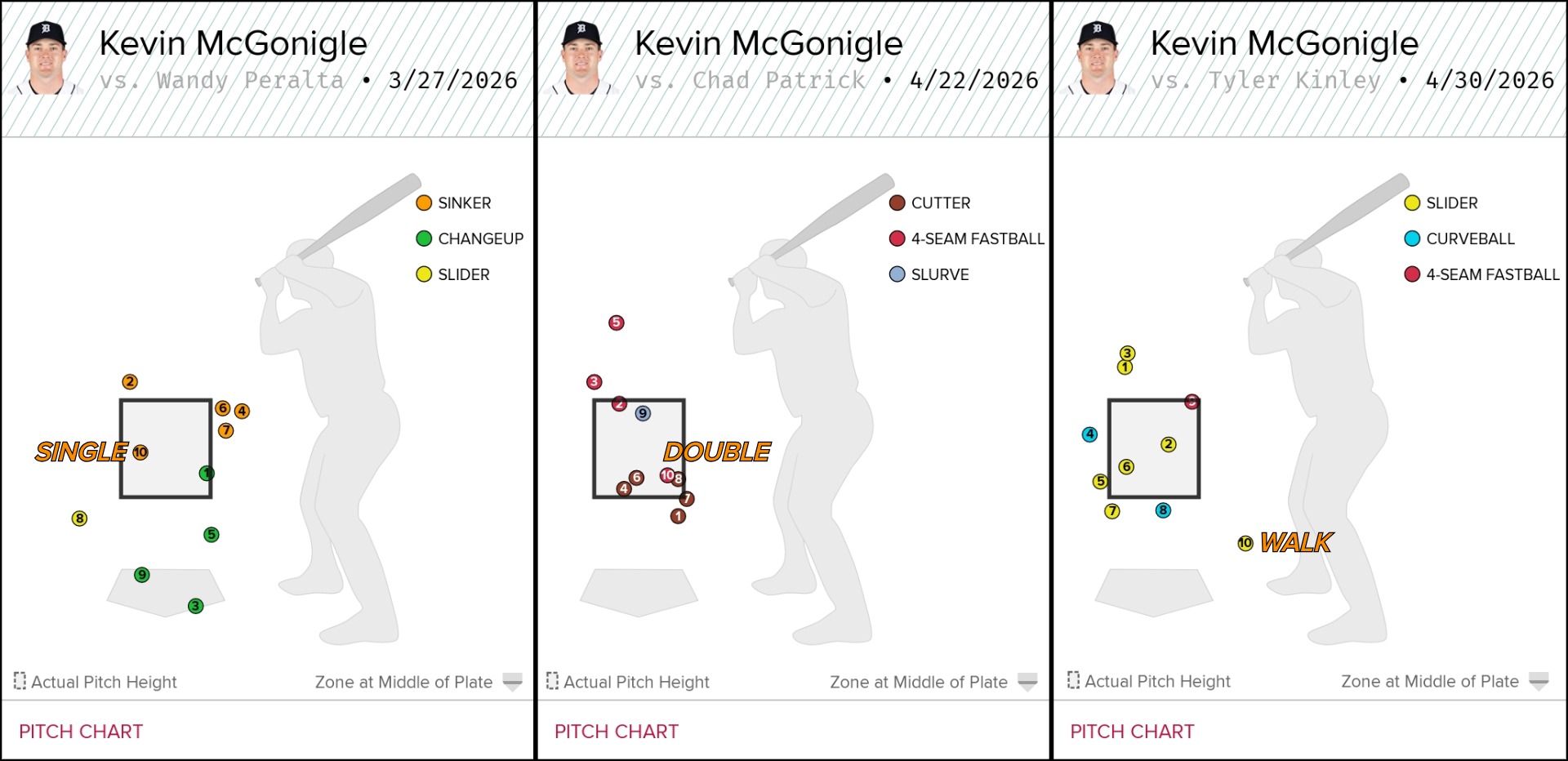
In all three of those at-bats, McGonigle fouled off at least four pitches with two strikes before finding a way to get on base. He doesn't just battle the pitcher, he wins the battle against the pitcher. Like his other idol, Tony Gwynn.
Gwynn did have the closed batting stance that McGonigle uses, and the on-top-of-the-plate style. And he was, of course, the king of contact. There's no hitter better for McGonigle to aspire to be like.
But if McGonigle's stance and swing and approach all scream "battle," they also scream "pull the ball in the air."
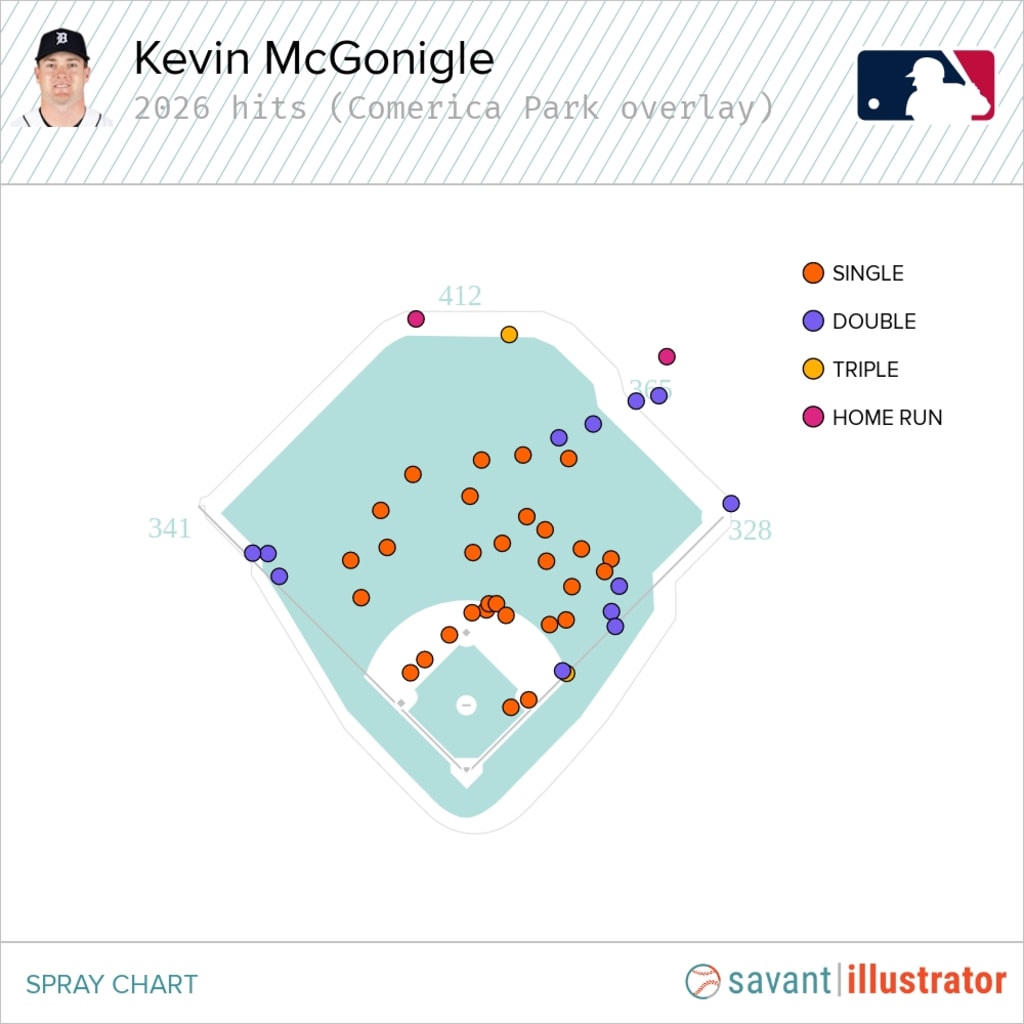
At heart, McGonigle is an airball hitter. That doesn't just mean home runs, but line drives ripped from center field over to right. Over 70% of McGonigle's contact this season has gone in the air -- a top-10 air contact rate in the Majors -- and most of that has been pulled in the air.
The pull field is where an undersized hitter can tap into his power, and McGonigle knows how to get the ball there: He hits it far out in front of his body. McGonigle's contact point is about nine inches in front of the plate and 38 inches in front of his own body -- one of the farthest out-in-front contact points in the Majors.
When you hit the ball out front, you pull it, and you lift it. It gives your bat more time to accelerate, and you catch the ball when you're on the upswing.
And that is actually the real purpose for McGonigle getting on top of the plate throughout his swing. He wants to turn on the pitch, no matter where it is, and rip it in the air.
"With my approach, being on the plate, I'm trying to get the pitch I want," McGonigle said. "If I'm on the plate, I can pull pitches middle-away -- I can maybe even pull pitches away. That's where I want to be with all my ball flight. I just want to try to get the head out, and I feel like if I'm on time with all different pitches and all different spots in the zone, that means I'll be able to pull it to right, right-center. Maybe even drive it to center field."
He can do that on pitches outside because he still has the quick hands and short swing to turn on pitches inside. McGonigle's swing length is 6.9 feet -- that's how far the bat travels from the start of his swing up to contact -- well shorter than the Major League average of 7.4 feet.
Pitchers might challenge McGonigle with heaters inside, but he doesn't back down. And by proving he can handle those, too, he can really get on top of the pitcher.
"I think it comes down to whether or not teams are willing to stay in one area, because he can still cover the inside part of the plate effectively," Hinch said. "And you really only have to do it a few times until teams stop challenging you inside. It's not comfortable pitching inside, routinely. And so when you hold your position, you're going to stay on more pitches. Plus, I think as the league has turned more secondary pitch-dominant, the times where a pitcher is going to throw four straight fastballs inside are rare."
With a steep, uppercut-style swing path, the torque generated out of his closed batting stance, his advanced contact point and his hold-your-ground approach, McGonigle is ready to launch. And because he's so good at getting the barrel of the bat to the baseball, he can keep his air contact in the right zone to get good results, instead of skying the ball too high.
"I know that I have a steep bat path," McGonigle said. "But I honestly think 'down' to the ball, and that kind of evens out the uphill swing."
McGonigle has a 42% launch angle sweet-spot rate this season, which means that he hits tons of balls in the ideal line drive-and-fly ball range of 8-32 degrees. That's where he can get his hits and extra-base hits. McGonigle ranks just outside the top 5% of all MLB hitters in that category.
To do what he's doing, at age 21, is more than impressive. The Tigers love the way McGonigle swings. They love the way he hits.
"He's a fast mover, to be able to rotate through his swing," Hinch said. "And there's not a fastball that is too fast for him. So right now, with his bat-to-ball and with his pitch recognition, I think he can stay exactly where he's at."