

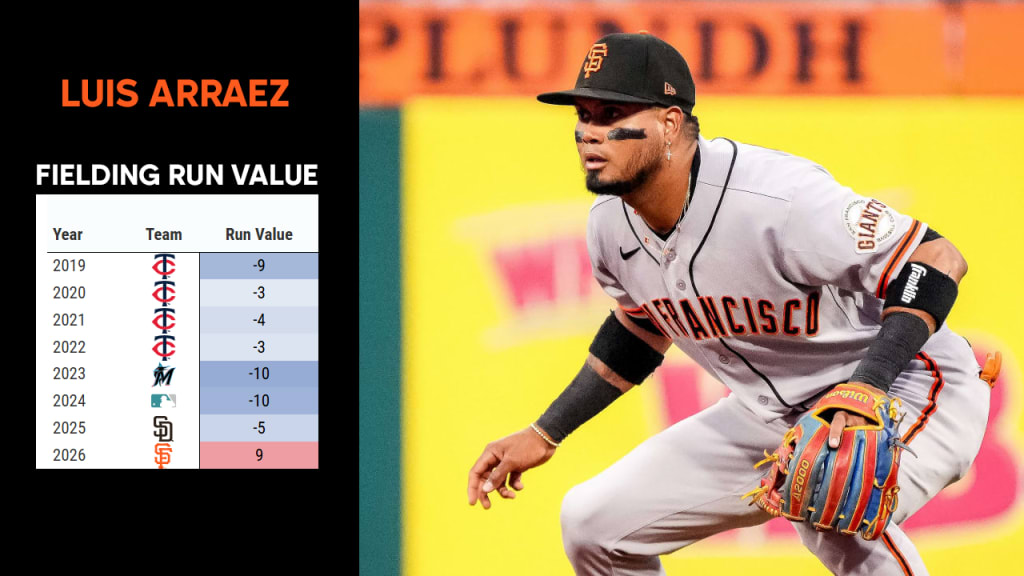
For years, Luis Arraez rated as something like the weakest defensive second baseman in the game, an opinion the Padres validated when they moved him off the position to be primarily a first baseman/DH over the last two seasons. Despite that, Arraez bet on himself last winter, taking a one-year deal with San Francisco over reported multi-year offers elsewhere – in large part because the Giants would allow him to play second base, and he wanted to prove he could.
During what has been a trying season for the fourth-place Giants, this is at least one thing that’s worked out tremendously. Arraez has played 90 percent of the team’s innings at second base, and by Statcast metrics – the same ones that said he was unplayably poor for all those years – he hasn’t just been good. He’s been outstanding. If you were to look at the Fielding Run Value leaderboards for second basemen, entering Monday, you’d have found St. Louis rookie JJ Wetherholt first at +14, and then Arraez second at +9.
It’s an absolutely incredible turnaround. As we dug into when exploring his free-agent case last year, Arraez’s style of high-contact, low power-and-speed offense doesn’t work that well as a below-average first baseman or a designated hitter. It works a lot better as a playable second baseman; it works a lot better if he’s really an above-average defender now. (It helps, too, that he’s simply hitting much, much better than last year as well, though we’ll focus on the fielding for now.)
How did we get here – and can it last? It’s a potentially very important question, not so much for what it means for the 2026 Giants, but for what it means for everyone else. The Trade Deadline, after all, is just a month away; as mentioned, Arraez is once again a pending free agent.
Defense is notoriously difficult to evaluate, but especially so in the infield. So much has to be considered, such as the speed of the runner, as well as the various decisions required based on which bases are occupied and the game situation. These are things that don’t necessarily come into play as much when you’re just trying to see if an outfielder caught the ball hit to him.
That said, the Statcast metrics generally work out the way you want them to. Over the last three seasons, the best-rated infielders are Bobby Witt Jr., Masyn Winn, Andrés Giménez, Nico Hoerner, Ke’Bryan Hayes and Joey Ortiz, a collection of defensive superstars that’s hard to quibble with; on the other end, you’ll find the weakest-rated are CJ Abrams, Mark Vientos and Pete Alonso, all of which seems exactly like you’d expect.
When you have an unexpected fielding improvement like Arraez’s, “working hard” isn’t exactly factored into the metrics, nor is the identity of a team’s coaches. It’s all nice supporting evidence to have, though, and it’s extremely difficult to not notice that Arraez’s defensive upgrade coincided with his first time working with renowned infield coach Ron Washington, newly hired to the staff this season.
“Every play that he's supposed to make, he's made,” Washington told MLB.com’s Maria Guardado last month. “He's made plays up the middle, where he just had to get rid of the ball. He’s turned tough double plays. He turned some tough, tough balls where he had to go to the hole and come back and throw to the shortstop. He’s made perfect throws. Those are the types of things that go in the work category.”
That was May. Here’s what Arraez was saying in February, just days after signing with the Giants.
“One hundred percent,” Arráez said. “Footwork, glovework, everything is better.”
Here’s where it gets tricky, though. Not every metric agrees, because Defensive Runs Saved sees absolutely no improvement from last year at all, ranking him a mild negative, at minus-2. On the other hand, his manager went in entirely the opposite direction.
“I'd be curious as to who's playing better at second base than [Arraez] is,” said manager Tony Vitello. “That's the easiest way for me to say it.”
That’s an easy question to answer: Wetherholt is better, by the 2026 defensive metrics. So are Hoerner and Brice Turang, by reputation at least, and as well by the metrics if you (correctly) look at more than just a half-season of data.
But we can show you why it’s happening the way it is, why Statcast thinks Arraez has made such an unexpected step forward. At its heart, any defensive metric is trying to tell you two things: “How often did you make the play?” and “How hard was that play to make?” The first one is an easy story to tell, because it’s a simple yes/no. The second part, well, that’s considerably more difficult.
Has Arraez made more plays? Yes!
We’ll group some years together here because, for as much negative value as Arraez accrued before this season, he never did actually play second base that much. From 2019-25, his 2,793 innings at the keystone were less than half of what more regular players (such as Ozzie Albies, Marcus Semien and Jose Altuve) were contributing. Yes, that makes the negative defensive metrics even worse, since they’re counting stats.
Put another way, Arraez has played 649 innings at second entering this week’s series against Arizona. It’s the end of June, and that’s already the second-most of his career in any season. It’s just the second time he’s made it to even 400 innings – which is roughly 45 complete nine-inning games.
So, let’s start simple. This is “success rate,” or how many opportunities he’s turned into an out. Consider it “fancy fielding percentage,” because it doesn’t care about hits vs. errors so much as plays made vs. plays not made, regardless of scoring. The Major League average for infielders this year is 74%.
Arraez success rate at 2B
- 2019-21 // 72%
- 2022 // 84%
- 2023-25 // 73%
- 2026 // 77%
You can see the shape of things here, broken roughly into: 1) A difficult introduction to the league, 2) A pretty good 2022, 3) The downturn in the years that followed, and then 4) The 2026 rebound. With the exception of 2022, a year in which he rated as a mild positive, Arraez has always been weaker than average at turning balls into outs – until Washington got his hands on him for 2026. This year, he’s turning an above-average rate of opportunities into outs.
That all tracks, and it has nothing to do with fancy metrics, as it’s just “plays made.” But here’s the trick, and it leads directly into the second question – while 77% plays made is indeed above average, it’s not elite, nor even great. It’s tied for 14th of 37 qualified second basemen this year.
That wouldn’t seem to match up with the outstanding Fielding Run Value outcome that has him second behind only Wetherholt. And that's where the second bit comes into play.
Have they been more difficult plays? Also yes!
Let’s do the same thing, except compare Arraez to the estimated success rate, which is based on the difficulty (mostly in terms of distance, time and runner speed) of the opportunities presented. Obviously, it’s important to know if you’re getting balls hit right at you, or if you’re being asked to run to make tough plays. A higher rate means ”easier chances,” and a lower rate means ”harder chances.”
Arraez estimated success rate at 2B
- 2019-21 // 76%
- 2022 // 83%
- 2023-25 // 77%
- 2026 // 73%
These are the most difficult chances of his career. It also helps explain why he played a little better in 2022 -- he was getting much, much easier opportunities. Why are they harder chances this year? Maybe just the luck of the bouncing ball. Maybe it’s an issue of inefficient positioning.
So the takeaway here is this: Yes, he’s making more plays than before – not an elite level, but an above-average one. Those plays are harder than he’s ever seen – again, not the hardest, but harder than average. Take the difference between what he’s done (77%) and what an average player given his opportunities would have been estimated to do (73%), and you get a gap of +4%, and that is tied for third behind Wetherholt and Kansas City’s Michael Massey – which is how you end up with that excellent Fielding Run Value measure.
That’s a lot to take in, we know, but it manifests into a play like this, which Arraez likely would not have made in previous years.
So: All good, right? Excellent defense guaranteed, Trade Deadline vultures starting to circle? Maybe – but also, maybe not. Yes, the bat has been a lot better, and that helps. But in terms of the defense, if you really do want to give much of the credit to the legendary Washington, then you might have some questions about what happens if Arraez no longer gets to work with him each day.
For another thing, much of this is tied up in an excellent first month that hasn't quite persisted.
- APRIL: +5 Fielding Run Value
- MAY: +1
- JUN: +2
In April, he was tied with Wetherholt and Hoerner for baseball’s best second baseman. In the two months since, he’s been more of a solidly above-average, part of a group of players tied for fifth-best.
Which, for the record, is more than good enough. Arraez doesn’t need to play elite defense at second base, and despite what the first month said, there’s little indication that he’s that kind of fielder right now or going forward. He doesn’t need to be, though. Arraez’s glove just needs to be good enough to let him stick at second, because the bat plays considerably worse at first base -- or especially DH.
It is, for the moment, "good enough." That’s not faint praise. Given what we’d seen over the last several years, it’s an incredible achievement.