

Matthew Liberatore stared down the batter, who lay crumpled in the dirt. The left-handed pitcher had just drilled him in the back. As the ball trickled its way toward the grass, Liberatore stepped off and walked toward home plate, fans assuming that he was checking on the injured player.
Instead, Liberatore bent down, picked up the ball, and walked back up the mound; a Clint Eastwood-Western hero in cleats, ready to duel again as soon as the next batter took his position in the box.
But this didn’t happen when Liberatore was in the Major Leagues. Nor was this a Minor League moment, or even one from Mountain Ridge High School, out of which the Rays selected Liberatore with the 16th pick in the 2018 amateur Draft.
No, Liberatore was “maybe five or six years old,” he said while visiting MLB's headquarters recently. His parents had given him a GameCube the year prior and he spent countless hours playing baseball games and learning the sport’s rules, rituals and routines.
“I think that was the light bulb moment for my dad and mom where they knew that I might play this game for a little bit,” Liberatore said.
Given this piece of early evidence, it’s perhaps not shocking that the Cardinals' starting pitcher is a self-described “student of the game,” one of those players whose youth was spent obsessed with the sport that would one day become his profession.
“I watched all of the Ken Burns baseball documentaries, and those old-school kind of bronzed films,” Liberatore said. “We watched Quick Pitch or MLB Tonight every night with my dad. Always kept up on the league.”
Growing up in Arizona with a New York family, he was split between Yankees and D-backs fandom “by location, not necessarily by choice,” he joked.
Like so many players of Liberatore's era, a Derek Jeter poster hung on his wall (just look at all the young Draft prospects and Minor Leaguers named Jeter), and he cut his pitching teeth watching CC Sabathia and Andy Pettitte.
“Any of those guys that were on the Yankees during that time, that was where my love for the game started,” Liberatore said.
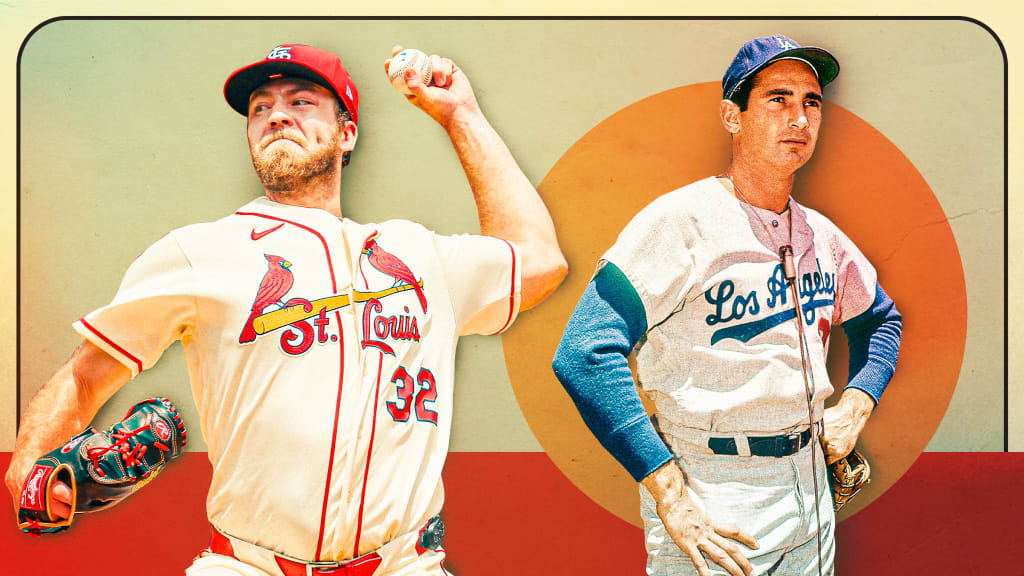
When he was given No. 32 in youth baseball, simply a number handed down by chance, his father compared him to two players who also wore the digits: Slugger Josh Hamilton and Hall of Fame legend Sandy Koufax.
“My hitting career didn’t last too long,” Liberatore joked, “so I clung more to the pitching comparison he made.”
Though the number may have been a coincidence, simply a shirt that fit the young southpaw, it soon connected him to baseball’s grand history.
“I don’t know if I threw it at seven years old, but shortly after joining that team, I started throwing a curveball,” Liberatore remembered. “He had a really nice, big left-handed breaking ball and we connected on that. I just started studying his life and his career path and the way he moved. He’s in the Hall of Fame, but he was still almost a baseball myth."
Unfortunately for Liberatore – and countless other pitchers throughout time who have looked to Koufax for inspiration – he couldn’t quite master an impersonation of the all-time great.
“I did try to emulate his mechanics at one point,” Liberatore said with a smile, “which was also very short-lived.”
Beyond the uniform numbers and youthful hero worship, there is a unique connection that pitchers share with one another, a brotherhood built upon the comparison of mechanics and the experimentation of pitch grips. Though it may not be Koufax’s curve or even Barry Zito’s – another southpaw breaking ball specialist to whom the Cards pitcher looked up – Liberatore’s curve is a standout. Batters have hit under .200 against the pitch in each of the last three seasons.
His Cardinals teammates have similar experiences. Hunter Dobbins picked up a Paul Skenes-esque splinker after studying videos and working with former Red Sox teammate Kyle Teel.
“I saw a video of Skenes explaining how he uses it, how he throws it, and I felt like that would help my game a lot,” Dobbins -- on the 40-man roster but sent down to Triple-A since our conversation -- said. “So, I literally tried to grab it pretty similar to what he does, and played catch with it. Then I went into the bullpen pregame one day, and Teel was catching me and I threw two of them that were really good. Teel walks up and goes, ‘We're throwing that today.’”
Though Dobbins doesn’t throw the pitch anymore, the discovery of the splinker “helped me find a true sinker and a changeup,” offerings to break arm-side and help Dobbins against right-handed batters.
Kyle Leahy, who slots in the Cards' rotation alongside Liberatore, has his own experience, stumbling upon a pitch before seeing it become a part of his arsenal.
“It’s relatively the same story as with my sweeper in the [Arizona] Fall League,” Leahy said. “I learned it from somebody who doesn't even throw one. They were like, ‘Oh, somebody once told me to throw a two-seam curveball,’ and I was like, ‘Well, I can throw a curveball, and that makes sense in my head.’ So, the exact same thing that [Dobbins] did: I threw it in catch play before the game, threw it in the bullpen warming up before the game, and then ‘I guess I'm throwing this tonight.’ It’s stuck ever since.”
This is the nature of the game and its endless art of adjustment, the small changes in grip or thought process passed from player to player.
“My favorite dugout entertainment is watching or listening to [Leahy] and Libby talk pitching,” Dobbins said. “These two guys are so in touch and in tune with their processes. I'm not really that way, but it's entertaining sitting next to them and listening to them hash it out. You can learn a lot listening to those two.”
The job may not be finished for any of these three, who are looking to help the surprising Cardinals push for a postseason berth, but they’re aware that they're living every young player's dream: Making it to the big leagues. Of course, when asked what his seven-year-old self would say to him now, Leahy deadpanned.
“He’d be like, ‘Well, you didn’t have any other options,’” Leahy said. “This was the only path you gave yourself, so it better have worked out.”
Liberatore, now wearing that Koufaxian No. 32 on the mound, sees it another way.
“I forget which broadcast it was, but they were talking about the fact that all the guys that have ever played in the big leagues wouldn't fill up half of one big league stadium right now,” Liberatore said. “Every time I hear that, I just get reminded of how cool and rare this opportunity is, and how grateful I should be for where I'm at. Even though I obviously want to continue getting better and moving up in the world, it's pretty crazy that so few people have ever done this. It's so much fun being able to compete with and against and be challenged by the best players in the entire world.”