

Mookie Betts endured the weakest offensive season of his career in 2025 (.732 OPS, a league-average-ish 104 OPS+), and, for most of 2026, it seemed like more of the same. Through the first 90 games, which took us more than halfway through August, given that he missed time earlier with an oblique strain, Betts was hitting just .232/.238/.401, with a mere .688 OPS. He had, at times, been pushed down as low as sixth in the lineup.
If last year’s issues could have been chalked up to an early-season illness, or a broken toe, or the extra stress of playing shortstop full-time, then the relatively unimpressive postseason that followed (.648 OPS) and the continued slide in 2026 felt more like the start of a slow decline after more than a decade of Hall of Fame-level excellence. It certainly wouldn’t be the first time a superstar in his 30s started seeing the end of the line, particularly given open concerns over his declining and relatively limited bat speed and running speed.
“I’ve been here before, so it’s not necessarily uncharted territory,” he told the Orange County Register in late July, near the low point of his season. “But I’d like to not continue to be here. It’s been a couple years now, and I don’t believe this is who I am.”
It was, for a while. Until it wasn’t.
Betts finished August much better, hitting .300 with an .816 OPS over the final 10 games. He was then so good in September, hitting .337/.438/.674 (1.112 OPS), that it actually ranks as one of the best hitting months of his entire career.
That stretch, from Aug. 20 on, was his best in more than two years, dating back to the very start of 2024. It made him a top-10 hitter in the Majors over the final six weeks, as effective with the bat as potent sluggers such as AL MVP contender Yordan Alvarez or AL RBI champ Pete Alonso.
As Shohei Ohtani, Andy Pages, and Freddie Freeman dealt with various aches, pains, and slumps, it was Betts who was the hottest hitter on the team in the final month of the season. It was Betts once again hitting first or second in the lineup, and suddenly, as the Dodgers wait to find out their opponent in the upcoming NL Division Series, it’s not so much, “What’s wrong with Mookie Betts?” It’s: “How did he turn this back around?”
It’s not strikeouts with Betts, because it rarely is. That’s the first place you look when seeing what red-hot or ice-cold hitters are doing, right? In his down 2025, his 10.3% strikeout rate was the best of his career, and that was up to all of 11.5% in the first five relatively down months of 2026. It’s really not that. It’s not about a sudden change in batting stance, which stayed consistent all year. It’s not even really about bat speed, also relatively unchanged.
It is, to oversimplify, seemingly about these two things:
- He focused on fixing a fastball problem that had been afflicting the entire team.
- That’s come with more swing-and-miss on the fastball, and so be it.
Remember this? Two months ago, Eno Sarris of The Athletic pointed out that the Dodgers were seeing far more fastballs, which coincided with a team-wide hitting slump.
Betts was no different. Way back in 2018, he’d been a top-three performer against fastballs (+43 Run Value, which includes the value of takes as well as swings), and prior to 2026, he’d been above-average-to-elite against fastballs every year of his career. But through the end of July this year, he was, for the first time, a negative against fastballs, hitting merely .223 with a minus-2 Run Value.
It’s the fastball that’s the key, because against everything else – all the breaking and offspeed stuff – nothing has really changed. Against fastballs, however … the turnaround is stunning. Betts had 21 hits against fastballs in September alone; it took him until June 19 to get his 21st hit against fastballs to start the season.
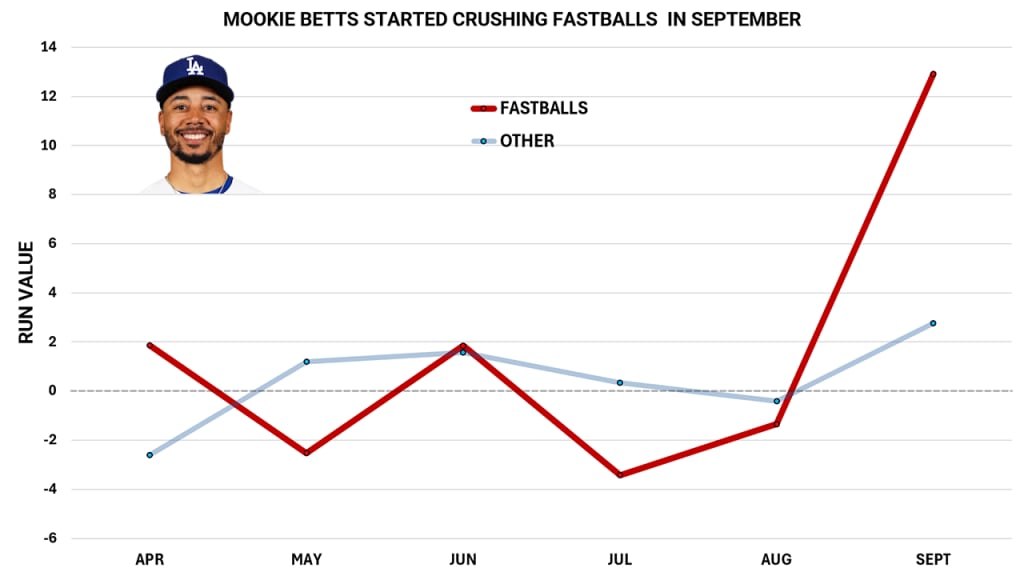
So: How, then? How does a hitter, no matter how accomplished, suddenly start hitting fastballs after months and months of not doing so?
It’s not just Betts, for one thing. Kyle Tucker, who also went through a summer fastball slump where he was a net negative for months, had his best fastball stretch of the season in September. You can say exactly the same about Teoscar Hernández, and while Max Muncy’s very-good-fastball-hitting September wasn’t out of character, he’d also been part of the same very-bad-in-July group.
There are echoes here of the Cubs, who were attacked with more breaking balls in May than basically any other team on record … and then spent the rest of the season being by far the best hitting team against breaking balls. The Dodgers, after being the fourth-weakest team against fastballs in July and August, then had a September that was the best month of any team all season long.
It is, from a distance, seemingly about swing decisions, and intent.
Betts, for example, has seen his walk rate skyrocket. He had a 9% walk rate last year, and a 7% walk rate through the middle of August, and then … a 15% walk rate in September. Put another way, Betts walked 16 times in September, after having walked 15 times during the entirety of July and August. It was his highest walk rate in a month in more than two years, dating back to June, 2024. (None of this came against position players pitching. We looked.)
To some extent, that was simply about seeing fewer strikes, as the rate of in-zone pitches he saw dropped from 56% in August to 46% in September, and Betts was happy to allow those walks to simply happen, without chasing. But it was also about patience in the first place. Look at 0-0 pitches in the zone, which occur long before you know a pitcher isn’t going to hit the plate. Betts, in September, was swinging at those far less than he had all season.
(Again, this wasn’t just Betts. It was a team-wide thing – the September 2026 Dodgers had a lower swing rate than any Dodger team had shown since 2018, and that’s not all going to be about the arrival of ultra-patient rookie Josue De Paula.)
All of which means Betts was getting fewer pitches in the zone, and was ready to attack the fastballs that were. Importantly, he was hitting those September fastballs with a steeper swing path than he’d had all year. This came with some swing-and-miss tendencies against fastballs, which, counterintuitively, isn’t a bad thing if it comes with more damage. It did. Of his 16 extra-base hits in September, 12 came off of fastballs, the most of any player in the bigs.
So: Full speed ahead for October, right? Maybe – and maybe not. For one thing, Betts had a late-season hot streak last September, too, before a relatively unremarkable postseason. For another, despite all the fastball mashing we’ve seen recently, they haven’t exactly been high-velocity pitches, either, as just one of the extra-base hits came off a pitch faster than 96 mph.
It remains a concern, because a late hot streak doesn’t wash away two years of questions. On the other hand, you’ll take a hot streak over nothing at all. For a very likely Hall of Famer such as Betts, it’s almost always too soon to count him out entirely.