

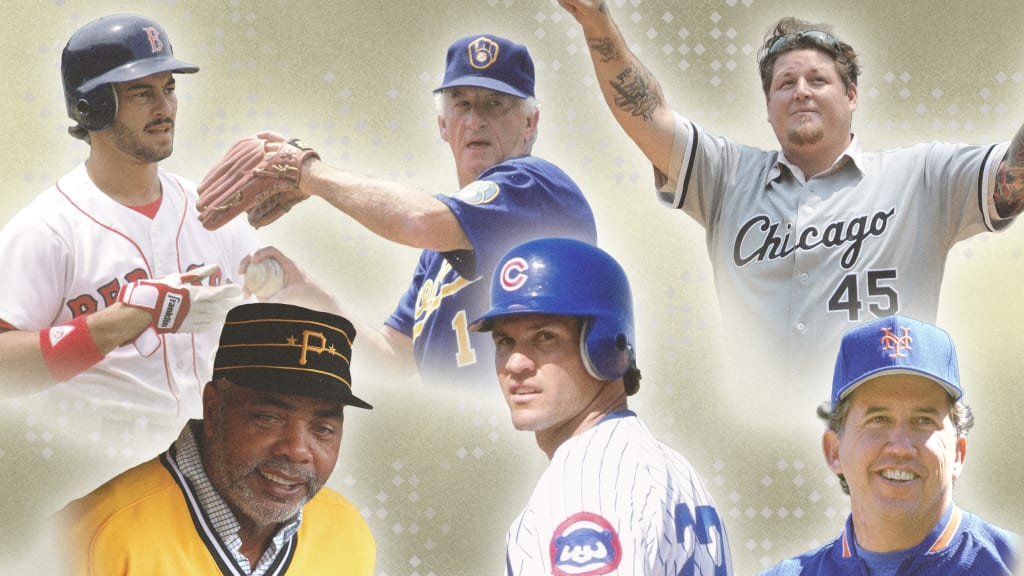
Today, on the final day of 2025, we take a look back at just some of the baseball people -- players, managers and executives -- we lost this year.
The deceased are listed in alphabetical order by last name, with their year of birth in parentheses. The baseball community is lessened by their absence, but their memories live on with all of us.
Sandy Alomar Sr. (1943)
These days, Sandy Sr. is probably known best for being the father of two fantastic Major League players: catcher Sandy Jr. (a six-time All-Star and current Guardians coach) and second baseman Roberto (a 12-time All-Star and Hall of Famer). But Sandy Sr. had a tremendous career in his own right. The Puerto Rico native spent 15 seasons in the big leagues, stole 227 bases, made the AL All-Star team in 1970 and went on to serve as a coach for four teams.
George Altman (1933)
He played three months with the Kansas City Monarchs of the Negro League before joining the Cubs and playing nine years in the Majors. He also had a full career in Japan, playing eight years and making several All-Star teams. It was a remarkable globe-spanning career in baseball. He is also one of only three big league players to homer off Sandy Koufax twice in the same game.
Jim Clancy (1955)
Most famous for his time with the Blue Jays, who selected him in the 1976 Expansion Draft, Clancy made an All-Star Game for the team in 1982. He also pitched in the 1991 World Series for the Braves and started 381 games in the Majors.
Joe Coleman (1947)
He pitched 15 years in the Majors and was best known for his strikeouts, including 236 in 1971. He also had 23 wins in '73 and made the All-Star Game in '72. His dad Joe also pitched in the Majors, as did his son Casey, making the Colemans the only three-generation pitching family in MLB history.
Rich Dauer (1952)
The slick-fielding Orioles Hall of Famer spent his entire 10-year career with Baltimore and was the team’s starting second baseman for several of those, including its 1983 championship season. Dauer later became a longtime Major League coach, winning his second ring as the first-base coach for the 2017 Astros.
Larry Dolan (1931)
Cleveland’s principal baseball owner from 2000 until his death, Dolan served as a Marine before going into private practice as a lawyer and ultimately buying the then-Cleveland Indians. The team reached the World Series in 2016 and quite famously came just short of ending the longest active title drought in baseball.
Octavio Dotel (1973)
A reliever most famous for pitching for 13 teams, the second most in MLB history, Dotel was a part of a six-pitcher no-hitter with the Astros in 2003. He would also win a World Series with the Cardinals in 2011.
Lee Elia (1937)
More than his infamous clubhouse rant at Wrigley Field, Elia later managed the Phillies and was a respected coach for more than 25 years and even served in multiple front offices.
Eddie Fisher (1936)
The knuckleballer pitched for 15 seasons, made the AL All-Star team in 1965 and won a World Series with the Orioles in '66. When he retired in 1973, he was the all-time American League leader in relief appearances.
Mike Greenwell (1963)
Greenwell played his entire 12-year career in left field for the Red Sox, one of the most famous positions in all of baseball. (He was preceded by Ted Williams, Carl Yastrzemski and Jim Rice.) While his career didn’t quite make it to those Hall of Fame heights, Greenwell did finish second in AL MVP voting in 1988, his first of back-to-back All-Star seasons.
Tommy Helms (1941)
The 1966 NL Rookie of the Year Award winner for the Reds played eight of his 14 Major League seasons with Cincinnati, making two All-Star teams and winning two NL Gold Glove Awards at second base. The Reds Hall of Famer’s impact on the franchise didn’t end there; after the '71 season, he went to Houston as part of a blockbuster trade that brought Joe Morgan to Cincinnati. Helms later coached for the Reds and served two stints as the team’s interim manager in place of Pete Rose, including in '89 after Rose received his lifetime suspension from baseball.
Billy Hunter (1929)
A member of the Orioles Hall of Fame after more than a decade as Earl Weaver’s third-base coach, Hunter actually played quarterback at Penn State before heading to the big leagues. He was the last surviving player who had suited up for the St. Louis Browns.
Bobby Jenks (1981)
The gregarious Jenks had 173 saves in his career, but none more important than the one to finish off the 2005 World Series, cementing his place on White Sox highlight reels until the end of time. The beloved fireballer made two All-Star teams and remains second all-time in White Sox history in saves.
Walt Jocketty (1951)
The architect of the great Cardinals teams of the 2000s (including the one that won the 2006 World Series), he was also the general manager who traded for Mark McGwire, igniting a Cardinals resurgence. A three-time MLB Executive of the Year award winner for his time in both St. Louis and Cincinnati, Jocketty is in the Cardinals Hall of Fame.
Davey Johnson (1943)
As a player, he was a three-time Gold Glove winner and four-time All-Star, and he won two World Series with the Orioles. Don’t think of him as a light-hitting infielder: He had 43 homers for the Braves in 1973. Johnson is still probably better known as a manager, though, having helmed five teams for a total of 17 seasons between 1984-2013. He won two Manager of the Year Awards (15 years apart, in Baltimore and Washington) and was of course manager of those 1986 World Series champion New York Mets … a team that, it should be said, was probably not always that easy to manage.
Randy Jones (1950)
He won the NL Cy Young Award with San Diego in 1976 and remains one of the most storied Padres of all time; his No. 35 has been retired by the team. He was an ambassador for the team until his death and, until Tony Gwynn, was almost certainly their most beloved player.
Chet Lemon (1955)
A 16-year veteran and three-time All-Star, Lemon was a star and beloved member of the World Series champion 1984 Detroit Tigers. Manager Sparky Anderson called Lemon “the best defensive center fielder I’ve ever seen.”
Brian Matusz (1987)
The fourth overall pick of the 2008 Draft by the Orioles, the left-hander made 32 starts for the team as a rookie in 2010 but struggled to hold down a rotation spot after that. Baltimore shifted him to the bullpen late in the 2012 season, and Matusz was superb as the team made its first playoff appearance in 15 years. He enjoyed a few more strong seasons as a reliever, making his name as an especially tough matchup for David Ortiz.
Jesus Montero (1989)
A once-heralded top prospect for the Yankees, Montero reached as high as a No. 2 rank by Baseball America. But after a brief debut with New York as a 21-year-old in 2011, the team traded him to the Mariners for pitcher Michael Pineda, and he would spend his final four big league seasons in Seattle. Yankees GM Brian Cashman said, at the time of the trade, that Montero “may end up being the best player I ever traded,” but injuries to his knee helped derail the rest of his career.
Dave Parker (1951)
The Cobra was a physical marvel who was great at everything. He hit for power and average, he stole bases, he could field and he had a cannon of an arm. But he may have been even more fun off the field, or at least around it. Case in point: If you hear any noise it’s just me and the boys boppin. He was a seven-time All-Star and the 1978 NL MVP, and he died exactly 29 days before he was to be inducted into the Hall of Fame.
Rich Rollins (1938)
Rollins signed with the Washington Senators but when he made his debut for a cup of coffee in 1961, the franchise was in its inaugural season as the Minnesota Twins. The very next year, Rollins had perhaps his best season, starting for the AL at third base in both of that season’s All-Star Games. He went on to spend 10 seasons in the big leagues and was the Opening Day third baseman for the expansion Seattle Pilots in 1969.
Ryne Sandberg (1959)
Also a Hall of Famer, “Ryno” may be one of the most universally beloved players in baseball history. It is nearly impossible to find a person who ever said a bad word about him. Sandberg was a fantastic player, too. He made 10 All-Star Games, won nine Gold Gloves and was the 1984 NL MVP. The Cubs retired his No. 23, and he was elected to the Hall of Fame in 2005. This year, every Cubs player wore No. 23 to honor him after his death in July.
Diego Segui (1937)
The Ancient Mariner holds two Seattle baseball distinctions. First, he was a member of the expansion Seattle Pilots in 1969, leading the team in pitching appearances in its only season before the franchise moved to Milwaukee. Eight years later, he threw the first pitch in the history of another Seattle expansion team, this time one that would stick around: the Mariners.
Segui, who was born in Cuba, pitched in 639 big league games over 15 seasons and led the Majors in ERA for the 1970 A’s. He is much more famous in Venezuela, where he holds the all-time strikeouts lead and is a member of the Venezuelan Baseball Hall of Fame. His son, David, also put together a lengthy Major League career as a first baseman.
Jeff Torborg (1941)
A longtime manager, Torborg helmed five teams, most notably the Chicago White Sox, where he won an AL Manager of the Year award in 1990. He won a World Series in 1965 as a Dodgers catcher and is one of just 18 players to have been the starting catcher for three no-hitters -- a tally that for Torborg included Sandy Koufax’s legendary perfect game in '65. He was also an accomplished broadcaster, announcing three World Series alongside Vin Scully.
Bob Uecker (1934)
There was no one like Mr. Baseball, one of the biggest and most beloved personalities in the history of the sport. Uecker wasn’t actually as bad a player as he made himself out to be and won a World Series as a backup catcher for the 1964 Cardinals. But he was of course Milwaukee through and through, an ambassador for the team and the sport for decades, from Johnny Carson’s couch to “Mr. Belvedere” to "Major League." He broadcast for the Brewers for 54 years and won the Ford C. Frick Award in 2003. His seat in the upper deck at American Family Field will be reserved for him forever.
Bob Veale (1935)
A two-time All-Star and World Series champion with the 1971 Pirates, Veale actually briefly pitched for the Birmingham Black Barons when he was 13. (He was the son of a player.) He led the Majors in strikeouts in 1964 and, after his career was over, served as groundskeeper at Rickwood Field.
Fay Vincent (1938)
Vincent served as the eighth Commissioner of Major League Baseball from 1989-92, taking over following the death of his lifelong friend A. Bartlett Giamatti. He was pivotal to resuming the 1989 Bay Area World Series after the Loma Prieta earthquake.