

SAN DIEGO -- It's impossible to tell the history of the San Diego Padres without the history of some of the nastiest pitches baseball has ever seen.
That’s fair to expect from a franchise with five Cy Young Award winners and a tradition of elite relievers.
You probably already know the greatest pitchers in San Diego history. But what about the greatest individual pitches? Here are nine unhittable pitches that shaped the history of the Padres:
9. Peavy's slider
Right-hander Jake Peavy's fastball might have been more important. He used it more frequently and routinely blew it by opposing hitters, even though his velocity wasn't overwhelming. But when Peavy was on, it was almost always because his slider was untouchable. Peavy won strikeout titles in 2005 and '07 with his slider as his primary putaway weapon. His location of the pitch was pinpoint, and he was savvy in letting the pitch play off his fastball, keeping hitters off-balance. As his career progressed, Peavy expanded his offspeed arsenal. But when he needed a swing-and-a-miss, he knew exactly where to go:
8. Perry's spitball
Right-hander Gaylord Perry won the second Cy Young Award of his Hall of Fame career while pitching for the Padres in 1978. He posted a 2.73 ERA and 21 wins, and -- depending on your perspective -- he did so either shrewdly or downright illegally. In the 1960s, Perry became notorious for his spitball. The sport cracked down on the doctoring of baseballs in the early '70s, but Perry persisted, using foreign substances to make his ball dart and dive in directions that made it nearly impossible to hit. Padres catcher Gene Tenace once told the New York Times: "I can remember a couple of occasions when I couldn't throw the ball back to him because it was so greasy that it slipped out of my hands. I just walked out to the mound."
7. Davis' curveball
Reliever Mark Davis rode his fastball/curveball mix to the 1989 National League Cy Young Award and consecutive All-Star appearances in his first stint with the Padres. From 1987-89, he posted a 2.24 ERA in San Diego. Davis' curveball had plenty of bend and was aesthetically pleasing from the left side. But it had bite, too -- thrown hard enough to make hitters who'd been waiting on a fastball look awfully silly.
6. Gossage's four-seam fastball
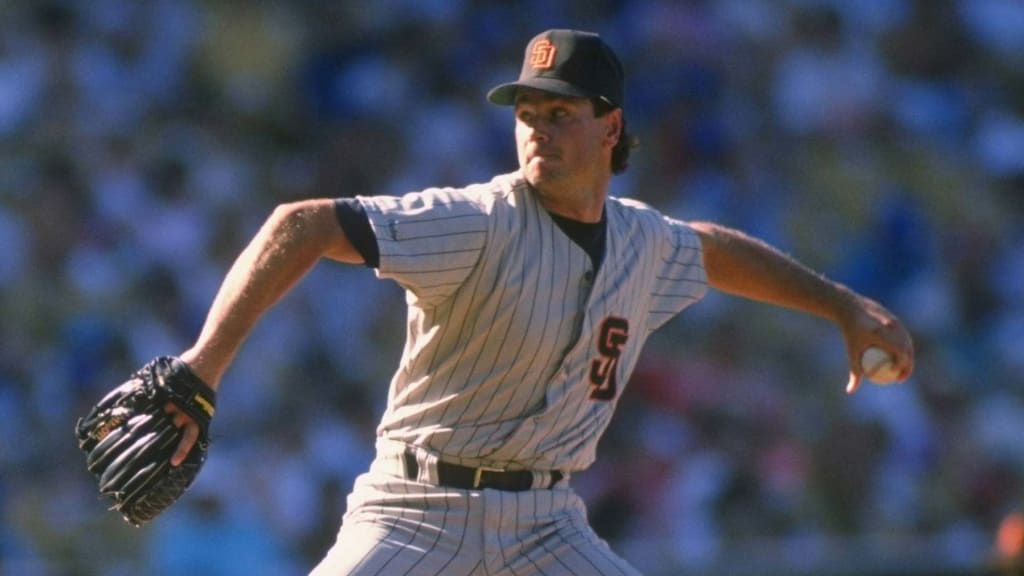
There wasn't much deception to Rich Gossage's arsenal. The Hall of Fame right-hander had plenty of firepower, and he brought it. At a time when fastball velocities sometimes hovered in the high 80s, “Goose” felt like a pitcher a generation ahead of his time. He sat in the upper-90s and sometimes topped 100 mph at a time when it felt preposterous to do so. Gossage is without question, one of the sport's greatest power pitchers. There's an argument to be made that his signing in January 1984 is the most important free-agent signing in franchise history. Gossage used that four-seam fastball at the back of the bullpen as the Padres won their first pennant in '84.
5. Miller’s fastball
Mason Miller arrived at the Trade Deadline in 2025 and instantly shattered just about every velocity record in Padres history. His fastball routinely hits triple digits and has clocked as high as 104.5 mph. It’s an utterly overpowering pitch. But, well, it might not even be Miller’s best …
4. Miller’s slider
It’s almost impossible to rank these two pitches. Because it’s impossible to know what one pitch is, without the threat of the other. But the numbers are pretty clear on this: Miller’s slider is nastier. In fact, it might be the single nastiest pitch in the sport today. No pitch induces swings and misses by a bigger margin. Miller threw his slider more than his fastball in 2026 (49% to 48%) and opponents slugged just .163 against it. Slugged.
3. Brown's sinker
Right-hander Kevin Brown was a Padre for only one season, but he authored arguably the most valuable pitching season in franchise history. Brown posted a 2.38 ERA and a franchise-record 257 strikeouts. And he did so by relying heavily on a bowling-ball sinker that darted down and to his arm side and was nearly impossible to put in the air. (In 257 innings in 1998, Brown allowed just eight home runs.) While some sinkers are meant merely to induce soft contact, Brown’s was the rare swing-and-miss variety. His sinker-balling masterpiece came in Game 1 of the 1998 National League Division Series, when he struck out a Division Series-record 16 Astros.
2. Jones' sinker
Without context, Randy Jones' numbers in 1975 and '76 are almost laughable. The left-hander compiled more than 600 innings across two seasons with a 2.50 ERA -- but he recorded only 196 strikeouts in the process. Jones was able to do so because of the pitch that came to define an era of Padres baseball: his sinker. The pitch tantalized opposing hitters, then darted below their barrels, as Jones became the king of weak contact. The pitch was easy to connect with but impossible to square up, and Jones used that to his advantage, amassing 43 complete games across two seasons. (For context, no pitcher has more than 24 complete games in the past decade.) On the strength of that sinker, Jones won an ERA title in '75 and the NL Cy Young Award in '76. He became one of the most beloved players in franchise history in the process.
1. Hoffman's changeup
The first line of Trevor Hoffman's plaque in the National Baseball Hall of Fame: "Master of a mystifying changeup." Strangely enough, when the right-hander arrived in San Diego after a trade with Miami in 1993, he was all power. It wasn't until a 1994 shoulder injury that Hoffman was forced to develop a putaway offspeed weapon. Teammate Donnie Elliott, who has a special place in Padres history as a result, taught Hoffman in the pitch, and the rest is history. No one could touch it. Hoffman rode his changeup -- arguably the best in baseball history -- to 601 saves and enshrinement in Cooperstown.