

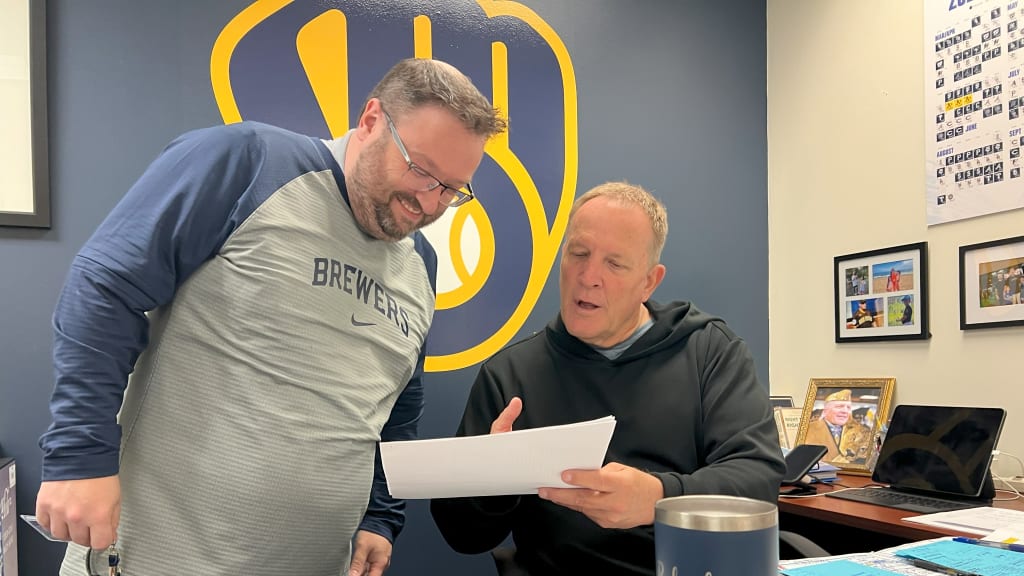
MILWAUKEE -- Brewers manager Pat Murphy was on one particular kick starting with the earliest days of Spring Training.
“I want evidence,” he said one March morning. “Receipts!”
Maybe as far back as February, Murphy had been reminding Brewers senior manager of media relations Andrew Gruman to print as many preseason prognostications as he could find. Murphy, the two-time reigning NL Manager of the Year Award winner, was convinced that the experts and their complicated computer models were once again shortchanging a Milwaukee club that annually manages to buck the odds.
So Gruman dutifully delivered a stack of paper to the manager’s office during Milwaukee’s opening homestand. It included predictions and projections that ranged from the mathematical models from Baseball Prospectus and FanGraphs to the more traditional picks from media outlets like Baseball America, The Athletic, ESPN, CBS and Yahoo.
And yes, MLB.com was in that pile of printed Internet. Fifty-seven of our writers and editors weighed in during the final days of the spring, the majority of whom picked the Cubs to win the NL Central. The Brewers were MLB.com’s pick to claim the final NL Wild Card.
“Our voters have learned their lesson by now: Never count out the Brewers,” it said in the article. “Pat Murphy's team is coming off a Major League-best and franchise-record 97 wins. On the eve of Opening Day, FanGraphs projects the Brewers to win 81 games and gives them a 38% chance to make the playoffs.”
Through the first 10 games of the season, the Brewers were 8-2 and it looked like they might blow away the projections all over again.
But baseball comes at you fast. Now they are 8-7 going into a three-game series against the defending American League champion Blue Jays, and basically right where the models say they should be.
***
But let’s zoom out, because Murphy does have a point. The models have been shortchanging his club for some time now.
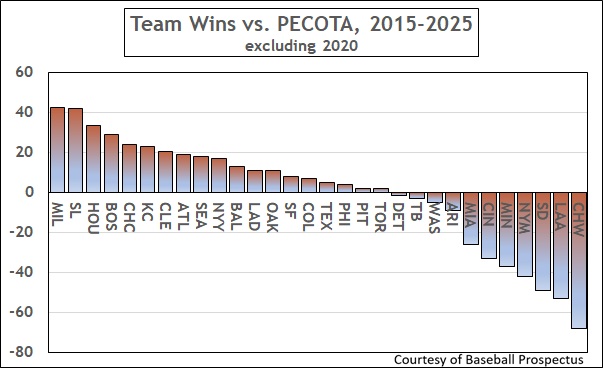
Take the Player Empirical Comparison and Optimization Test Algorithm, or PECOTA as it’s known. It is the proprietary system which Baseball Prospectus uses to project player performance, and it has been having a hard time getting the Brewers right. Going into last season, PECOTA projected the Brewers to be an 81-81 team. Instead, they went 97-65. Milwaukee was the first team in the Majors to clinch a postseason berth.
It wasn’t a novel development. Over the last 10 full seasons, the Brewers were PECOTA’s most underestimated team:
Murphy has taken note.
“Part of me wonders if he likes them being low,” said Jonathan Judge, a Chicago-based trial lawyer who holds the keys to PECOTA for Baseball Prospectus. “Certainly, at a minimum he should be subscribing and contributing to the good work we’re doing.”
Judge is the ideal expert to weigh in on Murphy’s beef. He is a Brewers fan who was born in Oconto, Wis., went to high school in Green Bay and got a degree in piano performance at Lawrence University in Appleton before going to law school. Judge eventually settled in Chicago and works full-time in consumer product regulation.
Maybe it was his love for patterns, rules and sequences that originally drew him to music, because those were also the things that made him fall in love with baseball. Over the years, he found he had a skill for writing about it. The folks at Baseball Prospectus took note and challenged Judge in 2015 to develop a better catcher framing model. Judge accepted, and over time he rose the ranks all the way to managing the PECOTA system.
So what gives? Why are the Brewers perennially undervalued?
The answer is complex, but for Judge it comes down to a couple of factors:
1. Their brand of player is hard to project
“The way they are doing it makes it really hard to see what’s coming next,” Judge said. “Back in the late 2010s, when their farm system wasn’t very good, their strategy was really, ‘Let’s find underappreciated veterans and use our savvy and [defensive] shifting to make them useful in ways other people didn’t think they could be. So now you’ve got Mike Moustakas, second baseman. And you have Yasmani Grandal for one year. The thing with those sorts of players is they have Major League track records.”
And thus, PECOTA could see into the future.
“In general, what we do is both enormously complicated and not complicated at all,” Judge said. “We expect players who have been good to remain reasonably good.”
Those were the good old days.
“The Brewers, over the last few years, have really changed,” Judge said. “Only in the last couple of years have they really found yet another innovation in terms of unusual Draft strategies and how they started to strike gold in the international market, which, to me, is truly the most remarkable thing this club has done over the past decade. That used to be the domain of the Red Sox, the Dodgers, A.J. Preller [and the Padres], and the Yankees. And everyone else was just wandering around looking for a lottery ticket.”
Which leads to trouble for folks like Judge. He calls it “The Chourio Problem.”
“These guys like Jackson Chourio don’t spend a lot of time in the Minors before they come up, so they don’t have a lot for us to work with,” Judge said. “And because the Brewers are favoring younger players, they let them take their lumps for a year.”
Take Brice Turang in 2023, when he had the fourth-lowest weighted runs created plus (WRC+) of any Major Leaguer with 400-plus plate appearances. Or Chouiro in 2024, when he was slumping badly as a 20-year-old rookie that some veteran players had to sit him down in late May and remind him how talented he was. Or Joey Ortiz, who was among baseball’s least-productive hitters for a year and a half from 2024-25 but stuck at shortstop because of his defense.
As last season began, the Brewers were taking their lumps as a team.
“Even though I’m happy to take the big picture L, up until Memorial Day, the Brewers were exactly the slightly below .500 team we thought they were,” Judge said. “They took one step forward, one step back. And then after a couple of roster shifts, a player like Caleb Durbin comes up and figures it out, and they just decided not to do that any more.”
Which leads to problem No. 2.
2. It’s hard to know who to project
“The Brewers want players who are young, who are controllable. They favor upside and volatility over past performance,” Judge said. “That’s kind of their economic model. And it used to be that they had Orlando Arcia ready, and when it was his time we have to give him the position and see what he does with it, and if he doesn’t do anything with it, we’re kind of stuck.
“Now they have, like, three players who can do something, and the odds are that one of them will pan out and become a great player, or pretty good. So we’re sitting here saying, ‘OK, we have to give 200 plate appearances to this guy and 200 plate appearances to that guy, maybe 100 to that guy.’ But what the Brewers do is they watch a player in Triple-A, see which one suddenly has the light go on, yank him up, give him all of the plate appearances for the rest of the year, and suddenly the team has made these sudden shifts.
“There’s a certain shrewdness to it. They don’t ever owe nobody nothin’, and they are rarely in a place they make a decision they truly regret. They can always pivot on a dime.”
The Brewers are not the only team operating with that kind of flexibility, and so the prognosticators are working on ways to adjust.
“I will say that I think we are on the verge of making some adjustments that will better allow us to react,” Judge said. “If that happens, I think the Brewers will suddenly be viewed much more favorably.”
***
He would never say it, but there has to be some part of Murphy that loves this stuff. The third-year Brewers skipper has a Patches O’Houlihan jersey in his office, after all, which is a nod to the fictional coach of the scrappy, underfunded Average Joe’s in the film, “Dodgeball.”
Maybe the folks upstairs relish the underdog role as well. They would never admit it, either.
“I don’t pay too much attention to what everyone outside is saying,” Brewers president of baseball operations Matt Arnold said. “We believe in our culture. We believe in the people in our group.”
Said owner Mark Attanasio: “Our names maybe don't line up [with other teams’ star power], but our pitchers are young and hungry. Our defenders, we are among the best defensive teams in the league every year. And so even if the ball is hit hard somewhere, one of our guys is gonna go get it. I don't think it's easy to understand that. And even if you do, it's kind of boring to write about.”
Both sides have had a case in the first two and a half weeks of the regular season. Are the Brewers the juggernaut they appeared to be in the first 10 games? Or are they more like the team they’ve been during their first five-game losing streak in nearly three years?
Judge and the baseball-crazed men and women at Baseball Prospectus won’t give up trying to project what’s next.
“Even my own 16-year-old son gives me a hard time about it. He doesn’t think much about my projections,” Judge said with a laugh. “It’s part of the fun. I would be delighted if they’re all aligned [with on-field results], even if that gives the manager one fewer thing to point to in his press conferences.”