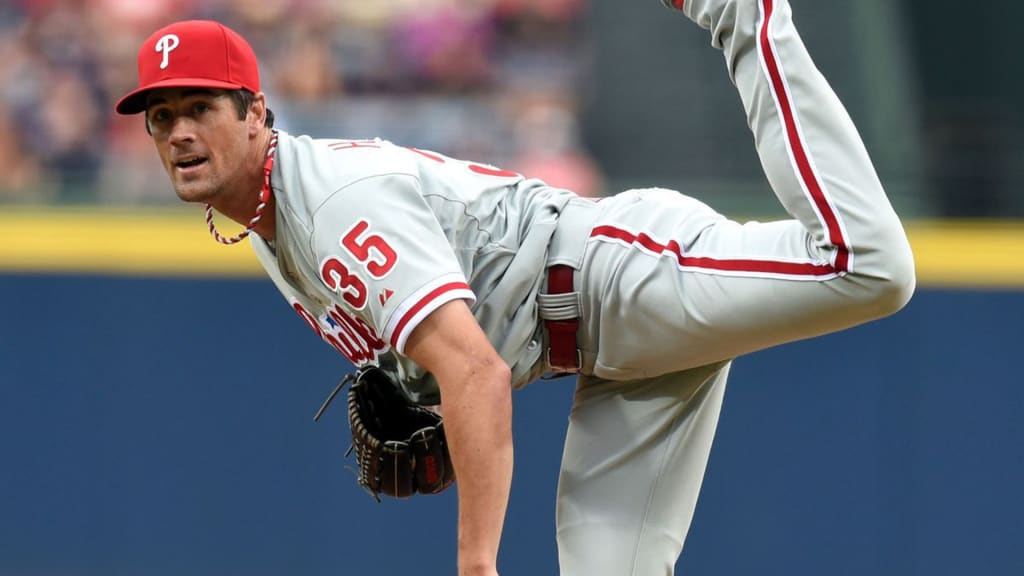
High schoolers Curt Simmons, Jack Meyer, Rick Wise, Larry Christenson, Brett Myers and Cole Hamels are among ballyhooed Phillies pitching prospects through the decades.
The newest is Andrew Painter. The Phillies' first selection in the 2021 Draft was chosen 13th overall. He’s 6-foot-7. Expectations are that tall. He’s currently pitching with the Lehigh Valley IronPigs in the Triple-A International League as he continues to work his way back following July 2023 Tommy John surgery. His Major League debut has been tentatively targeted for “July-ish.”
Painter’s hype can be partially attributable to the age in which we live -- internet, social media, analytics, Statcast, Trackman and multiple prospect rankings. Every start is reported by numerous websites. About the only thing that hasn’t been documented is how many times he touched the resin bag.
Draft Hype
Baseball started the Draft in 1965. There’s always hype with first-round selections, regardless of being high school or college arms. When they are “1-1” (first pick of entire draft) super-hype exists.
The Phillies have selected a lot of pitchers as their first pick, 26 to be exact.
The most hyped? Christenson (third overall selection, 1972), Brett Myers (12th, 1999), Cole Hamels (17th, 2002), Aaron Nola (seventh, 2014) and Painter. Nola was the lone college pitcher of the group.
Debuts
A year after he was drafted, Christenson made his Major League debut at age 19, a complete-game five-hitter vs. the Mets at Veterans Stadium. Mets broadcaster Ralph Kiner said he wasn’t impressed and felt he would never win another game.
21-year-old Myers won, 4-2, over the Cubs in Chicago, July 24, 2002. Eight innings, two hits, one run, one walk, five strikeouts.
Less than a year after being drafted, the Phillies took 19-year-old Hamels to Cooperstown to pitch in the Hall of Fame Game on June 16, 2003. The Class A southpaw pitched five innings, allowed three runs -- two of which were earned -- on three hits and struck out a game-high nine batters while walking just one en route to the Most Valuable Player honors.
Hamels’ Major League debut came three years later (May 12, 2006). He gave up one hit while striking out seven in five scoreless innings against the Reds in Cincinnati, an 8-4 winner at age 22. Then, Hamels was named the MVP in both the NLCS and World Series in 2008.
Mick Abel was the Phils first pick in 2020 (15th overall). The Draft was limited to five rounds because of COVID. Abel was the first high school pitcher selected, which brought additional attention. He struggled until this year and had an impressive debut on May 18, six scoreless innings with nine strikeouts in a 1-0 win over Pittsburgh’s Paul Skenes, a super-ballyhooed pitcher. The 23-year-old Abel matched Curt Simmons’ strikeout total, the most in club history in a pitcher’s debut.
Little-Known Arms
Mike Adamson was the Phillies very first selection in 1965 (18th overall). Followed by fellow first-rounders Mike Biko (ninth overall, 1966), Sammye Wellborn (12th, 1975), Rip Rollins (23rd, 1978) and Johnny Abrego (20th, 1981). Each was a high school right-hander.
Of this group. Two stepped on a big league mound, Adamson (0-4 over parts of 1967-69 seasons with Baltimore) and Abrego (1-1, six games, 1985 Cubs).
Pre-Draft
Hype was basically based on a signing bonus.
Owner Bob Carpenter, in an effort to build a winner, opened the check book.
As a high school senior in 1947, Simmons was the most sought-after pitching prospect in the country. The Phillies signed him to a $65,000 bonus, the largest at the time. Before signing him, Carpenter sent his big league club to Egypt, P.A., for an exhibition game against Simmons. He held the Phillies to four runs. Because of darkness, the game ended tied at 4-4 after nine innings.
A Major League team going to a prospect’s hometown for an exhibition game against a teenager? Does that qualify as hype?
Signed in June, Simmons went to the Minors (Wilmington Blue Rocks) and made his big league debut that Sept. 28. Career: 20 years, 193 wins.
During the same 1947 season the Phillies signed Robin Roberts to a $25,000 bonus after a workout at Wrigley Field. He returned to classes at Michigan State and reported to Spring Training in Clearwater in 1948. Like Simmons, he was sent to Wilmington. His stay there was brief and historic.
In his first pro start, Roberts struck out eight of the first 10 batters and finished with 17 punch outs. 14, 12 and 12 strikeouts in his next three starts. May 18, 16 strikeouts in a 15-inning tie game. June 5, league-record 18 strikeouts in a 4-1 win. After a 9-1 record in 11 starts, 121 strikeouts in 96 innings, Robbie was promoted to the Majors on June 17. Does that qualify as hype? Career: 19 years. 286 wins, Hall of Fame.
Ray Culp of Stephen F. High School in Austin, Texas, drew contract offers from 15 big league clubs in 1959. The Phillies signed him for $100,000 following graduation. Career: 11 years, 122 wins.
Big-bonus pitchers who didn’t make it include lefty Seth Morehead ($50,000, 1952). Career: 5 years, 5-19. RH Tom Qualters ($40,000, 1953). Career: 3 years, 0-0.
Jack Meyer, a Philadelphia Penn Charter School athlete, was considered the city’s greatest high school pitcher.
He reportedly turned down $25,000 from the New York Yankees to attend Wake Forest College. In 1951, he developed a sore arm while pitching semi-pro ball and wound up signing with the Phillies for just $3,500. (SABR Bio Project, Russ Walsh).
The 19-year-old started his pro career in Bradford, Pa. (Class D Pony League). Two years later at Schenectady, N.Y., he led the Class A Eastern League in strikeouts (226, 218.2 innings). After a year in Triple-A (led International League with 173 strikeouts), Meyer made his big league debut on April 16, 1955.
Primarily a starter in the Minor Leagues, he began as a starter but was moved to the bullpen after a 1-6 start. He finished the season relieving in 45 games. His 16 saves and 36 games finished led the National League. Meyer was second in Rookie of The Year voting.
That same rookie season, he tossed eight shutout innings in a 1-0, 15-inning win in Wrigley Field (June 19). His first win as a reliever.
He had a highlight moment as a hitter -- an April 29, 1956, game-winning homer off the New York Giants’ Hoyt Wilhelm. It came in the 10th inning, Game 1 of a doubleheader at the Polo Grounds. 5-4 final. (retrosheet.org).
On Sept. 22, 1958, the hard-throwing right-hander set a Major League record by striking out the first six batters he faced in relief (12th and 13th innings), vs. Pittsburgh, Game 1 of a Connie Mack Stadium doubleheader. (baseball-reference.com).
A herniated disk that required major surgery in July of 1960 limited him to seven games that season. His career ended a year later after one game (April 30, two relief innings). Career: 6 years, 24-34, 21 saves. He died of a heart ailment at age 34, March 9, 1967.
Rick Wise, a Madison High School phenom from Portland, was signed by Phillies scout Glenn Elliott on June 16, 1963, two years before the MLB Draft began. Bonus for the 17-year-old: $12,000. After one season in Class A (nine starts, 6-3, 2.63 ERA, 98 strikeouts in 65 innings), Wise made his Major League debut, April 18, 1964. Career: 18 years, 188 wins.