Train Kills Man in Wagon
Cyclist is Fatally Injured
2 Children Badly Burned Overturning Tea Kettles
Allies’ Hard Blow Forces Germans to Reinforce Armies
New Orleans Hard Hit by Hurricane; Fear Vast Damage
All news headlines in the Philadelphia Inquirer on the morning of Sept. 30, 1915. The big sports news was a two-column headline: PHILLIES, BEATING BRAVES, CAPTURE NATIONAL’S FLAG. (The game took place in Boston the day before, Sept. 29; Game No. 147).
Excerpts from that Inquirer story:
“Winning the necessary game to assure them the championship, the Phillies, by defeating Boston by 5 to 0, captured their first National League pennant in thirty-five years.
“Wonderful pitching by Grover Cleveland Alexander, the greatest pitcher of the day, and a record-breaking home run drive by Clifford Cravath were the salient features of this wonderful game. Alexander held Boston to one hit, that being made by his former roommate, Sherry Magee, and so helpless were the Braves before the modest Nebraskan that they gave up winning long before the last inning was played. It was Alex’s thirty-first victory, his thirteenth shutout and his fourth one-hit game of the present year.
“Cravath’s home run was undoubtedly one of the longest ever made and it was incidentally his twenty-third of the season. He needs two more to equal baseball’s record made by Buck Freeman in 1899 when he made twenty-five home runs playing with the Washington National League club. Cravath hammered out his circuit clout in the first inning with two men on base. That blow snuffed out every hope the Braves may have secretly held of winning the game.
“The Phlying Phils have now completed a record of eighteen wins out of their last twenty-two engagements, fourteen of the eighteen having been won on the road trip which critics designated as their time to ‘crack.’”
While quotes weren’t part of game stories in those days, Manager Pat Moran was quoted on Page 1: “You can say for me that I am tickled to death and that the Phils didn’t crack. Give me credit if you want to, but don’t forget the boys as they worked like hell for me and deserve just as much credit as I do.”
SEASON IN REVIEW
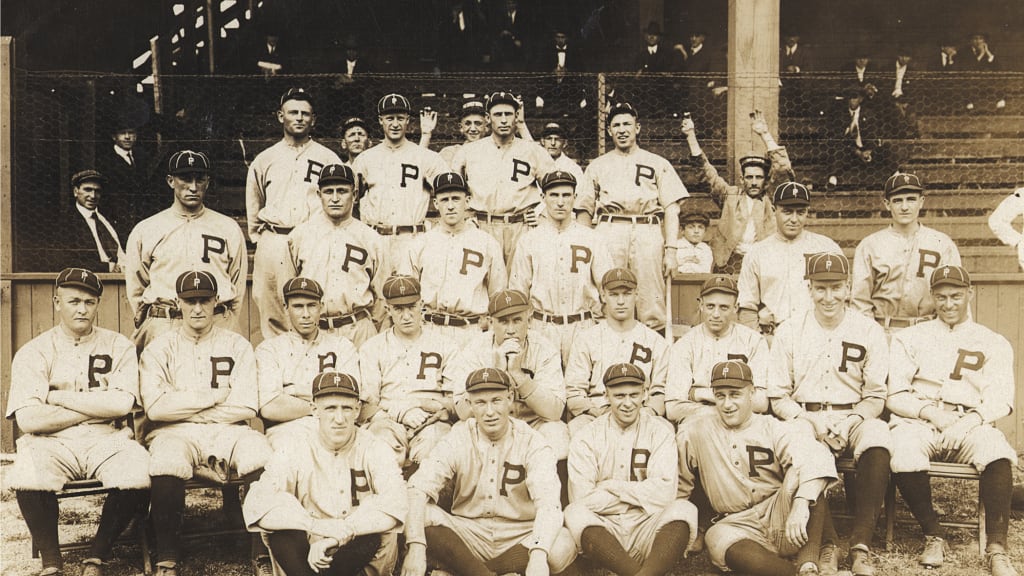
The Phillies played the entire season with 23 players (14 position players; nine pitchers): a club record for the fewest players. The previous season, they used 28 players -- including 10 pitchers.
Manager Pat Moran brought in eight new players including starters at second base, shortstop and left field. Bobby Byrne, the incumbent second baseman, moved to third base giving the team different players at three infield positions. He made one roster move during the season, acquiring right-handed pitcher George McQuillan on waivers on August 20.
Average opening day age: 26.
The oldest were outfielders George Paskert and Gavvy Cravath, 34. The youngest: pitcher Stan Baumgartner, 20.
College grads included Eppa Rixey (University of Virginia), Baumgartner (University of Chicago) and Joe Oeschger (St. Mary’s College of California; master’s degree from Stanford University). There was also a member of the Cherokee tribe (Ben Tincup), one of the era’s rare Jewish players (Erskine Mayer), an offseason cartoonist (Al Demaree) and a native of Scotland (George Chalmers).
Nicknames
Clifford "Gavvy" Cravath, George "Possum" Whitney, George "Dode" Paskert, George "Dut" Chalmers, Joe "Bareback" Oeschger, Grover Cleveland "Old Pete" Alexander, Dave "Beauty" Bancroft, Eppa "Eppa Jephtha" Rixey, Milt "Handle Hit" Stock, Bill "Paw Paw" or "Reindeer" Killefer and Pat "Whiskey Face" Moran.
Hall of Famers
Three were later enshrined in the National Baseball Hall of Fame and Museum, Alexander (1938), Rixey (1963) and Bancroft (1971). The latter two earned their credentials primarily playing for other teams.
St. Petersburg’s Coffee Pot Park was the site of spring training. Moran drilled the team on fundamentals daily. He was quoted, “This is not a sixth-place team,” referencing the Phillies finish the previous season.
The Phillies won their first eight games and 11 of 12. The 8-0 start remains the club record. They overtook first place for good on July 13, then clinched pennant on Sept. 29 (Game No. 147), winning, 5-0, behind Alexander at Braves Field in Boston. They won the pennant by seven games over Boston, the defending World Champions.
They led the league on May 1, Aug. 1 and Sept. 1. Best months: April (11-3) and September (21-10). Low point: fourth place on June 28, (30-27). Second half (51-29). Home (49-27). Their longest winning streak was eight games; longest losing streak, four games.
The season included 20 postponements and 22 double-headers (8-5-9).
They finished 90-62, the second time in franchise history they reached 90 wins. They also played one tie game, 1-1, over nine innings at the New York Giants on June 22.
All games were played in the day. Because of Pennsylvania blue laws, organized sports competition on Sundays was illegal.
The pitching staff led the National League in ERA (2.17), complete games (98) and shutouts (20). Offensively, their 58 home runs were the most. The Phillies led in total attendance (449,898) and average (5,290). By comparison, the 1914 Phillies drew a meager 138,474.