
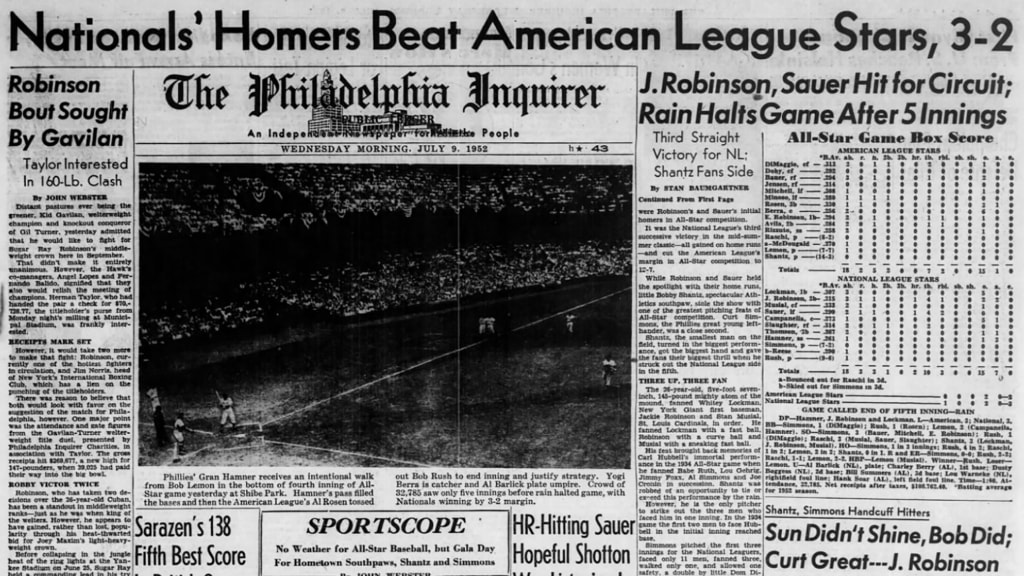
This is the second in a series of the four All-Star Games played in Philadelphia.
Philadelphia’s second All-Star Game -- 1952 at Shibe Park -- also became a historic one. The first in 1943 was the first night game.
The 19th edition held on July 8, 1952, remains the only “Midsummer Classic” to be shortened by rain, ending after just five innings. The National League won, 3-2.
Through social media, the entire world now learns quickly who will be the starting pitcher. It was way different 74 years ago.
"For some reason, I was late getting to the ballpark," Curt Simmons said in an interview a long time ago. "The NL manager was Leo Durocher [Giants], and he was having a team meeting. I walked in and he said, 'Curt, we're going over the hitters. Robbie [Robin Roberts] started two days ago, so you're going to start.'" As simple as that.
Because of rain, there were no pregame festivities, and the start was delayed 20 minutes.
Simmons worked three scoreless innings, allowed one hit, one walk and struck out three.
Jackie Robinson (Dodgers) homered in the first inning (first pitch) to give the NL a lead, but the American League came back with two in the top of the fourth. Hank Sauer (Cubs) unloaded a two-run blast over the left-field roof in the NL's at-bat in the fourth, a blast that proved to be the game-winner.
The AL was managed by the Yankees' Casey Stengel who started his own Vic Raschi.
Another Philadelphia favorite, Bobby Shantz, took the mound for the AL in the fifth inning. The diminutive A's left-hander, who would go on to win the league's MVP Award that season, delighted the crowd of 32,785 by striking out Whitey Lockman (Giants), Robinson and Stan Musial (Cardinals). Thirteen total pitches. Rain deprived Shantz of a chance to match or break the ASG record of five consecutive strikeouts set by Carl Hubbell in the 1934 game.
"Casey never said anything before the game about me pitching. I had no idea," recalled Shantz. "I guess he put me in because we were in Philadelphia. I remember striking out the side and getting a huge ovation, which was nice. After the game, I learned Hubbell had the record, but I didn't have any idea how many he struck out."
Bob Rush (Cubs) threw two pitches to outfielder Minnie Minoso (White Sox) in the top of the sixth when home-plate umpire Bill Summers halted play. Following a 56-minute wait, the game was called. Rush was the winning pitcher.
The Phillies had two other players on the team: shortstop Granny Hamner, who started and batted eighth (0-for-1), and Roberts, who didn't pitch. Joining Shantz in representing the Philadelphia A's were first baseman Ferris Fain and shortstop Eddie Joost. Neither got into the game.
Fun Facts
The Phillies were designated as the host team.
Simmons’ start marked the sixth straight for the Phillies. Roberts had the honor in 1950-51 and from 1953-55.
Forty-six-year-old Satchel Paige (St. Louis Browns) was on the AL squad but didn’t pitch.
NBC, for the fourth straight year, televised the game with Mel Allen and Jack Brickhouse. It was also broadcast on the Mutual Radio Network with Al Helfer and the Phillies’ Gene Kelly.
Gem Promotion
Twenty years later, the Phillies scheduled an Old-Timers Game as a “completion of the 1952 All-Star Game," a Bill Giles promotion gem on Aug. 19 before a game vs. the Astros.
The Old-Timers began in the "sixth inning" with the Veterans Stadium scoreboard showing the National League ahead 3-2 after five innings. Hank Sauer, Bobby Thomson, Enos Slaughter, Pee Wee Reese, Hamner, and Roberts all played for the National League. Shantz pitched the first inning, which appeared as the sixth inning on the scoreboard. Shantz yielded five runs, while the American League scored only a run to "complete" the game with a score of 8-3.
“In all truth, the players performed like all stars at least as long as they didn’t have to run,” wrote Art Morrow in the Philadelphia Inquirer. Fain, the A’s first baseman who didn’t play in the 1952 game but did in the Old-Timers Game, said, “I choked up so much tonight the bottom of the bat hit my belt.”