

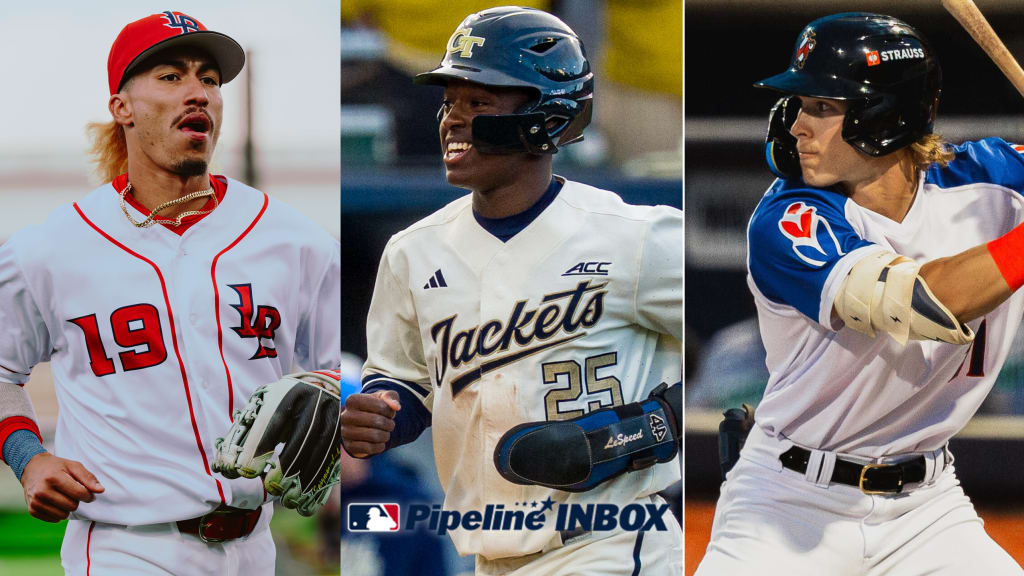
We’re all about synergy at MLB Pipeline. We recently ran a story when we picked a pleasant surprise for each team, so we made sure the first two questions in this week’s Inbox involve players featured in that piece.
We’re also deep into Draft coverage, with our second mock draft just out. So of course, our third and fourth questions this week are Draft related, one looking at the system and one looking at a team picking in the top 10.
More from MLB Pipeline:
• Top 100 prospects | Stats | Video | Podcast | Complete coverage
When do you think they'll call up Edwin Arroyo? – @MartinGuillermo on X
We answered this one on this week’s MLB Pipeline Podcast, so be sure to give it a listen for a longer answer to this question about when the Reds might call Arroyo up for the first time. Recently added (or returned, since he had been there in years past) to the Top 100, Arroyo was our Reds entry in that “pleasant surprise” story. And he’s very loudly knocking on the big league door with his .344/.406/.590 line with Triple-A Louisville.
He’s an excellent shortstop, but has played plenty of second base and seen time at third. That’s important because as good as he’s been, it’s not like he’s going to push Elly De La Cruz off the six. Third baseman Ke’Bryan Hayes has a .420 OPS (albeit with Gold Glove defense) and Matt McLain – who can also move around the diamond – is at .652. The Reds have moved Sal Stewart around to each of those positions at times, but they could get some consistency by letting him play first every day and bring Arroyo up, though they’d have to decide what to do with their veterans at the hot corner or keystone.
Twitter did a pretty good job answering this one, coming up with some excellent choices of outfield prospects who could be ready over the next few years, though I think everyone would prefer to see Acuña stick around longer, right?
There’s a lot of buzz around No. 19 prospect Eric Hartman right now, and he was the Braves’ entry in that story about pleasant surprises. The Alberta, Canada native is only 19 and has an OPS over 1.000 in the High-A South Atlantic League while using his outstanding speed to steal 16 bags in 19 tries. If he continues to show he can stick in center and impact the baseball, the 2029 ETA we have for him will be too conservative.
Luis Guanipa is right behind Hartman on the Braves’ Top 30, and is a level behind Hartman in Single-A Augusta. He got $2.5 million to sign in January 2023 and he moved from the Dominican Summer League that summer to the Florida Complex League in 2024, struggling with a move to Augusta that summer. He repeated that level last year, but a hand fracture limited him to just 35 games. He’s still chasing too much (40 percent according to Synergy), but he’s coupling his knack for contact and 65-grade speed (21 steals) with a lot more impact (eight homers, .535 SLG) and it might be fun to see him and Hartman in Rome together.
There are other outfielders to keep an eye on, like Isaiah Drake and Owen Carey (both in Rome). And if you want a long-term play, Diego Tornes was the club’s big international signing in January of 2025 and he’s making his United States debut in the FCL as we speak.
Of course it’s appropriate! The bonus pool system has been in place since the 2012 Draft. For the uninitiated, each slot of the top 10 rounds is given a dollar value, so each team is given a bonus pool that adds up the values of all their picks over those rounds and they can spend that money however they see fit. For example, a team can go “under slot” in the first round, signing a player for less than that pick value, and use the savings to go over slot in a later round. Without getting too deep in the weeds, teams can go a bit over without being penalized, with stiffer penalties for overages being the forfeiture of future Draft picks (It should be noted that no team has ever incurred such a penalty to date.).
There are those who feel that a hard slotting system for the MLB Draft would make sense. It’s what other leagues do, like the NBA and NFL, and proponents of such a system feel like it would take away the gamesmanship and posturing that happens between teams, players and agents come Draft time. The bonus system was implemented to bring Draft spending a bit more under control – prior to 2012, teams could spend as much as they wanted on any player and over the course of the Draft – and it’s largely gotten the job done on that front.
There has been fear voiced that teams would “punt” the Draft, as the pool doesn’t have to be spent, with concerns teams would just save money on each pick and not use revenue to bring in a new wave of talent. That has not happened since the system was implemented; sure, occasionally there are money-saving deals made at different stages, but the best players tend to go where they’re supposed to.
Changing the Draft system is something that comes up any time a new agreement needs to be collectively bargained, and I imagine it will be on the agenda this offseason. Whether it gets altered remains to be seen, but arguments surely could be made that the bonus pool system more or less gets the job done.
Some of it depends on how the top four unfolds, but one of the things about picking that high in the Draft is there’s the chance to take the best available player AND technically go under slot. The Pirates were about $500,000 under slot when they took Paul Skenes No. 1 overall in 2023, but he was the best player in the class, wasn’t he? They went a touch over for Konnor Griffin, and a little bit under for Seth Hernandez, over the next two years, but they were the best player on the board each time.
2026 MLB DRAFT PRESENTED BY NIPPON EXPRESS
Day 1: Saturday, July 11 (Rounds 1-4)
• 1:00-2:30 p.m. ET - Picks 1-10 (NBC/Peacock)
• 2:30-4:30 p.m. ET - Picks 11-40 (MLB Network, MLB.com, MLB TV, MLB+)
• 4:30-7:45 p.m. ET - Picks 41-135 (MLB.com, MLB TV, MLB+)
Day 2: Sunday, July 12 (Rounds 5-20)
• 11:30 a.m.-7:30 p.m. ET (MLB.com, MLB TV, MLB+)
Coverage
Right now, the prevailing thought is that UCLA’s Roch Cholowsky, Texas prep shortstop Grady Emerson, Georgia Tech’s Vahn Lackey, Santa Barbara right-hander Jackson Flora and south Florida high school shortstop Jacob Lombard could very well land in the top five picks, in some order yet to be determined, with perhaps high school outfielder Eric Booth Jr. in the mix. The Pirates are in a position to wait and see what happens ahead of them and take whoever is still on the board (unless they have someone else on the top of theirs). Pick value at No. 5 is just over $8.3 million, and it’s hard to imagine any of these players coming in north of that figure, with the chance to save a little bit (a la Hernandez) and use it later on in the Draft.