

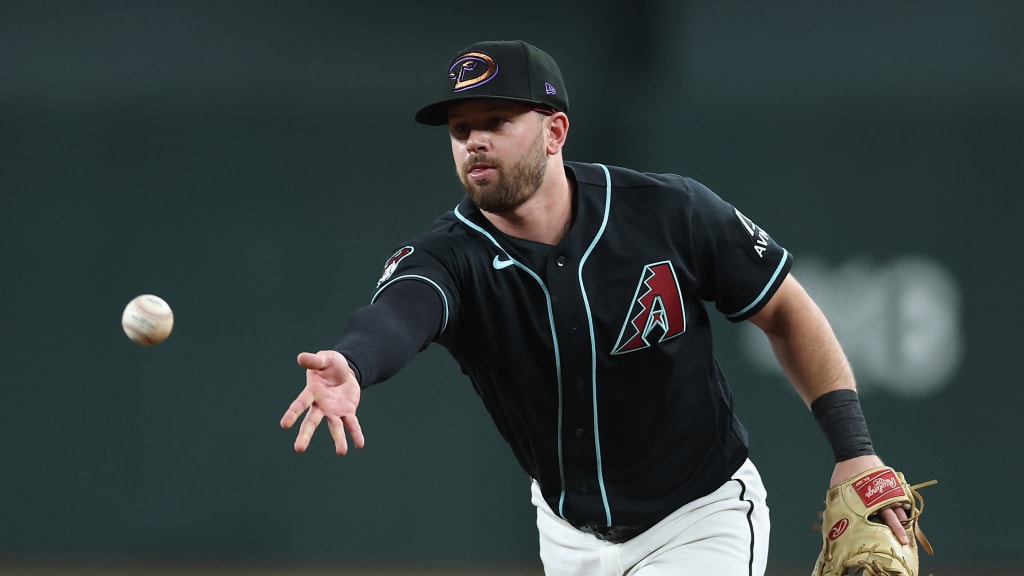
Tim Tawa didn’t exactly have the Black Friday he was expecting. No sales, no shopping. Instead, around 10:15 a.m., Tawa’s phone rang with a call from Diamondbacks general manager Mike Hazen.
“When you get a call from the GM, you kind of have a feeling [a trade] is going to happen,” Tawa said. “It was definitely a whirlwind, and a lot of stuff was happening really quickly.”
A day later, the dust has settled some for Tawa, a Stanford University graduate who doesn’t appear to be overwhelmed by much.
The newest Pirate, acquired for Henry Davis, arrives here with an interesting backstory, from his upbringing in Oregon to what he accomplished after making an adjustment at the plate this past season.
Here are five things to know about Tawa:
1. That July adjustment helped a ton.
The way Tawa remembers, Diamondbacks assistant hitting coaches Damion Easley and Travis Denker pulled Tawa aside during early at Dodger Stadium and asked him a question.
“They were basically like, ‘How early can you be ready? How early can you be ready to hit this pitch?’ ” Tawa recalled during my interview with him on 93.7 The Fan Saturday. “The earlier I tried to be ready, even ridiculously early, the better I was hitting the ball, the more adjustable I was, the more ability I had to react and hit the ball where it needed to be hit.”
The results came quick, as Tawa had three hits, including a homer, to start that series — a sweep for Arizona. Over his final 68 games of 2026, Tawa hit .264 with 34 RBIs and a .747 OPS that included 21 extra-base hits (10 homers).
“The biggest thing for me was simplifying, trying not to overthink or do too much,” Tawa said. “I’ve always believed I could be a consistent, good big league hitter. You just needed to implement it and get those chances
“Last year, in that second half of the season, I was able to not let a lot of outside things, or trying to find that one fix, change me or be too influential. I just tried to simplify by telling myself, ‘Alright, how can I be on time as often as possible?’ … I just kind of ran with that.”
2. Tawa was an extremely good high school football player. And gave up football for a specific reason.
Playing for West Linn High School in Oregon, Tawa finished with 11,337 career pass yards and 143 touchdowns. Three times he was named the state’s Gatorade Player of the Year. His coach was Chris Miller, who played and coached in the NFL.
But as a sophomore, Stanford offered Tawa a baseball scholarship, and he committed. As the football thing blossomed, Tawa also didn’t waver, believing baseball offered the brightest future.
“I knew I wanted to go to Stanford,” Tawa said. “It was an easy decision for me to commit there. Football kind of happened after that.
“It is a little bit of a ‘what if’ for me in my life, but I don’t have any regrets. Baseball was the better option for me and has worked out.”
3. Tawa majored in communication and media studies at Stanford. He minored in political science and graduated in four years, returning for his senior season in baseball following the pandemic.
It’s an experience Tawa wouldn’t trade for anything.
“The four years I spent [at Stanford] were massive for my development as a player and a person,” Tawa said. “I made a lot of really great relationships there. Had a lot of really great memories. Very, very grateful for my time there.
“Getting my degree is a great accomplishment. When I set out to go to Stanford, it wasn’t just, ‘Oh, I’m gonna be there for three years, then go play professional baseball and not worry about the degree.’ I wanted that degree. It’s something I valued. I’m very proud I was able to accomplish that.”
Two more fun nuggets: Tawa grew up a Seattle Seahawks fan though not the “ride-or-die” type. He’s a much bigger Portland Trail Blazers fan and has been encouraged by the NBA team’s strong start.
4. Tawa’s positional versatility is another point of pride.
The most notable thing to Tawa’s game so far has been his ability to play pretty much everywhere. He’s played six spots — and well. His outs above average in 2026 ranked in the 77th percentile, and Tawa has proven himself to be an adequate or above-average defender at every place he’s played.
That requires careful and intentional work, including reps at multiple positions whenever he’s not in the lineup, but Tawa loves the challenge. He’s done it since middle school, enjoying the outfield for how it can favor instincts and athleticism, infield because you have to be precise.
All of it allows Tawa to showcase another of his strong traits: his work ethic.
“For me, there’s never been a lack of work ethic,” Tawa said. “I’ve always valued putting effort in. That’s one of the things that I’ve always really loved about the game of baseball, especially from the defensive side. The more work you put into it, the better results you get. That’s something I value and has been instilled in me from a young age.”
5. Tawa hasn’t spent a lot of time in Pittsburgh but loved what little he’s experienced, especially PNC Park and the excitement he sensed from Pirates fans.
It also reminded him a little of home.
“The rivers with bridges going into the city, that’s something I was familiar with growing up,” Tawa said. “That’s one of the reasons I really enjoyed it. You don’t get a lot of trees, rivers or bridges in Arizona. I really enjoyed [coming to Pittsburgh with the Diamondbacks]. It felt a little familiar, like what home was for me for a long time.”
Tawa comes across as extremely honest and likable. He’s shown flashes of power but knows he needs to do it more consistently. He loves playing different positions because he believes it helps the team.
Tawa wants nothing more than to fit seamlessly into the clubhouse and help the Pirates, a group he believes he can identify with given his blue-collar approach.
“I’m excited to get in and make some new relationships, make some new friends,” Tawa said. “From what I’ve seen, it’s a really good group. Excited to help and contribute in any way that I can.”
Jason Mackey: Jason.Mackey@pirates.com and @JMackey_PGH on X.