

Justin Verlander is one of the few pitchers to have performed during the entire pitch-tracking era of Major League Baseball. He broke into the big leagues in 2005, which is well before Statcast debuted in 2015, and even before Pitchf/x began in '08.
He once cruised.
Earlier in his career, Verlander could fire his four-seam fastball in the low-to-mid 90s for most of an outing, saving 100 mph in his back pocket for the moments that mattered most.
Now, to stay competitive as league benchmarks keep climbing, he must pitch nearer to max-effort far more often. The numbers tell the story.
In 2011, the range between Verlander's maximum and minimum four-seamer was 12.9 mph — topping out with a 103.1 mph heater, while also tossing a 90.2 mph fastball at one point that season. By 2024 that range had shrunk to 6.4 mph. This season, it sits at 5.9 mph.
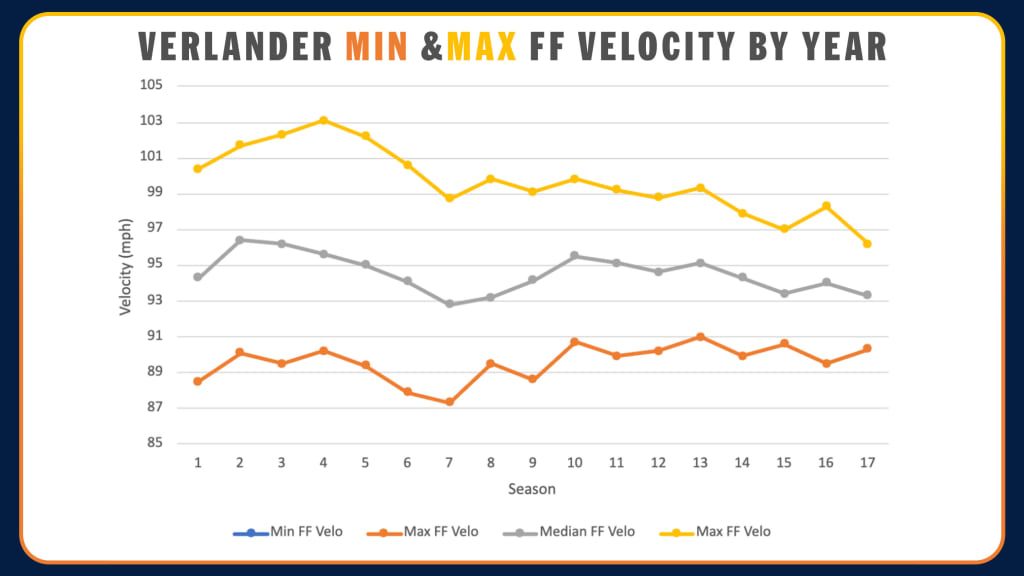
In many ways, Verlander is the face of a league-wide trend behind the velocity that also coincides with the conversation about how we can do a better job protecting pitchers from injuries. In fact, as of this writing, Verlander is on the 60-day IL, though it’s for a hip injury, rather than something specific to his arm.
Major League pitchers are on track to establish yet another velocity record this season. The average four-seam fastball thrown this season sits at 94.6 mph, which would be yet another new high, a few tenths up from a year earlier.
With all due respect to those who claim Bob Feller was throwing 108 mph, it’s fair to say pitchers have never thrown this hard.
But it's how pitchers are achieving this increase that is so fascinating.
I analyzed every pitcher's max, minimum and median fastball velocity for single seasons during the pitch-tracking era. What I found is that the range of velocity in which arms operate is condensing in a particular way.
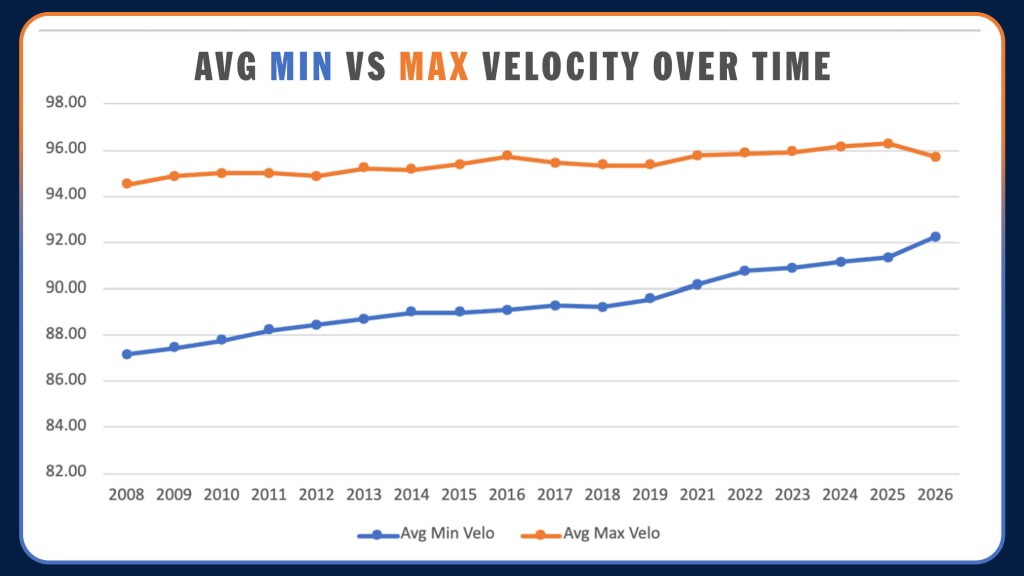
In 2008 there was a 7.37-mph gap between pitchers' maximum and minimum fastball velocities within a season. Nearly every season moving forward that gap narrowed, reaching a full-season low of 4.92 last year. This season the gap has significantly shrunk again to 3.47 mph.
Pitchers' minimum velocities are increasing at a much greater rate than their maximum velocity within a season.
On average, pitchers' minimum fastball velocity within a season is up 5.1 mph when comparing 2008 with 2026 (87.1 mph to 92.2). Conversely, pitchers' maximum fastball, on average, is up just 1.2 mph (94.5 mph to 95.7). In other words, the average minimum fastball velocity has increased four times more than average max velocity.
"I think the biggest thing is the style of pitching has changed so much," Verlander said in 2024. "Everyone is throwing as hard as they possibly can, spinning the ball as hard as they can. It's hard to deny those results, but it's a double-edged sword."
What's driving the narrowing band of velocity ?
- Pitchers are incentivized to keep up with an ever-increasing benchmark of league-average stuff if they want to excel at the top level of the game. That's a big part of it.
- Weighted-ball and velocity-building programs are raising velocity capacity for pitchers. Such regimens also improve mechanical efficiency, thereby enhancing the ability to repeat top-end velocity.
- Outings are shorter, enabling more max-effort approaches. There are more innings absorbed by relievers, who are more likely to have max-effort outings. Relievers accounted for 42.5% of innings last year, which was the record for a non-COVID season. (Interestingly, this year right-handed starting pitchers are throwing faster — 95.1 mph four-seam average — than right-handed relievers, 94.9 mph).
The chase of ever-improving quality of stuff presents a Catch-22. In today's game it's tough to be below stuff benchmarks and excel. Yet, MLB's report on pitching injuries published in December 2024 found broad consensus that pitchers "chasing max-effort velocity and 'stuff' is driving the increase in injuries."
Days lost by pitchers to IL placements increased from 13,666 in 2005, to 32,257 in 2024.
Verlander did not have Tommy John surgery until his 16th year in the Majors, when he had stopped using a cruising speed.
Long-time Guardians pitching coach Carl Willis said he would like to see a different world, one where pitchers are not so often red-lining. But Willis also understands the demands of the modern game, and the advances driven by data and new tech, as well as the training regimens that are shaping it.
"[Today] pitchers go out and start the game with their best stuff, hold it as long as they can hold it, hit a wall, and we'll go on to the next guy," Willis said.
Tampa Bay pitching coach Kyle Snyder acknowledges the tightrope walk required today to add stuff and remain healthy. How does Snyder balance these competing interests?
"I'm trying to leverage a pitching lab to be able to get 100 pitches out of a starter, and let's say typically 17 [pitches per start] are stressful," Snyder said. "If we can drop that number to 10 or 12 by building out drill packages, corrective exercises to make their deliveries more efficient -- less stress on the arm -- then their workloads aren't gonna run them down quite as quick.
"But the other half of it is finding guys that are able to command the ball. If you cannot put [plus stuff] in what's now a smaller strike zone, then stuff doesn't matter. I think command guys are underappreciated in the industry right now. … It's going to be a two-part equation."
Different approaches exist in each MLB clubhouse.
Consider the range in Baltimore. Orioles starting pitcher Chris Bassitt is in his 12th MLB season. He entered this campaign having accumulated the eighth-most innings, and 23rd-most pitching fWAR over the last five seasons.
"When I came up, I threw it a lot harder, and then I got hurt in '16 from chasing velo. I pretty much told myself 'I'm not doing that again,'" Bassitt said. "My cruising velocity is 91 [mph today]. A few years back, it was 92-93, and then when I really wanted it, I could throw 97. I wasn't trying to throw 97 every pitch. I am trying to pitch. I am trying to hit spots. I am trying to locate it. That's what was taught to me."
Kyle Bradish, Bassitt’s teammate, owns some of the nastiest breaking stuff in the league when he's right. He holds a much different approach than Bassitt.
"If I am thinking 'I am going to take something off of this pitch,' usually, the outcome is not great," Bradish said. "Whenever I am throwing well, when I'm right, I don't want to say it's max effort every time, but the mentality is throw my nasty stuff, and just rip it."
Bradish features a tighter velocity range than his peers. Like Bassitt, he has undergone Tommy John surgery. Trevor Rogers enjoyed a rebound campaign in Baltimore last season tied to greater velocity.
The velocity jump last season came from improving his lower-body strength, a flaw discovered during an offseason strength test. That added strength gave him a greater cruising speed.
Rogers doesn't believe in a max-effort approach. He estimates his cruising speed of 93 mph is about "70 to 80 percent" of his max velo capacity.
"I've never been a max-velocity guy," Rogers said. "In the past as a rookie, it was 'Anything to stay up here.' Everything all the time — and that's when the IL stuff started to happen. I think a well-executed fastball 93-94 plays."
Among the three Orioles, Rogers owns the widest range of velocity — 7.3 mph between max and minimum — suggesting he does cruise.
Willis would like to see more of this, more cruising, in the game. "Not having to just rip your best stuff each and every pitch," he says.
What could compel change? It's complicated.
The incentives from Draft to Majors are all geared to creating better stuff. Those incentives are all tied to narrowing the range of velocity and taking more and more pitchers off cruise control.
"I will say this: It's hard. Not every pitcher can do that," Willis said. "I can recall a game Pedro Martínez started (against Cleveland) in Fenway, I think it was 2005 or 2006, and it was 95, 96, 97 (mph). Literally six days later here (in Cleveland) and it's 91. A lot of breaking stuff, offspeed. But in the sixth inning, a base-loaded situation, and Pedro was 96-97. … But I think that's a gift not every pitcher owns."