
NEW YORK -- On April 10, 1947, Jackie Robinson signed a Major League contract with the Brooklyn Dodgers for $5,000, breaking baseball’s long-standing color barrier.
On Saturday, 79 years and one day later, his enduring impact was impressed upon a new generation through a different type of game: “Bases loaded, Opportunity Knocks,” a scavenger-hunt-style challenge designed to guide kids through the sprawling collection of artifacts and awards at the Jackie Robinson Museum, located in downtown Manhattan.
Jackie Robinson Day coverage presented by Capital One
• How MLB is commemorating Jackie Robinson Day
• On this annual day of celebration, 'We Are Jackie'
• Top 10 Jackie Robinson Day moments
• A few words from Jackie inspired this former MLB star for life
• 10 significant moments from Jackie's life
• How Jackie's on-field dominance helped lead him to Hall
• Why does Jackie have two Hall of Fame plaques?
• This is what it was like to wear No. 42 every day
• Each club's last player to wear the iconic No. 42
• Robinson Foundation Scholars reinvigorated by visit to MLB HQ
The activity was part of the museum’s third-annual event in partnership with the Nike RBI (Reviving Baseball in Inner Cities) program, as youth ballplayers and their families from the New York City and New Jersey area were invited to explore the many facets of Robinson’s story on and off the field. This year, the event featured an overarching theme of financial literacy.
“I think there’s a lot that goes into the man who makes up this terrific, wonderful legacy,” said Marcus Murray, senior coordinator for the RBI program. “This experience [allows the kids] to really learn about the legacy of the man who broke the color barrier, but also to learn about the legacy of Jackie Robinson the veteran, Jackie Robinson the entrepreneur, Jackie Robinson the activist.”
Upon their arrival, the kids were given T-shirts sporting Jackie’s iconic No. 42. The official programming then commenced with a viewing of the museum’s introductory video, before the group circled around an Ebbets Field replica model, where Murray and the museum’s director of education, Samantha Gibson, delivered speeches.
Murray told the children he wanted them to do three things: have fun, learn as much about Jackie Robinson as possible, and incorporate what they learn into their everyday life.
“This event, for the community, is huge,” Murray said. “[It] definitely impacts them and allows them to take the values that they learned here back home into their respective communities and really implement them, whether it’s on the field or in the classroom, at home, and really just live life the Robinson way.”
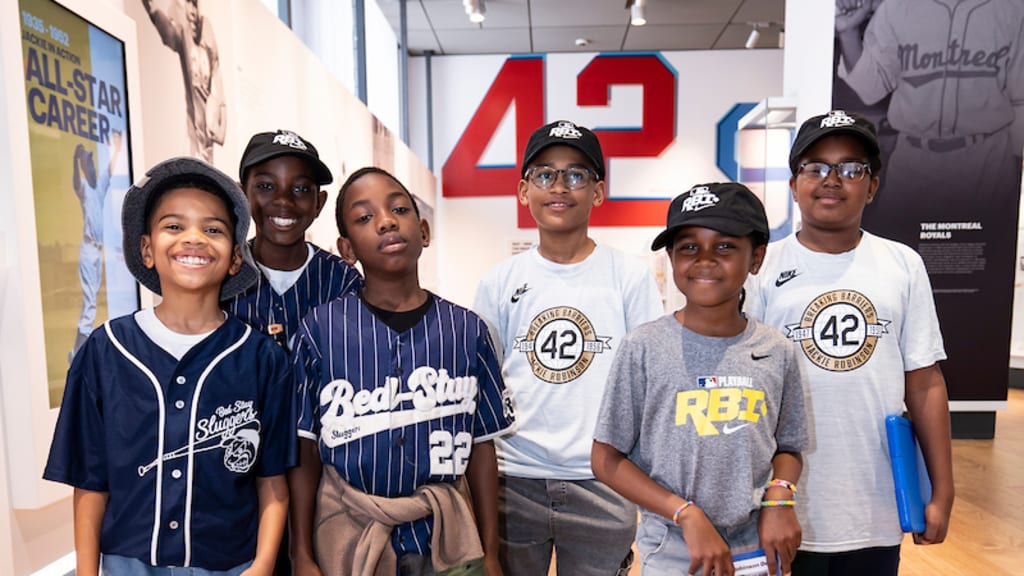
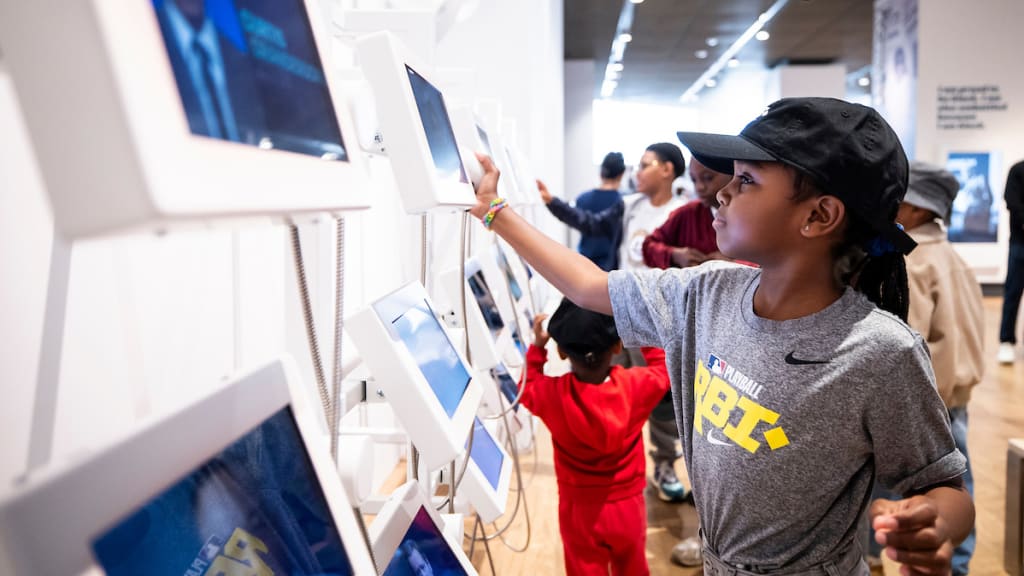
While roaming the museum, some families traced a timeline highlighting Robinson’s most pivotal accomplishments. Others gravitated toward an area with 42 screens, each featuring a video with commentary on Jackie’s impact delivered by everyone from Mookie Betts and Mo'ne Davis to Ken Burns and George Bush. All the while, the families could work to complete the interactive challenge, which helped center the day’s broader educational theme.
“We’re always trying to think about how we tell the stories here in the museum in interesting ways, and also make them resonate in different formats and in ways that work for different generations,” Gibson said. “[The game] helps our visitors look at different stories in Jackie’s life through the lens of business ... whether it’s what he’s earning in a given job that he took on or the investments that he made to follow through on his beliefs in economic equality.”
Participants were given a sheet listing objects and information to find, such as spotting Robinson’s All-American football sweater or discovering the amount he raised for the NAACP after retiring in 1957. Near each item was a playing card listing a gain or loss of “dollar” points based on Robinson’s actual experience; for instance, locating his 1947 contract yielded 5,000 points.
Gibson highlighted one item which seemed especially relevant for the event at hand: a plaque made for Robinson by members of the 1955 Harlem YMCA little league team, in recognition of his sponsorship. Robinson’s persistent belief in young people is, according to Gibson, a defining through line of his life that is often overshadowed.
“Even as a young person in college, he was coaching youth sports and working with kids through his Sunday school program, all the way back to his days in Pasadena,” Gibson said. “Then, after UCLA, the first job he takes on is at the National Youth Administration. … In 1948, he starts volunteering at the Harlem YMCA. So immediately after breaking the color barrier, he’s the biggest possible celebrity and has obviously big league fame, and he’s using it to dedicate his time, his platform to supporting kids and young people in the offseason.”
On the museum’s second floor, kids designed their very own Dodger Blue baseball cap, complete with customizable numbers and letters as well as pins and patches related to Robinson’s journey. They could even get an original painting on the hat, done by an artist on the spot.
More important than any hat or T-shirt, the hope is the kids will carry with them the lessons demonstrated by Jackie’s unwavering integrity as a leader and community member, his unmistakable courage in the face of profound racial prejudice and his undying determination to continue fighting for inclusion in all corners of society.
Robinson famously once said that “a life is not important except in the impact it has on other lives.” Now 79 years later, the scale of his impact on baseball and beyond remains immense. Whether points on a scavenger hunt or stats on a box score, Jackie’s legacy will forever be far greater than any game can quantify.
“I think he would be very humbled by what this foundation and also this facility represents,” said Marlon Jackson, a father in attendance on Saturday. “I don’t think he would take it for granted that he’s continued to give back in a way that he gave back when he was alive.”