

This story was excerpted from Mark Sheldon’s Reds Beat newsletter. To read the full newsletter, click here. And subscribe to get it regularly in your inbox.
CINCINNATI -- Many youth baseball fields and organizations support the inclusion of ballplayers who overcome physical disabilities and obstacles to participate in the game.
Little do many know, there was an ahead-of-his-time pioneer for those efforts. The most successful deaf Major League player is considered to be Dummy Hoy, but many have not heard of him. A group is trying to change that -- and also mobilize efforts to get Hoy into the Baseball Hall of Fame.
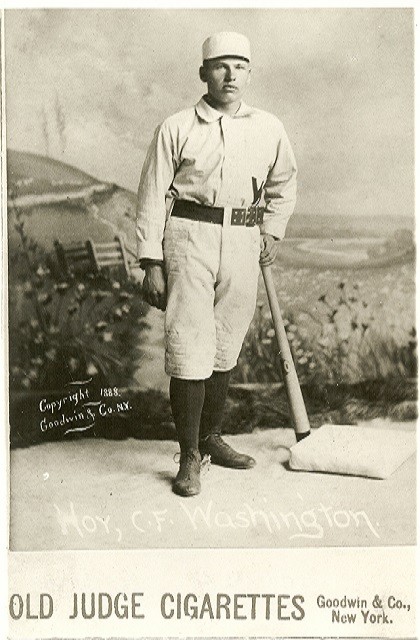
Hoy, a center fielder who played 14 professional seasons from 1888-1902 including five years for the Reds, has a champion in baseball radio broadcasting icon Marty Brennaman. The 2000 Ford C. Frick Award winner at the Hall of Fame, Brennaman is a spokesperson for Dummy Hoy Day, being held in Cincinnati on Saturday -- which is also Hoy's birthday.
"There's no question there is a movement underway to try and make people aware of what his accomplishments were, which were even more magnified by the fact that this guy is deaf," said Brennaman, who wears hearing aids.
"This campaign is designed to make people aware. But his story is as fresh now as it was when he first came to the big leagues over 130 years ago because he was able to overcome that disability. Part of the campaign is designed to make people who are deaf or have another disability go out and accomplish things that they feel they're capable of doing if given the opportunity."
Hoy, who was inducted into the Reds Hall of Fame posthumously in 2003, spent 1894-1897 and 1902 with Cincinnati and also had stints with the Senators, White Sox and Louisville Colonels. He batted .288 for his career with 596 stolen bases, including a National League-leading 82 during his rookie year, and was considered a great defensive player and a strong leadoff man.
After contracting spinal meningitis as a child, Hoy lost his hearing and eventually attended the Ohio School for the Deaf, where he graduated as his class valedictorian.
Upon reaching pro baseball, Hoy was viewed by many historians as a catalyst for inventing hand signals and signs that are still used in the game today -- namely balls and strikes and safe and out calls by umpires. The Society of Baseball Research noted that pitchers quick-pitched him when he looked back for the home-plate umpire's balls or strikes call, so Hoy's third-base coach began relaying them.
"His numbers are good, but more important than that is that he helped shape -- to some extent -- what the game is all about today," Brennaman said. "He had a major influence as far as visual signs are concerned. Baseball had to accommodate him being deaf -- they had to come up with something that could make him aware of things that were going on in the field."
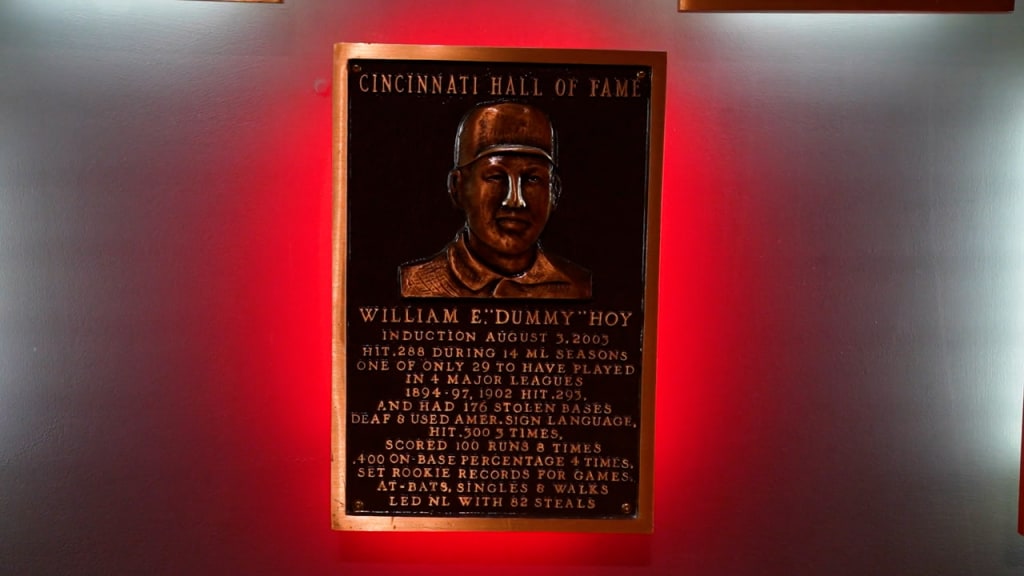
Hoy's nickname was an unfortunate byproduct of his era, when deaf or mute people were referred to as "dumb." His given name was William Ellsworth Hoy but he apparently didn't like being addressed by his first name.
According to SABR, Hoy was annoyed in 1961 when sportswriters called him William Hoy.
“Tell them to call me Dummy again, like always," Hoy replied.
Two months prior to his death at the age of 99, Hoy threw a ceremonial first pitch at Game 3 of the 1961 World Series between the Reds and Yankees at Crosley Field.
Dummy Hoy Day is scheduled for 5-7 p.m. ET on Saturday at The Banks outside of Great American Ball Park, before the Reds play the Cardinals. A free event that will be family friendly, the celebration will include interactive storytelling that features Hoy's historical moments. There will also be deaf advocacy groups from local and regional organizations and ASL integration and inclusive programming.
A website called Sign for Hoy has been created and a petition was launched to try and get the game-changing player inducted in Cooperstown.
"I don't think that's unrealistic at all," Brennaman said. "If the Hall of Fame were all about statistics, a lot of guys wouldn't be in there today. But just as important, there are people who have helped shape the game, impacted the game in a different way aside from just the numbers they posted. If there's a candidate for someone like that, it would certainly be him."
The next voting cycle by the Hall's Classic Eras Committee for pre-1980 players is 2027. Hoy was a finalist in 1996 but not elected. If the latest campaign gets Hoy renewed serious consideration, Brennaman would lobby committee members.
"I would be more than happy to," Brennaman said. "It's one of the great stories in the history of baseball that few people have ever paid attention to."