

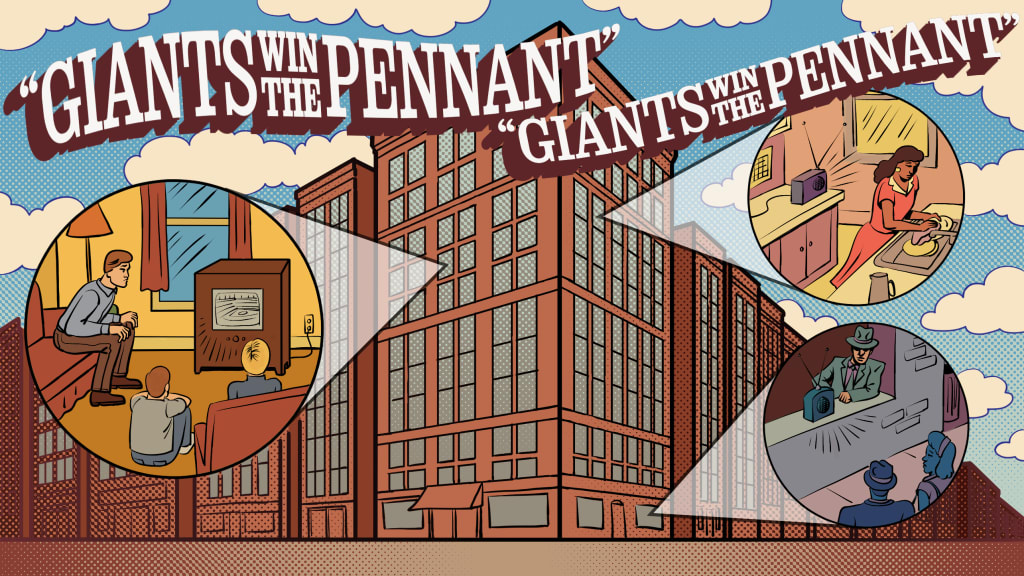
On Oct. 3, 1951 -- 75 years ago tomorrow -- Jerry Austin was in the second grade at P.S. 75 in the South Bronx, counting the minutes until he could run from the classroom. The night before, he had seen a headline about a big game that would air on TV. That “big game” was the Brooklyn Dodgers taking on the New York Giants in the third and final game of a tiebreaker playoff for the National League pennant.
There was only one problem:
“We didn’t have a TV,” Austin told MLB.com. “I didn’t know anybody who had a TV. My mother or father then said, ‘There’s a TV at the five-and-dime on Westchester Avenue.’”
Though he had first been taken on a trip to the Polo Grounds by his father a few years before, Austin was young enough that he didn’t quite understand what this contest was really all about. He just knew it was something important and he wanted to be a part of it.
“When school ends, I run to the five-and-dime, which is in the complete opposite direction from where I lived, because I heard they had a small TV to see this big event,” Austin recalled. “I really had no idea what it was.”
When he arrived at the store, a swarm of adults had already amassed around the small television screen, packed shoulder to shoulder like links in a fence.
“But I’m a little guy,” Austin said with a laugh. “I pushed myself to the front as Bobby Thomson comes to the plate.”
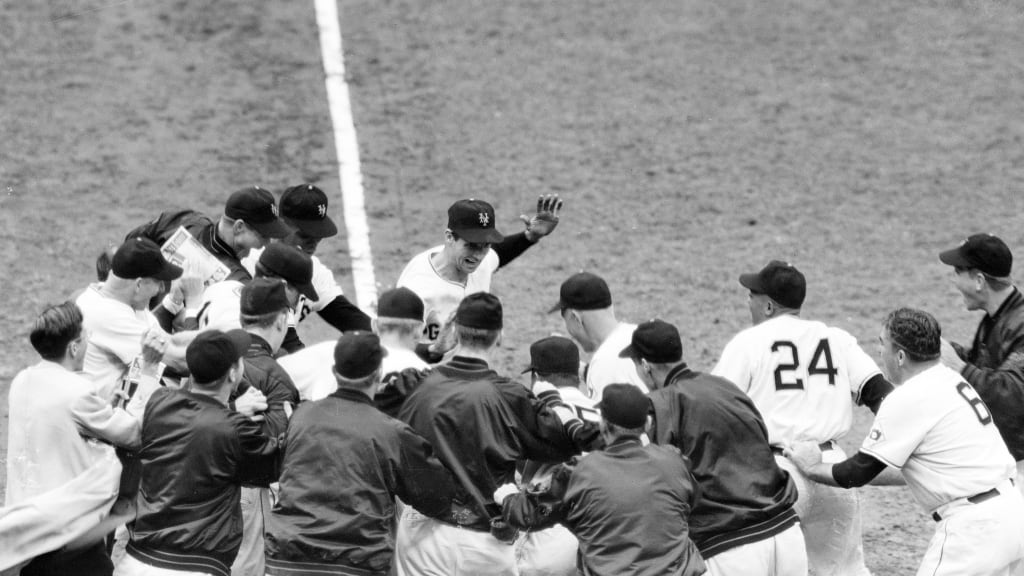
Austin stood on his tiptoes, watching the tiny television. At the Polo Grounds, 34,000 fans were watching, too. Across New York, millions more were following along on the television and radio. By the seventh inning, 90% of the area's televisions were tuned to the game, while the Armed Forces Radio brought the game to U.S. servicemembers around the globe. So, when Bobby Thomson swung against Ralph Branca’s 0-1 pitch and launched a three-run home run to catapult the Giants into the World Series, the message went far beyond the Polo Grounds.
“The Giants win the pennant! The Giants win the pennant! The Giants win the pennant!” Russ Hodges shouted as Thomson rounded the bases. His legendary call was amplified by simultaneous television and radio broadcasts, cementing the contest as the “then-most widely covered event in each medium’s history.”
“That was the first thing I saw, and people were going crazy,” Austin said. “I didn't even realize what it was. From that day forward, I became a Giants fan, and I have not missed a World Series game since 1951.”
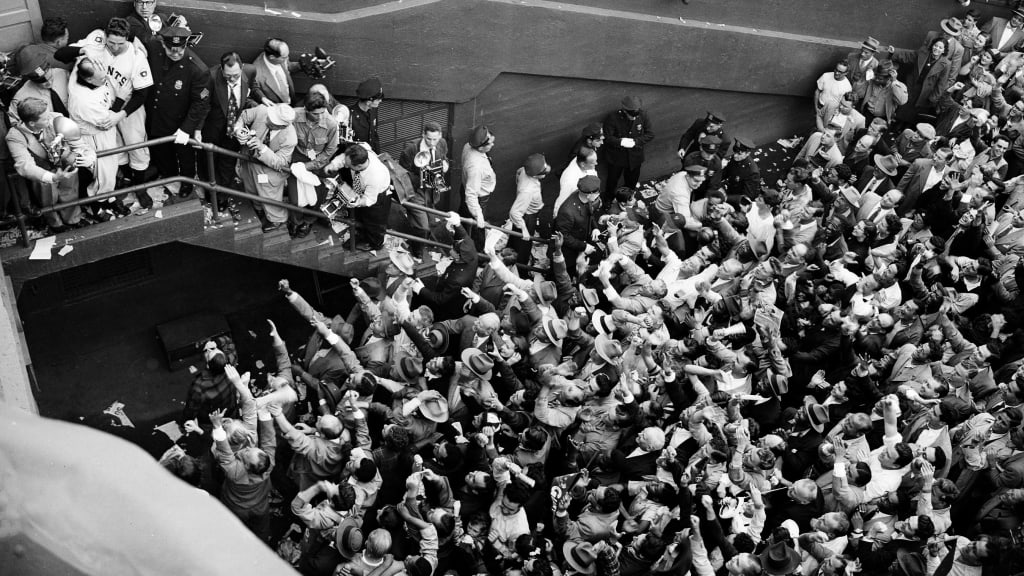
The stands weren’t even full at the Polo Grounds for baseball’s most famous home run. Only 34,320 fans entered the 55,000-seat stadium -- perhaps deterred by a headline in the Herald Tribune on Sept. 28 claiming, “Giants have no tickets! Series oversubscribed.”
Seventy-five years later, with the players gone and most of the fans in the ballpark no longer with us, the memories belong to the fans who were watching and listening from afar. With help from Gary Mintz at the New York Giants Preservation Society, we found people like Bruce Podwal, a then-12-year-old in the Bronx who was getting ready for bar mitzvah lessons when he turned on the radio.
“The radio was on as I’m changing and getting ready,” Podwal said. “I just couldn’t leave, so I heard him hit that home run. Obviously, I was excited.”
Unfortunately for Podwal, while the fans in the park were going wild together, he instead carried the joy alone.
“Nobody was home. My brother hadn't gotten home from school. My father was at work, my mother might have been shopping,” Podwal said. “I was alone, so I now had to walk the three, four blocks to the rabbi's house with nobody to share my feelings. And the rabbi didn't care really.”
Herb Silkowitz was a rare Giants fan in Brooklyn, holding out against his best friend Richie Klayman’s efforts to convert him to the Yankees. The 8-year-old had spent the summer poring over box scores and mirroring his heroes’ batting stances in stickball games, watching as the Giants slowly rose up the standings day by day.
Come Oct. 3, he was ready.
“I went to Cunningham Junior High School, which was right around the corner, so I was home in three minutes,” Silkowitz said. “When he hit the home run, like a lunatic, I ran out, up and down East 16th Street, screaming, ‘The Giants won the pennant! The Giants won the pennant!’ I basically emulated Russ Hodges' call.”
Charles Sachs was another Giants fan who experienced the same thrill across the river in Bayonne, N.J., surrounded by Dodgers fans who had fallen in love with the team's stars like Duke Snider, Gil Hodges and Jackie Robinson.
The Giants, meanwhile, “were a patchwork of not very good ballplayers,” Sachs joked.
As he sat watching, seeing the innings click by and the Giants behind, he worried that the team's late-season sprint would all be for naught.
“It’s terrible to have come so far, to come so close and to not win is a horror,” Sachs said. “I’m sitting there in my folks’ living room, looking at a black-and-white television set, saying ‘I’m going to go outside and these Dodgers fans are going to be all over me like you will never believe.
“Then the miracle happens,” Sachs said.
He grabbed a Turkish towel from the bathroom, ran outside and threw it at his neighbor, friend and ardent Dodgers supporter, Howard Adelman.
“Here, it's a crying towel," Sachs told him. "Go cry.”
The two remain close friends today -- even though Sachs still brings up the moment every chance as he gets.
“He came running out and he was very demonstrative. He threw a towel at me,” Adelman confirmed. “As sad as it was for us, there was a little levity because the Giants deserved to win. They beat [the Dodgers] fair and square. I don't think I ever considered changing a friendship because of the results of a baseball game.”
In New Haven, Conn., 13-year-old Barry Cutler -- nicknamed “Yogi Barry” for his baseball fanaticism as he was always seen carrying a ball and glove with him -- became a neighborhood celebrity thanks to Thomson’s blast. After calling his mother in tears, he walked to the local grocery store.
“All of a sudden, they broke out in cheers as I walked in,” Cutler said. “It was like I hit it, like I was rounding third base and they’re cheering for me.”
He then walked down the neighborhood's main street, receiving applause at the barber shop, the dry cleaners and from commuters on the bus.
“People started waving to me,” Cutler said. “It was like a personal event.”
The contest even helped hook future sportswriting giants, too.
Lyle Spatz, now a Seymour Medal-winning author and longtime SABR chairman, was then a young Dodgers fan who had considered going to the game with a friend, making the long train trip up to the Polo Grounds for the first time.
“I’m thankful I didn’t,” Spatz deadpanned.
Instead, he went to school, getting score updates as he passed friends in the hallways in between classes. Finally, when the bell rang after the last period, Spatz and his friends gathered around a red Emerson portable radio.
“We headed to the stairwell to leave school and it happened,” Spatz said. “I was stunned.”
Jerry Izenberg, who wrote for the Newark Star-Ledger for more than 50 years and has penned more than a dozen books, was early in his career on that day in 1951. He had been indoctrinated into Giants fandom thanks to his father, a dye factory worker, and saw just how a baseball team could help change a person.
“My father’s five years younger all of a sudden,” Izenberg remembered. “I’m rooting for my father.”
Even still, Izenberg couldn't bear to watch with his father that night, the stress would be too much. Instead, he headed to a local college bar he frequented to watch the contest.
“They're losing, and I'm saying, 'Well, that's destiny,’” Izenberg said. “I want to explain to my father that there are three kinds of fans in New York, which was the only three-team city in America. Yankees fans who are all stockbrokers; Dodger fans, who are all crazy; and Giant fans who were the rebirth of Job.’”
But when Adam Pafko looked up at the wall and watched as Thomson’s fly soared into the stands, “Dodger fans were crying, I was jumping around, and my father was ecstatic,” Izenberg recalled.
While Thomson’s home run is the most iconic moment from 1951, that wasn’t the actual end of the baseball season. The victory meant that the Giants then had to face the Yankees in the World Series. In a sign of the baseball gods' sick sense of humor, Thomson even came up in the ninth inning of the deciding Game 6, with two runners on and the Giants trailing 4-2 -- just as they were when he sent Branca’s pitch into the stands and his name into eternity.
This time, however, his fly ball didn't create pandemonium, it was only a sacrifice fly. One batter later, and the series was over: The Yankees were champions, a fact that is almost forgotten today.
“The World Series almost felt anticlimactic,” Cutler said. “After Thomson’s home run, I ran out of adrenaline.”
As the years go on, fewer and fewer people are left who witnessed the most famous home run in baseball history. For them, though, the memory can catapult them directly to another time and place.
“I remember it like I was 14 years old,” Sachs said. “It was a fantastic moment. In my opinion, the greatest baseball moment ever.”
On Saturday, Silkowitz will do what he has for so many decades: He’ll listen to the game once again. The stadium is gone, the players have passed, but as long as there are people left to remember it, the moment will never end.
“I have the three calls on audio tape,” Silkowitz said. “Les Keiter, Red Barber and I have the entire game from Gordon McLendon. The whole day is dedicated just to Bobby Thomson.”