

You don’t have to look too deep into Major League Baseball’s history to find rookies who made big impacts in the postseason.
Just last year, Blue Jays righty Trey Yesavage set a World Series rookie record by striking out 12 Dodgers in Game 5 of the Fall Classic, the perfect highlight in a dominant playoff run in his first full season. Also, Yankees starter Cam Schlittler became the first pitcher in postseason history with eight-plus scoreless innings, 12-plus strikeouts and zero walks in the AL Wild Card Series against the Red Sox. Brewers fireballer Jacob Misiorowski struck out 16 of the 46 batters (34.8 percent) he faced in relief. Both Schlittler and Misiorowski are favored to win Cy Young Awards this year, by the way.
You may have to go a little farther back on the hitting side, but we aren’t that far removed from Rangers rookies Evan Carter and Jace Jung and D-backs star Corbin Carroll pushing their respective clubs to the 2023 World Series.
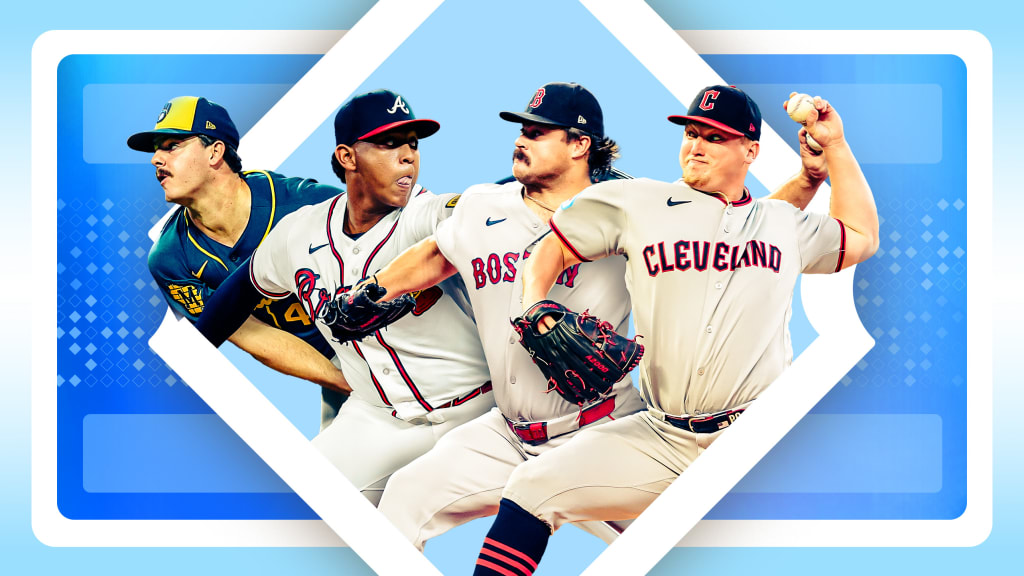
This postseason is a stage for this year’s crop of rookies to show what they can do under baseball’s brightest lights and add their names to this list in the process. For this week’s MLB Pipeline podcast, Jonathan Mayo and I counted down 10 rookies slated to make the biggest playoff impacts this year, and a breakdown of that list is below:
More from MLB Pipeline:
• Top 100 prospects | Stats | Video | Podcast | Complete coverage
10. Spencer Jones, OF, Yankees
With Aaron Judge officially out for the Wild Card Series against the Red Sox, the Yankees will need to find other sources of thump, and for all the concerns about his swing-and-miss tendencies, Jones could provide that thunder. His 94.1 mph average exit velocity was actually a touch higher than Judge’s 94.0, while his 55.1 percent hard-hit rate was second-highest among Yankees (min. 150 batted-ball events) behind only the three-time AL MVP (57.5). Jones, who finished with a .245/.313/.429 line and 11 homers in 86 games, will also need to tighten up his center-field defense to give New York a shot at its first title since 2009.
9. Victor Mesa Jr., OF, Rays
Tampa Bay acquired Mesa from Miami in what seemed like a minor move back in February, and seven months later, he’s a likely starting corner outfielder for this year’s playoff run. The 25-year-old became a 2-3-win player thanks to exceptional defense from the grass (including arm strength that ranks in the 94th percentile) and a solid ability to find the barrel from the left side. His .498 slugging percentage was second-highest among Rays with at least 250 plate appearances; only MVP candidate Junior Caminero’s .524 mark was higher on the club.
8. George Lombard Jr., SS, Yankees
Lombard hasn’t been the model of consistency on either side of the ball since he debuted on Aug. 4, but he heads into his first MLB postseason with some momentum, having gone 12-for-42 (.286) with four homers in his final 10 games of the regular season. He went deep only three times in the first 32 games of his Major League career before that. And while there have been the occasional errors at shortstop, he still has the promising actions, hands and throwing ability to make plays that will be ultimately beneficial to New York’s autumnal push.
7. Bradgley Rodriguez, RHP, Padres
For all the big names on the roster, San Diego’s bullpen is its best postseason asset, and the 22-year-old rookie right-hander has been a big piece of it. His 68 appearances were second-most on the team, and he posted a 2.19 ERA with 81 strikeouts in that time. Rodriguez can show elite velocity with a 97-99 mph four-seamer and sinker, but his 88-91 mph changeup is the star of the show with a .132 average-against and 39.9 percent whiff rate.
6. Brody Hopkins, RHP, Rays
Hopkins’ 92 walks in 94 Triple-A innings were untenable to his chances of debuting as a starter this year, but knowing the quality of his stuff, the Rays transitioned him to the bullpen, where he can focus almost exclusively on his four-seamer and curveball -- both of which may be near top-of-the-scale in pure quality. Hopkins threw the 43 fastest pitches of the season by a Rays pitcher, topping out at 101.8 mph, and his curveball averaged 87.1 mph -- 6 mph faster than the average MLB deuce. (He also has a mid-90s cutter.) If Hopkins can stay over the plate, he could be this year’s version of 2008 David Price for the Rays.
5. Chase DeLauter, OF, Guardians
An inability to stay healthy in the Minors always made DeLauter a tough rank in the Top 100 as a prospect. Well, he played 133 games and got 559 plate appearances with the Guardians in his rookie season, so that’s a positive development. He hit .287/.363/.457 with 16 homers and 11 steals in that time, and his 131 wRC+ was the best on the team, beating out Steven Kwan (114) and Travis Bazzana (110). DeLauter, who has rotated between right field and DH, is no stranger to the MLB postseason either, having debuted in the Wild Card Series last year.
4. Didier Fuentes, RHP, Braves
At just 21 years old, Fuentes may well still have a future as a starter for Atlanta, but he stuck as a reliever this year in a “if it’s not broke, don’t fix it” way. Throwing his 96-99 mph four-seamer 69 percent of the time, his 31.0 percent strikeout rate was 10th-best among 213 Major Leaguers with at least 70 innings this season, placing between Cam Schlittler (31.4) and teammate Chris Sale (30.9). The 6-foot right-hander gets above-average extension to get right on top of hitters with that heater, and his mid-80s slider and 88-90 mph splitter (the latter reserved solely for lefties) give him other options to get high-leverage outs at a young age.
3. Logan Henderson, RHP, Brewers
A 103-win team might turn to a rookie right-hander as its No. 2 starter, and it would be right to do so. Henderson’s 0.84 WHIP was second-lowest in the Majors (min. 90 IP), while his 2.47 ERA ranked fifth and his 24.5 K-BB% sixth. His four-seamer plays plus despite average velocity because of its flat approach angle, and his low-80s changeup is another weapon with huge armside run and good velo separation.
2. Payton Tolle, LHP, Red Sox
If this was based on vibes alone, the Boston southpaw would be No. 1, as Tolle has become a fan favorite across New England. The Sox are trusting him as their Game 1 starter against the Yankees after he posted a 3.03 ERA and ranked third among rookies with 171 strikeouts over 148 ⅔ innings. Tolle’s standout trait is his elite extension of 7.4 feet, and he throws mostly heat with a concentration on his 95-97 mph four-seamer, 94-96 mph sinker and 87-90 mph cutter. It’ll be an uncomfortable at-bat for the Yankees and anyone else in Tolle’s path this fall.
1. Parker Messick, LHP, Guardians
There’s a good argument that Messick is a Top 10 (at minimum) starter in the sport right now, regardless of the rookie designation. His 4.9 fWAR placed ninth among pitchers, while his 6.3 bWAR was fifth-best after he finished with a 2.56 ERA, 1.06 WHIP and 193 strikeouts in 186 ⅓ innings. The 6-foot southpaw avoids barrels with a six-pitch mix and exquisite command, and he even runs slightly reverse splits with a .599 OPS-against versus righties this season and a .689 OPS-against versus his fellow lefties. Gavin Williams is also in the Game 1 starter conversation, but Messick looks the part of Cleveland’s present and future ace.