

The biggest name the Cubs acquired at the Trade Deadline is probably Kevin Gausman, who once was the No. 4 overall pick in the Draft, who has garnered Cy Young votes in three different seasons and who started two World Series games last year. Maybe you prefer Clay Holmes, a two-time All-Star as a reliever who moved into the rotation last year to great success – and who himself appeared five times in the World Series the year before Gausman did. Perhaps even David Peterson, acquired a few weeks ahead of the Deadline, who himself was an All-Star just last season.
They’ll all help a rotation that badly needed it. But allow us to present the most interesting name – and not just because any name that starts with a “Z” is, by default, cool. It’s reliever Ryan Zeferjahn, formerly of the Angels, and not even their closer at that. The six career saves will inspire no songs, nor will the 3.94 ERA. By the surface stats, he’s just a guy. By everything else? He might be, in baseball parlance, a Guy.
That’s in part because he throws hard (97 mph), a badly needed skill on a Cubs team that mostly does not. Slightly less than 25% of Cubs four-seamers and sinkers are 95 mph or more; this is by far the lowest figure in the Majors. Seattle, to give the best example, has three times as many as the Cubs.
Lots of guys (or Guys) throw hard, though. Plenty of relievers strike out one-third of the batters they’ve faced, as Zeferjahn has. Were you to know nothing else than, “hard-throwing 28-year-old reliever with bat-missing stuff who can’t be a free agent until 2031,” you’d find it a worthy add.
But despite the lack of name value, Zeferjahn was flashing a pretty serious fastball. For example: How does “lowest batting average against and slugging against of any pitch type” strike you? Particularly ahead of star-studded names like this.
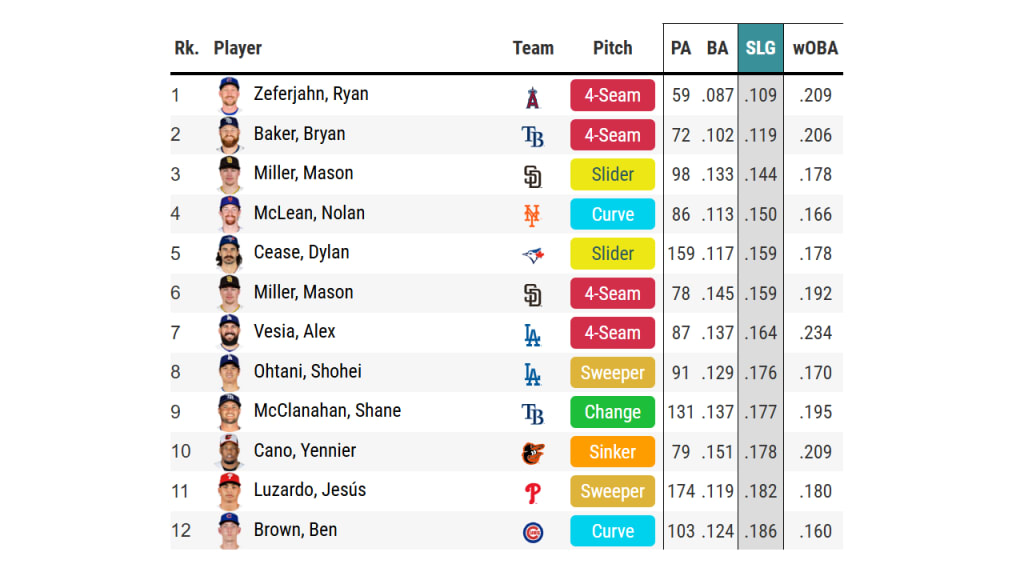
That’s what happens when a pitch you have thrown 310 times this year turns into a measly four base hits, only one for extra bases. (Even that, off the bat of Elly De La Cruz, probably should have been caught or scored an error.)
Let’s get even a little deeper, then. Statcast’s latest bat tracking metrics can tell you which pitchers miss the bat by the most – that’s still Mason Miller, shockingly – and which pitchers make batters generate the highest rate of late swings. No one does the latter more than Toronto’s outstanding Tyler Rogers, who throws off the timing of hitters by throwing underhanded slop from beneath the ground. Just behind him is impressive Minnesota rookie Kendrys Rojas, who cost the Twins ace reliever Louis Varland last year. Third? Zeferjahn.
If you can look at who’s making batters swing early or late, you can look at who’s making them swing under or over the ball, too. No one in baseball is getting more misses under the baseball than Zeferjahn, and yes, any time you are Number One on a list and Jacob Misiorowski is Number Three on that list, you know you’re doing something right.
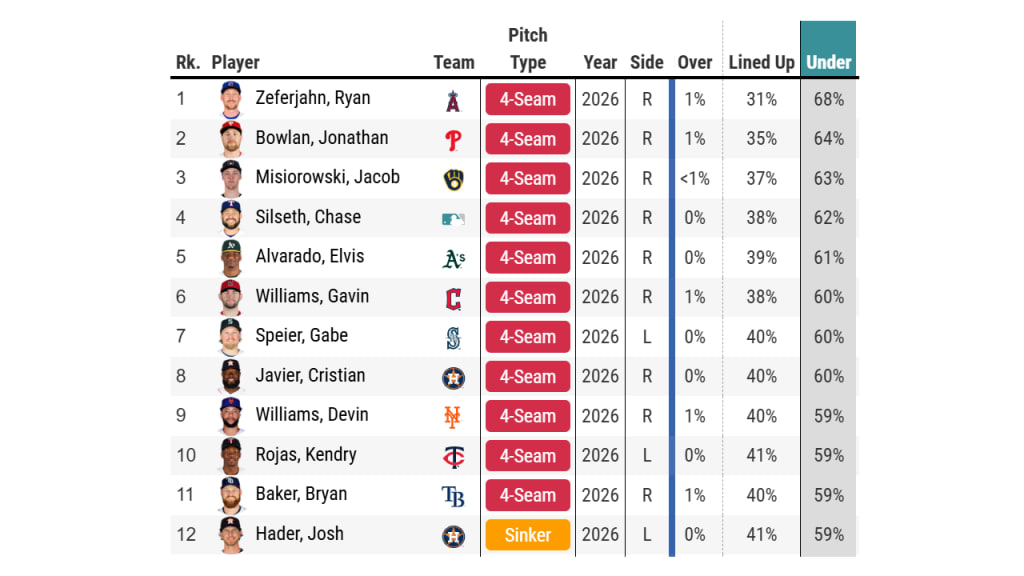
That four-seamer ranks third behind Misiorowski and Miller in whiff rate, yet it’s not really because Zeferjahn has that elite rising action fastball that you’d expect to see here. Instead, it has more of a spin-inefficient cutting effect, which has been very much the Cubs’ style lately. (Braxton Garrett, another Deadline acquisition, doesn’t throw anywhere near as hard, but also has that movement profile.) It is, however, beloved by "stuff" models like Stuff+, which has this as the seventh-nastiest fastball in 2026, which again is a list that is stopped by Misiorowski.
You can see that in action with this timid swing he got while striking out Isaac Paredes.
If anything, it seems like it might be because Zeferjahn's fastball isn’t even his primary pitch.
That’s his sweeper, which he has thrown far more this year since phasing out his old cutter as 2025 went on, and which currently rates as the third-most valuable sweeper in the game, and has the fourth-highest whiff rate. We’re not going to show you yet another leaderboard, yet know this: the top two names for sweeper value are Jesús Luzardo (who was an All-Star) and Shohei Ohtani (who is Shohei Ohtani). When he’s doing it right, it looks like this.
That all sounds wonderful, and you’re wondering why Zeferjahn wasn’t already a household name – though here we provide credit to Ben Clemens of FanGraphs, who was on this more than a year-a-half-ago, correctly describing him as “basically unhittable and largely anonymous.”
Here’s the thing, though: Zeferjahn had a pretty serious problem, one that limited his upside with the Angels. Right, that is, until he didn’t.
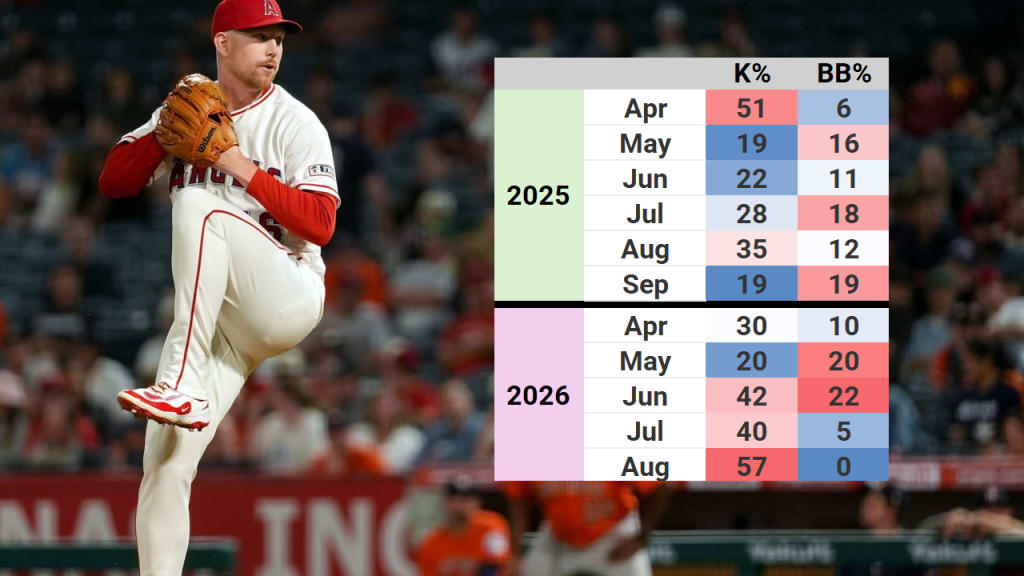
Last year, Zeferhahn walked too many hitters, a hefty 13.6%. That’s too many; it was the seventh-highest of any pitcher with 50 innings. This year, he's walked too many hitters, too. Through the end of June, that had shot up to 17% of hitters, which was the second-highest of any pitcher with 50 innings.
That’s an enormous issue, one that if not resolved doesn’t just limit your effectiveness; it tends to end your career. It’s a minor miracle he’d even made it this far given that this was a problem even in the Minors, too. Do note that in Double-A in 2023, he walked an incredible 20% of batters. That was the fifth-most at that level. No one ahead of him, or even anywhere close beneath him, has had much Major League success. It basically can’t happen.
It was a big problem, until it wasn’t. In July and August, Zeferjahn made 11 appearances. He walked two hitters. That’s a 4% walk rate, miles beneath what it was, and at the same time, he was whiffing batters endlessly, striking out 42% of hitters he faced, ninth-best on a July/August list that includes Misiorowski and Miller in the top three. We simply have to break this out into monthly table form to show you what those numbers look like.
How, then? It’s actually not what you’d expect, that likely being “throw more strikes,” because he’s not really hitting the zone more. It’s a small amount about getting more chase, though he’s generally been pretty poor at that. Instead, it simply seems to be the old idea of “you can’t walk anyone if you dominate them off the field before it comes to that.” Last year, Zeferjahn had a 30% swing-and-miss rate. This May, that was 26%. This July, it was 43%.
It’s surely not a coincidence, we imagine, that he moved to the third-base side of the rubber around the same time, changing the look and making things extremely hard on righty hitters.
Zeferjahn isn’t a household name, nor the one who will get the most notice among even just pitching acquisitions by his new team. But it’s hard not to notice how many times we’ve referenced Miller and Misiorowski, either. Over the last two years, he’s been one of the game’s better bat-missing relievers. Over the last six weeks, as he’s reined in his walk problem, he’s simply been one one of the best pitchers in the sport. (By a very simple metric of strikeout rate minus walk rate, he’s sixth, where the M & M boys along with Zack Wheeler are three of the five names ahead of him.)
The focus, understandably, was on the issues the Cubs had at the start of games on the mound. It might just be that their most impactful arm added here is the one you’ll see at the back of games – quite possibly in October.