

Shohei Ohtani just spent the better part of two months getting outslugged by Chandler Simpson, which -- no offense to Simpson -- should never happen.
But when your knee hurts and your arm hurts, well, it might just mess with your swing, even if it's a four-time MVP-caliber swing. And Ohtani's was all out of whack.
We all saw it. It was the power outage heard 'round baseball. Between Aug. 19 and Oct. 14 (that's through Game 3 of the National League Championship Series), 345 Major League players hit at least one home run. Ohtani wasn't one of them.
This would all be a pretty big cause for concern for the Dodgers going into 2027 -- their best player ending his season on a whimper, not catching up to any fastballs, not driving the baseball, not looking healthy at all -- EXCEPT … there was that one swing.
In what turned out to be the Dodgers' last game of the year, Game 4 of the NLCS, Ohtani's swing finally came back. It was just one swing, but it was a big swing: His first home run since Aug. 18, and a loud home run, off the Brewers' Dustin May.
What can one swing really tell us about the state of Ohtani's bat heading into next season? Well, it makes us think that Shohei is a lot closer to his usual self than he looked like for most of the playoffs. Here's why.
How hard he hit it (113.1 mph)
Ohtani's home run was the second hardest of the postseason, and it was also the hardest one he'd hit since the first half of the year -- you know, back before his injuries had sapped him of his elite power. The last homer Ohtani hit harder than his NLCS blast was on June 20. When Ohtani is right, he reaches those upper echelons of exit velocity with ease.
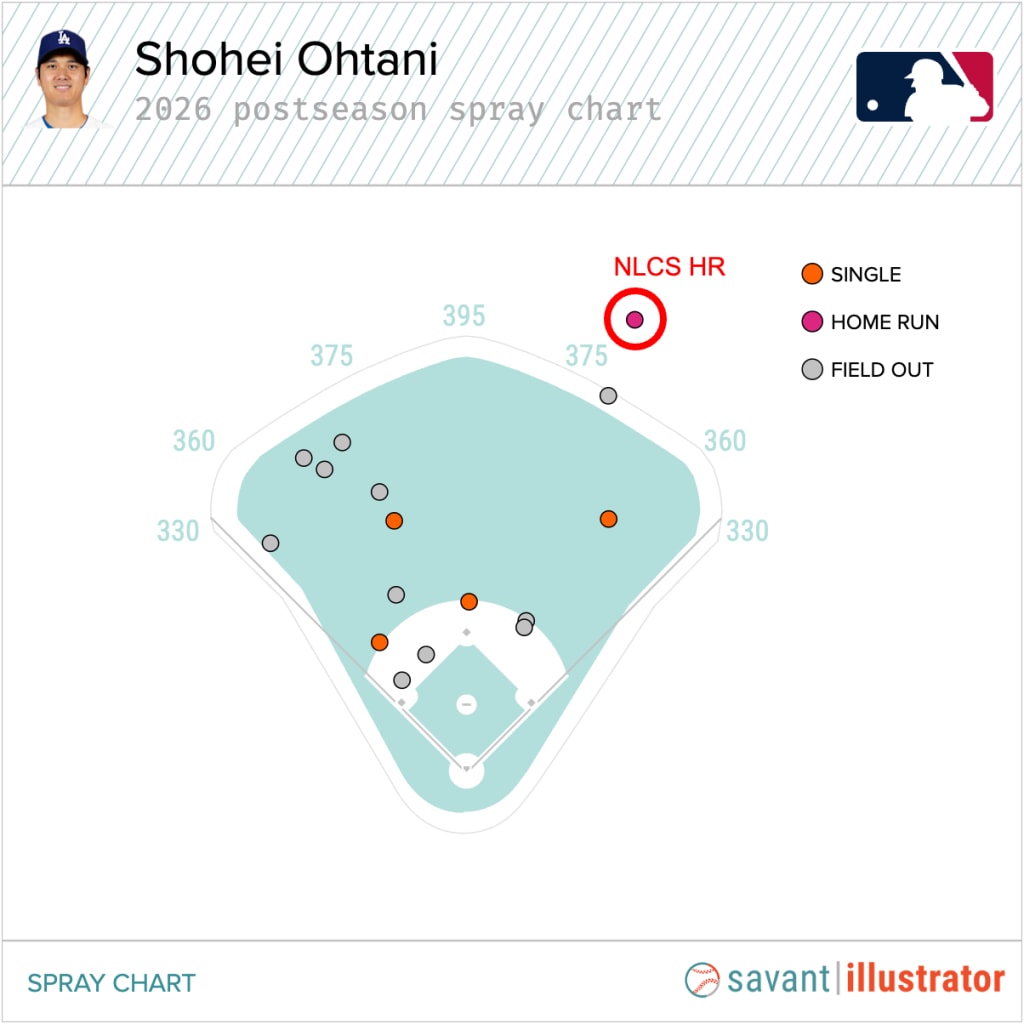
Where he hit it (to the pull side)
Ohtani normally has incredible all-fields power. He doesn't rely on pulling the ball to hit homers like some hitters. In Dodgers terms: He's more like Freddie Freeman than Mookie Betts. So why does it matter that this home run was crushed to right-center field? Because Ohtani wasn't driving the ball to the pull side at all before that. He might not rely on pull power, but he has elite pull power (Exhibit A: His Greatest Game Ever Played from last year's playoffs), and if that disappears, something's wrong.
Up until Game 4 of the NLCS, Ohtani had the highest opposite-field rate of any hitter in the playoffs, ahead of guys like Brice Turang and Steven Kwan and Simpson. That's not where he wants to be. Hitting the ball to the opposite field isn't bad (just ask the world champion Brewers), but Ohtani doesn't want to be going oppo that much -- especially because it was mostly either soft contact or popped-up contact. For a hitter like Ohtani, going to the opposite field weakly is bad. Seeing Ohtani pull the ball with authority, on the other hand, is good.
The pitch he hit (a 95.1 mph cutter)
Ohtani wasn't catching up to anything for most of the playoffs. As Mike Petriello explained when he broke down Ohtani's slump, there was a big red flag in his swing timing: He was late against fastballs more often in October than in any other month of his Dodgers tenure, and really, the problem extended back to the start of his slump in August. Ohtani couldn't handle velocity. From Aug. 19 through Game 3 of the NLCS, he was batting .067 against pitches thrown 95 mph or faster, and striking out a third of the time. So it's encouraging to see a home run swing like this one, where Ohtani turned on a 95-plus mph pitch on the low-inside corner and got the barrel to it.
The contact point he got to (2 inches in front of the plate)
This goes hand-in-hand with the late swings and weak opposite-field contact. Ohtani was letting the ball get too deep. Now, even when he's hot, Ohtani always likes to let the pitch travel, and he still has the top-tier bat speed to drive the ball to left-center. That's why he has such rare all-fields power. But in the 2026 postseason, ahead of Game 4 of the NLCS, Ohtani's contact point was more than nine inches behind the front of the plate.
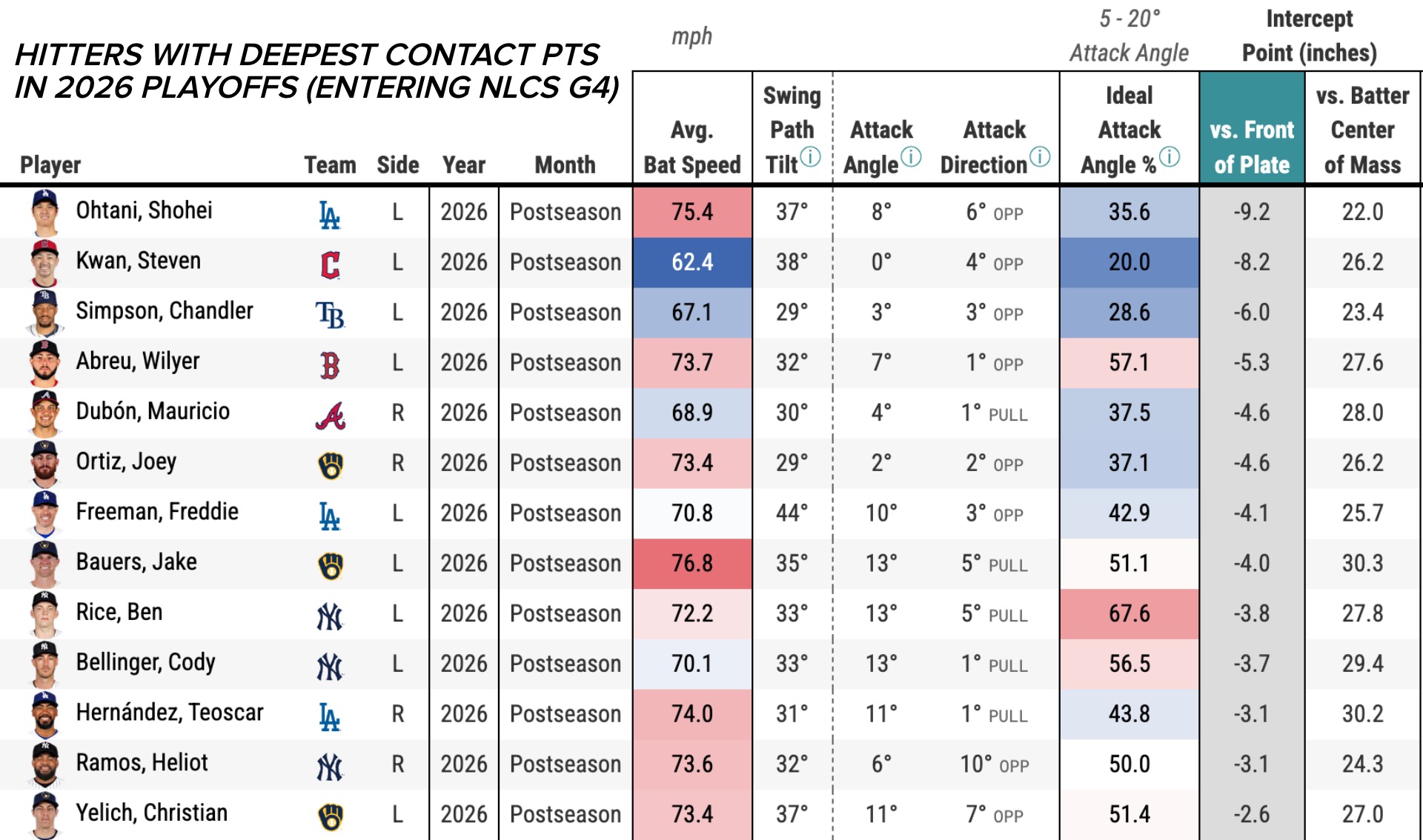
That's just too extreme. It was his deepest contact point of any month as a Dodger, the deepest of any hitter in the playoffs. With a contact point that deep, Ohtani wasn't able to generate the bat speed or vertical angle in his swing to do damage. On that home run swing, though? Ohtani hit the ball 2 inches in front of the plate. Hitting the ball out front gives your barrel the time it needs to reach its peak speed, and lets you catch the pitch at the point where your swing is moving upward at the right angle to smash it in the air. Hence, a big home run for Shohei.
The bat speed he reached (81.7 mph)
See above. The proof is in the bat speed. Ohtani's better swing timing and contact point allowed him to generate an elite 81.7 mph bat speed. A "fast swing," by Statcast's definition, is 75 mph or better. So an 80-plus mph swing is, well, extremely fast. Ohtani's bat speed on his NLCS home run was his highest on a homer since June 22, almost four months prior. When we're seeing Ohtani connect with the baseball with bat speeds like that, we know his swing is in the right place.
Are we overanalyzing one home run? Maybe! But we think that one home run was a harbinger of what's coming next year: the return of MVP-level Ohtani.