

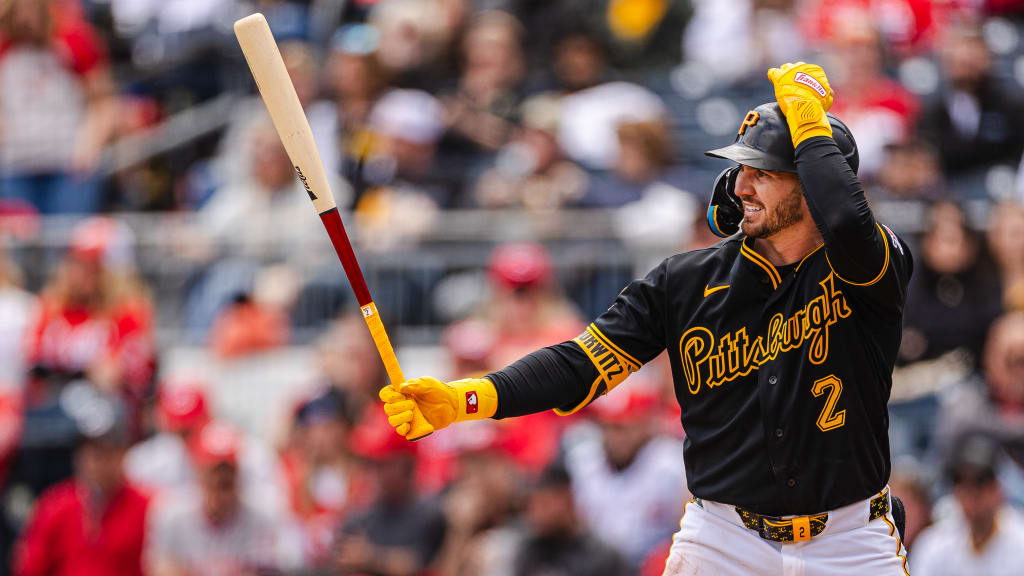
ST. LOUIS – Spencer Horwitz leaned against a wall outside of the visitors’ clubhouse at Busch Stadium and couldn’t help but chuckle at the premise.
“The last 24th-round pick in Blue Jays history,” Horwitz said. “Take that to the grave, I guess.”
It’s the perfect encapsulation of Horwitz, the consummate underdog and someone with a higher OPS than Bryce Harper, Freddie Freeman, Bobby Witt Jr., Vladimir Guerrero Jr. and several other elite hitters since 2025 MLB All-Star Game … but you’d never know it.
Not by his unassuming stature.
And certainly not by his deep-down draft position.
Oh, and Horwitz played college baseball at Radford University because it was his one-and-only offer.
“I was just happy to get a chance,” Horwitz said. “I remember going to college thinking, ‘Maybe I’ll play a year. Maybe I won’t be good enough for college. … But I just kept going. I’ve been riding it ever since.”
All the way to an impressive place, even that’s often overlooked or underappreciated.
From July 18, 2025 through Thursday morning, Horwitz had an .875 OPS. That’s 15th-best in MLB among 139 qualified hitters. Among the others looking up at Horwitz: Julio Rodriguez, Ian Happ, Jose Ramirez, Cody Bellinger and Mike Trout.
When it comes to wRC+, another all-encompassing stat where 100’s considered league average, Horwitz checks in at 145 since the most recent All-Star break, good enough for 14th and directly below Junior Caminero.
“I’ve been underappreciated at different parts of my career,” Horwitz said. “But I believe there’s always an MLB spot for hitters. If you can hit, you can stick around.”
Horwitz certainly isn’t in danger of losing his spot. But how did we get here?
‘Always a chance’
Horwitz grew up in Timonium, Md., located about 25 minutes north of Baltimore. The Orioles weren’t very good when Horwitz was a kid, but he loved them anyway.
Naturally, Nick Markakis was one of his favorite hitters to watch, someone with a shorter frame but a lefty with gap-to-gap power. From 2007-10, when Horwitz was really getting into baseball, nobody in the sport had more doubles than Markakis (181).
“He could hit it all over the park,” Horwitz said of Markakis, who accrued 33.7 wins above replacement (per Baseball Reference) but never hit more than 23 homers in a season.
Horwitz also gravitated toward hitters like Michael Brantley and early Matt Carpenter, guys who could drive the ball and find gaps without an Aaron Judge-like power profile.
In high school, Horwitz played baseball and hockey at St. Paul’s School for Boys. The baseball team was small, rostering just 16 players, but Horwitz also saw LaMont Wade Jr. and Steve Johnson carve out MLB paths for themselves.
If they could do it, Horwitz thought, why couldn’t he?
“Those guys inspired me to know there’s always a chance,” Horwitz said.
When Horwitz arrived at Radford, he wasn’t sure what to expect. Baseball in Virginia was supposed to be excellent. In the back of his mind, Horwitz worried he might be overmatched.
But starting with his first college practice, Horwitz realized he belonged.
“It was pretty eye-opening,” he said. “I was surprised how my abilities translated.”
Horwitz got a chance to start the second game of his freshman year and never looked back, slashing .311/.384/.481 that season and becoming a freshman All-American.
The next year, Horwitz led the team in most offensive categories and ranked seventh in the Big South Conference in RBIs (43). He left Radford having slashed .288/.387/.462, solid numbers but also nothing that led pro teams to trip over themselves in the MLB draft.
However, the impression of Horwitz changed when he joined the Blue Jays organization.
‘Try to do it all’
“I’m gonna have a talk with him,” Pirates hitting coach Matt Hague said at the end of an interview, feigning disgust. “Apparently he lowered his standards.”
The numbers in question are .800 and .900. They relate back to the time Horwitz and Hague spent together with the Blue Jays.
With Double-A New Hampshire in 2022, Triple-A Buffalo in 2023 and then the Major League club in 2024, Horwitz and Hague grew close. Hague was also one of the Blue Jays coaches who challenged Horwitz with consistently producing a high OPS.
“You got a little prize if you got a .900 OPS,” Hague explained. “When he got there, he definitely wore the gifts we gave them.”
One was a “.900 Club” T-shirt.
“It was all the time!” Hague said. “So, it’s a little surprising to hear he’s lowered his standards.”
It’s all in good fun, the two going back and forth, but there’s a mathematical reality here: As a Blue Jays farmhand, Horwitz believed a stat like OPS could finally summarize or express his hitting style appropriately.
And that he could carve out a career for himself if that number looked a certain way.
Which is why Horwitz remains steadfast in his approach, willing to take his walks or drive the ball to gaps, whatever pliability it requires to remain productive, never selling out too much for home runs and refusing to get outside of a specific plan even if it results in outs.
“I quickly learned that if you can get to an .800 OPS, you’re gonna play a long time,” Horwitz said. “Whether you’re a 24th-round pick or a first-rounder, if you have an .800, you’re gonna be pushed [up in the Minor Leagues].
“That’s something the Blue Jays preached to us: OPS is super important. But they also preached there are different ways to get there.
“I’ll have a week of base hits, a week with a lot of walks or a week with four homers. I just try to do it all. Whatever’s working in that timeline, ride it.”
‘He’s a pure hitter’
From Hague’s perspective, Horwitz has been able to “ride it” for a few different reasons. First and foremost, he’s efficient with the movements in his swing and controls the zone well.
Instead of long levers or an elongated load, Horwitz is much more compact.
The second thing is more between the ears. Hague sees a hitter who’s “an expert game-planner” and has “a high attention to detail.” That pays off when failure inevitably creeps in; Horwitz knows how to stick to what makes him effective.
“When he’s clicking and moving well, he can put up power numbers in a hurry,” Hague said. “That speaks to his attention to detail and the swing maintenance that he puts in. He’s a pure hitter.”
If you visit Horwitz's Baseball Savant page, you won't see gaudy exit velocities or crazy barrel or hard-hit numbers. He's actually not above the 11th percentile in any of those this season. However, he's in the 89th in percentage of pitches squared up (32.1%), as well as chase (72nd, 25.4%) and whiff rates (92nd, 15.4%).
Those process numbers have led to excellent results when it comes to walks and strikeouts; Horwitz has actually a higher walk rate (14.8%, 89th percentile) than he does percentage of strikeouts (14.2%, 89th).
“There’s a lot of quality contact,” Hague said. “He can get on base. He can do a lot of the small things really well. I think that’s overlooked sometimes.
“But I think on our team, he’s very valuable.”
That’s nothing new for Horwitz, a player with one college offer who was drafted in a round that no longer exists. Being overlooked has been part of his game for a long time.
Just don’t expect Horwitz to worry too much about it.
“I don’t care,” he said. “That’s not for me to say. I’ve always tried to be that complete hitter, the guy where you can’t do anything to get him out.
“At the end of the day, I’m just trying to do whatever I can to help this team win.”
Jason Mackey: Jason.Mackey@pirates.com and @JMackey_PGH.