

When Spencer Strider made his 2026 debut in Colorado at the beginning of May, returning from a left oblique muscle strain, he made a distinct declaration after giving up three runs on four hits while walking a career-high five batters in the Braves’ 11-6 win.
“I don’t want a participation trophy,” Strider said.
Despite Strider walking away unscathed with no-decision against the Rockies, the 2023 All-Star believed that he fell short of his lofty standards with his comeback to a beleaguered Atlanta rotation that has faced injuries and shifting structure on its way to the best record in the Majors. In the three starts since his return, Strider has pitched as though he’s got something to prove. Over the past 17 2/3 innings, he has allowed just four runs (2.04 ERA), striking out 21 batters while walking seven, notching a 0.85 WHIP during that stretch.
Small sample sizes and slight speed bumps aside, there are encouraging signs that support the optimistic idea in the Braves’ organization that Strider’s return will only help to bolster the club’s staff. Ahead of his fifth and final start in May on Tuesday (6:45 p.m. ET, MLB.TV and TBS) -- and his second career outing at Fenway Park -- here some notes on the righty’s first month back on the mound:
He’s sporting an increasingly diverse pitch mix
When Strider was the Majors’ sole 20-game winner in 2023, while leading all pitchers with 281 strikeouts, the right-hander bowled down lineups with heavy four-seam fastball usage. He threw the heater 58.9 % of the time with an average velocity of 97.2 mph, pairing it with a steady diet of sliders (33.8% usage) that hummed along with an opposing batting average of .154. However, that was three years and one UCL internal brace surgery ago. When he came back and struggled, batters could reliably sit on one of his two main pitches, neither of which were very effective. Working with a lowered fastball velocity and managing control issues that surfaced in 2025, Strider is evolving to fit his new reality.
In his first four starts in 2026, Strider is throwing his four-seam fastball less than half of the time (48.3%, the lowest mark of his career), with its velocity sitting well below his past flamethrowing standard (95.3 mph, also the lowest mark of his career). But he seems to have more belief in his tertiary pitches, namely his curveball and changeup, both of which have had their usage increase compared to his ‘25 arsenal. While being almost completely deployed against left-handed hitters -- Strider has only thrown two changeups and nine curveballs to right-handed batters, per Statcast -- they’ve morphed into effective tools that opponents have to respect at any point in an at-bat. Entering Tuesday, Strider had yet to allow a hit on his changeup (31 pitches), with its whiff rate at 69.2%, which would be the highest of any pitch in any year of his career.
The slider is still king
Strider may not call upon it as much -- 27.1% use in his first four 2026 appearances compared to a 35.3% mark in ‘25 -- but his signature pitch from when he racked up 483 strikeouts from 2022-23 sure does still work. Opposing hitters are batting just .067 against his slider, with an xBA that’s even lower and a miniscule xwOBA to boot (.198). It’s tied with the curveball as his most common put-away pitch with nine strikeouts.
It doesn’t seem to matter that the induced vertical break (IVB) on Strider’s slider has 3.6 inches of less drop than the average right-hander this season, or that its velocity hovers around a similar mark to that of the most frustrating year of his career in 2025. What’s encouraging is that the slider seems adept at both missing barrels (16.7% hard-hit rate) and bats as a whole (48.8% whiff rate), especially considering that it has been his bread-and-butter since he broke onto the scene in ‘22.
Going back to the well
Opposing teams in May have stacked their lineups against Strider with lefties, with 53 of his 82 plate appearances coming against left-handed hitters. Strider’s remedy? Pound pitches into their back foot. And it’s been remarkably effective so far.
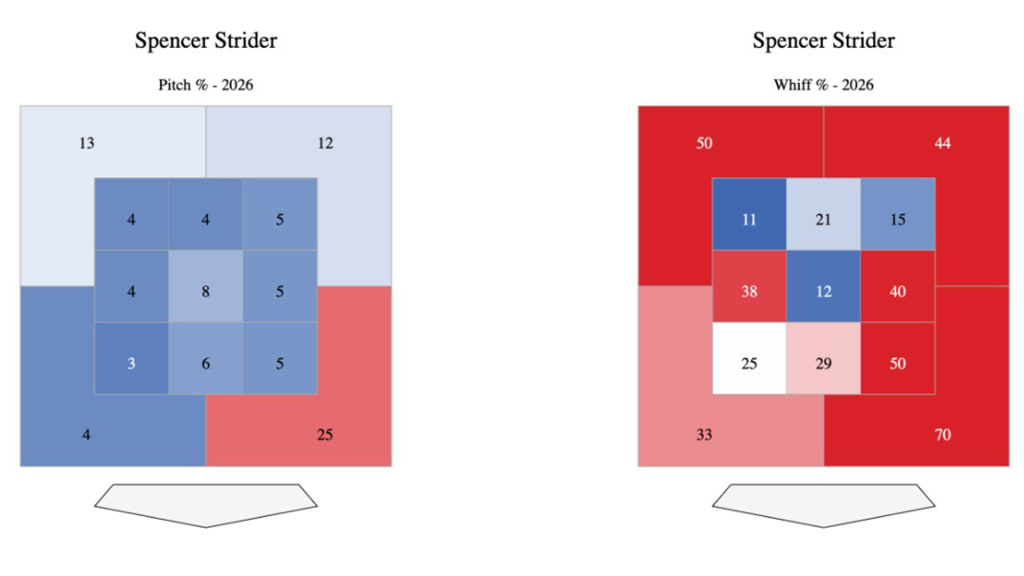
According to Statcast, 25% of Strider’s pitches entering Tuesday have landed outside of the zone, in the lower quadrant closest to the left-handed batter’s box. These pitches have produced a 70% whiff rate, allowing just one hit while notching racking up eight strikeouts (the most of any zone). While it does contribute to the fact that he’s landing fewer pitches within the strike zone early on than in years past (he’s walked two or more batters in each of his first four starts), he’s getting hitters to bite on his offerings, which may be the clearest indicator that Strider may be back.
In 2023, Strider’s chase rate skyrocketed to 34.5%. In his much-maligned ‘25, that mark plummeted to 28.9. So far this season, his chase rate sits at 29.4%, approaching the 30% plateau that’s turned into a white whale throughout his career.