

Two games, or even three, is not a large enough sample size to draw any conclusions.
But we can glean a few insights from the past few days of postseason baseball -- stuff that actually matters and could even be a harbinger for things to come in the Division Series.
With that in mind, here are four Statcast takeaways from the Wild Card Series, with a tidbit that might prove meaningful for each advancing team.
White Sox: Jordan Hicks leads a flame-throwing bullpen
Every year, fastball velocity rises in October. The White Sox are the early poster child for that trend in 2026.
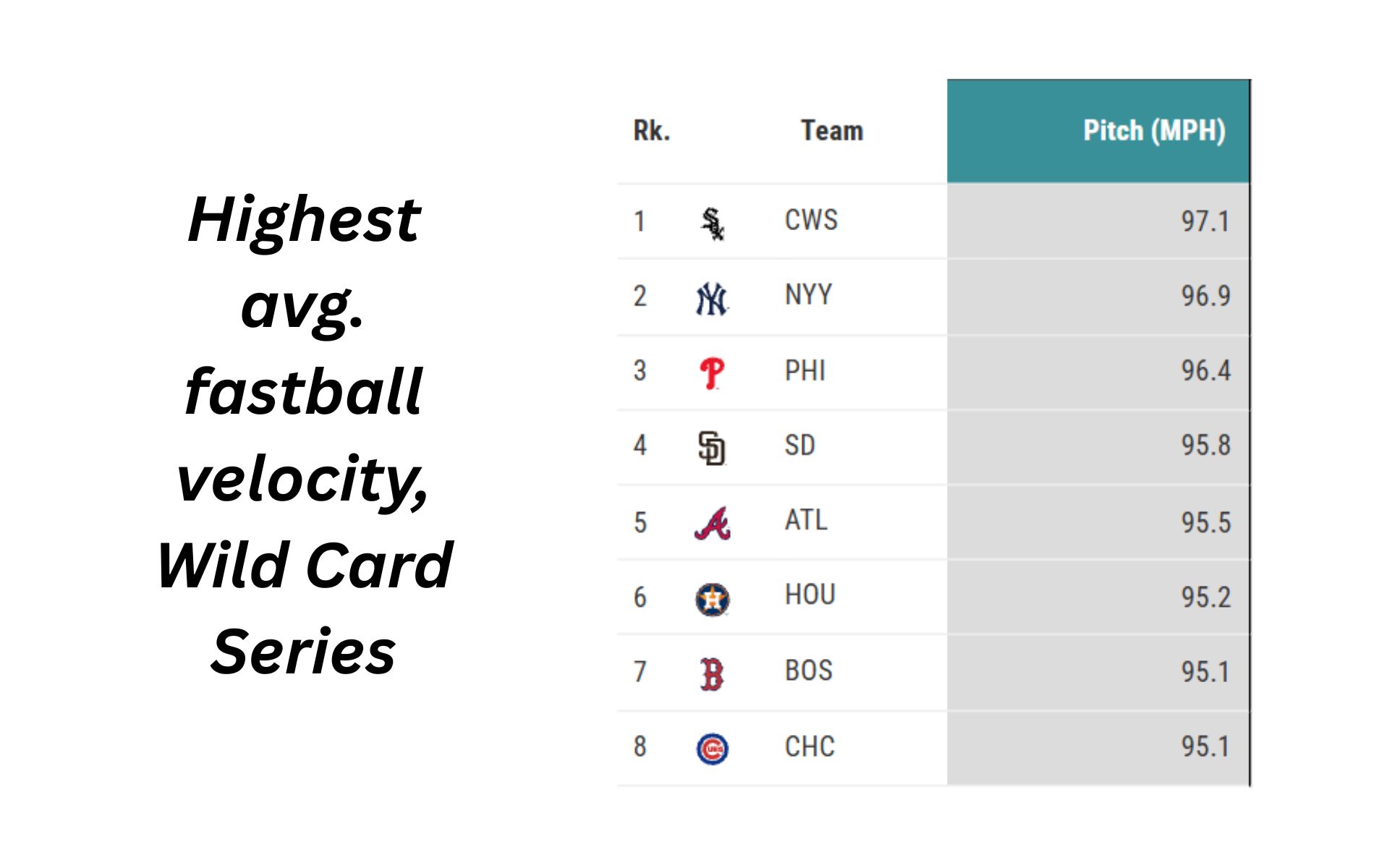
In the regular season, Chicago's pitching staff combined for an average fastball (four-seamers and sinkers) velocity of 94.7 mph, tied with the Yankees for ninth fastest in baseball. That shot up to 97.1 mph in the AL Wild Card Series, the fastest of any team in the postseason thus far.
Hicks brings a lot of this heat. The 30-year-old right-hander sat at 100.1 mph with his four-seamer and sinker, harder than every pitcher in the Wild Card Series but Mason Miller and Jhoan Duran. Hicks dominated the Astros, needing just 38 pitches to retire all 10 batters he faced across two outings. He threw 15 pitches 100+ mph, with three of his four strikeouts coming on 99.9+ mph fastballs.
Hicks is famous for throwing hard, so perhaps none of this is all that surprising. But Hicks did not have his fastball earlier in the season. He rediscovered his best pitch while on the IL with a lat strain in June, raising his arm slot by 10 degrees to adopt a more traditional three-quarters slot. That's a significant midseason change, and one that drastically altered his fastball shape, leading to more vertical movement. His four-seamer gained over six inches of Induced Vertical Break, or "rise," from April to September. Paired with elite velocity, it is exceptionally difficult to hit -- just ask the Astros.
Since June 21 -- the day Hicks came off the IL -- he has the fifth highest strikeout rate (38.0%) in baseball, among pitchers to throw at least 30 innings. All of this comes off the heels of 2025, when Hicks' strikeout rate (18.5%) dipped to a career low. His performance in Houston had the makings of a playoff X-factor.
Yankees: Ben Rice continues to mash fastballs
Rice is one of baseball's best hitters because he feasts on fastballs. The slugging first baseman led all qualified hitters in slugging percentage (.843) and batting run value (+24) against four-seam fastballs. If we define "fastballs" as four-seamers and sinkers, Rice still owns the highest slugging percentage (.668), 50 points higher than the second-highest mark.
Rice is especially adept at crushing high fastballs, the sort of elevated heat that stifles so many hitters. In 2026, he posted an .853 SLG against fastballs in the middle of the strike zone or higher, once again the best in baseball (min. 50 PA ending in elevated fastballs).
And in the AL Wild Card Series, Rice rapped out five hits -- all with 95+ mph exit velocity -- and all against fastballs.
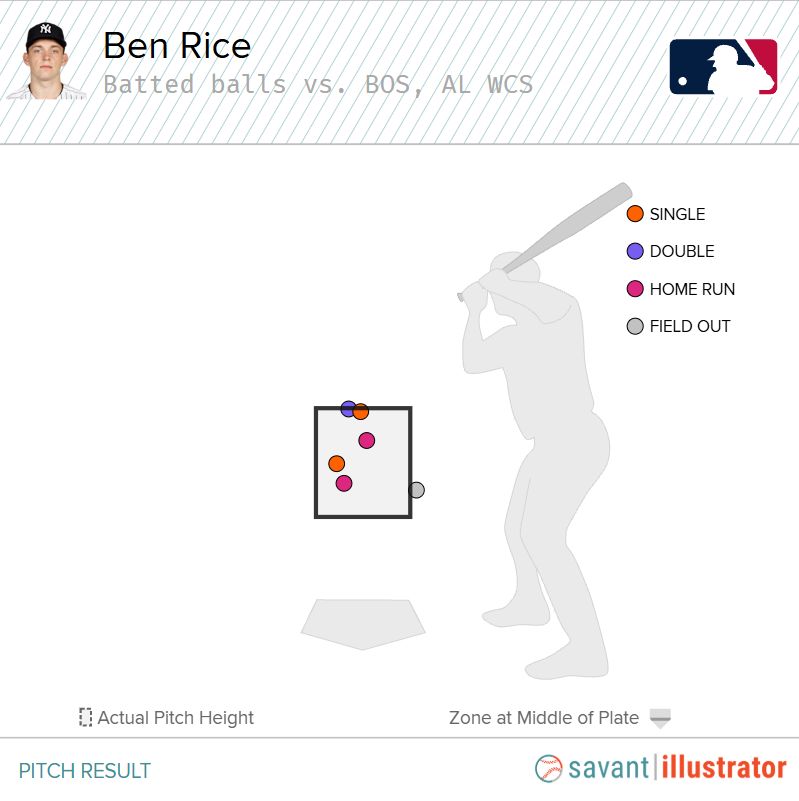
This raises an age-old question: Should pitchers pitch to their strengths, or should they pitch to a hitter's weakness? The answer is probably somewhere in between. Red Sox left-hander Payton Tolle threw his four-seamer 45% of the time in 2026 and allowed a .188 batting average against the pitch. In the first inning of Game 1, Tolle peppered Rice with four straight heaters; Rice cracked the fourth one into the right-center field gap for a double. In their next at-bat, Tolle did not throw Rice a single four-seamer. He struck out Rice on a curveball.
In total, 23 of the 40 pitches that the Red Sox threw to Rice were four-seamers or sinkers.
We'll see what the Rays do. At least on paper, there are a few strength-on-strength matchups looming. Among starting pitchers, only Cam Schlittler and Tolle throw a higher percentage of fastballs than Drew Rasmussen, Tampa Bay's Game 1 starter. Freddy Peralta -- "Fastball Freddy" -- throws his four-seamer 53% of the time, more than all but three qualified starters.
Padres: Nick Pivetta's fastball looks sharp
Pivetta returned to the Majors on Labor Day following a five-month stint on the IL with inflammation in his pitching elbow. He pitched well enough down the stretch -- a 1.45 ERA in 18 2/3 innings -- to draw the start in Game 2 of the NL Wild Card Series on Wednesday.
Pivetta validated the decision, allowing one run while recording 10 outs against baseball's best offense, bridging the gap to the Padres' vaunted bullpen. Of note, Cubs hitters went 1-for-10 with three strikeouts against Pivetta's four-seam fastball. The heater induced five whiffs on 16 swings.
That's encouraging, because Pivetta's fastball is an elite weapon with outlier shape. The right-hander throws from an extreme over-the-top arm angle, releasing his fastball at a higher point than all but four MLB pitchers (min. 250 fastballs thrown). That release point allows Pivetta to get behind the baseball and impart tremendous backspin, which generates vertical movement. Only the Dodgers' Alex Vesia averages more inches of Induced Vertical Break on their fastball than Pivetta.
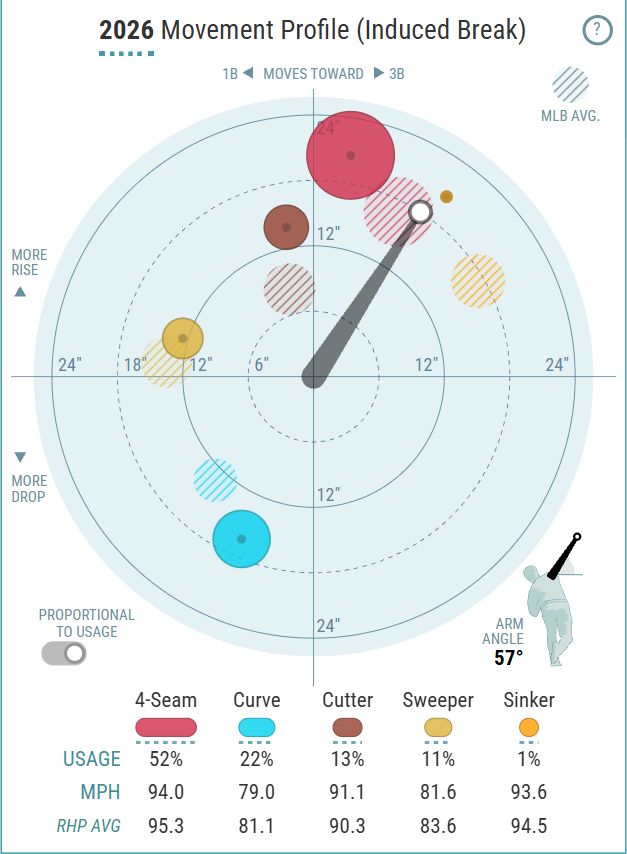
That produces a "rising" effect that causes hitters to swing right underneath Pivetta's hoppy fastball. It is difficult to hit. The league hit .203 against Pivetta's fastball in his eight regular-season starts.
Don't expect Pivetta to pitch deep into games; he hasn't recorded an out in the sixth inning this season. But the Padres -- who are still working with a patchwork rotation -- do not need much more than that. The fastball alone gives Pivetta a path through the opposing lineup at least once before handing the ball to the bullpen. That formula worked perfectly on Wednesday.
Braves: Tyler Mahle's dominant splitter
Mahle pitched to a 1.99 ERA in nine regular-season starts for the Braves after they acquired him from the Giants at the Trade Deadline. Atlanta has prioritized his splitter, and it sure seems to have unlocked something.
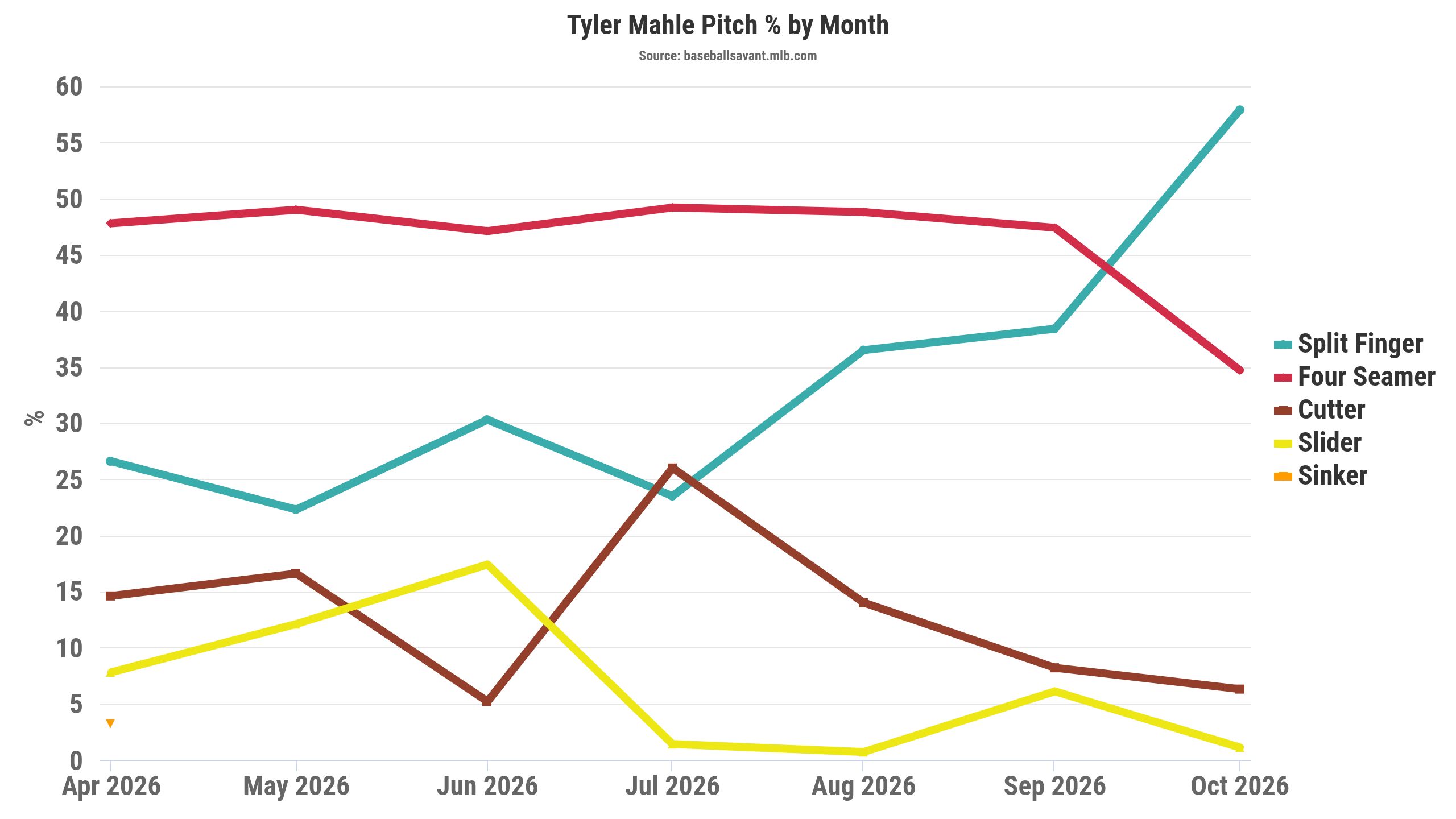
Mahle threw his splitter 25.1% of the time in 18 starts with San Francisco. That ticked up to 38.5% usage rate with Atlanta.
And then came Wednesday, when Mahle flummoxed the Phillies with 55 splitters in Game 2 of the NL Wild Card Series. He had never thrown more than 40 splitters in a single game in his career. It's only the 19th time that a pitcher has thrown 50+ splitters in a single game in the pitch-tracking era, which dates to 2008.
We saw splitters seize the spotlight last October -- especially in the World Series -- but even then, no one matched Mahle's usage. Kevin Gausman fired 49 splitters in Game 6 of the Fall Classic, pacing all pitchers.
Mahle's splitter was also quite good on Wednesday, which is why he threw it so often. He generated 13 misses on 35 swings -- a 37% whiff rate -- and recorded five of his six strikeouts on the offering.
Atlanta's rotation is thin, and the Braves will need more than just Chris Sale to dethrone the Dodgers in the NLDS. Perhaps the splitter will solidify Mahle as a legitimate No. 2 option.