

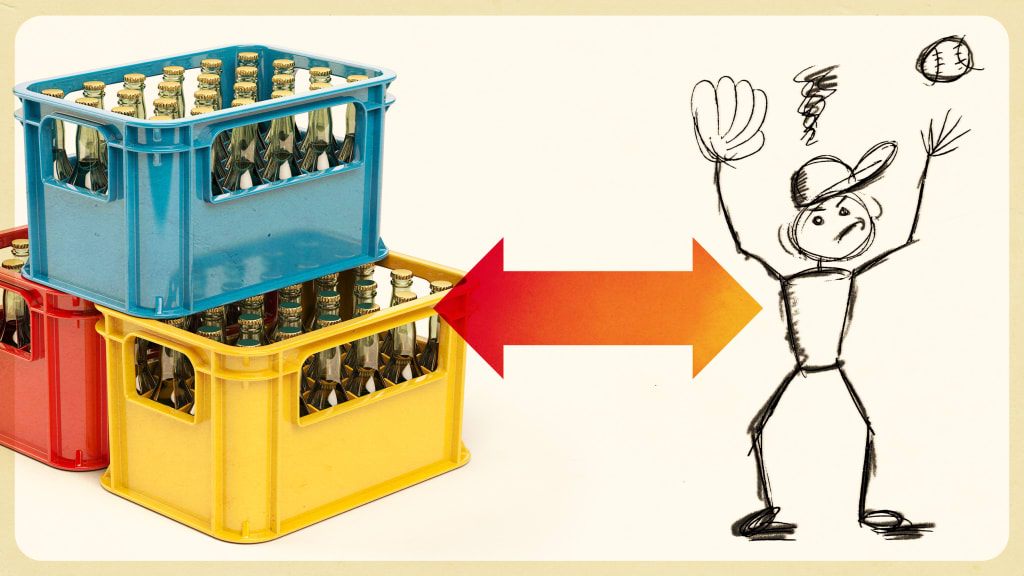
You can imagine how a baseball player, really any professional athlete -- really any human being -- might feel after learning they were traded for 60 cases of beer.
That they were worth the same as about 1,440 cold ones.
That their in-game talents provided as much value to an organization as a bunch of in-stadium libations fans suck down and discard game after game.
"I seem to recall that he didn't take too kindly to it," former Fullerton Flyers GM Ed Hart told me over a Zoom call. "He came out right at the beginning of Spring Training, we had a conversation, and then he didn't come back."
---
It was always Ed Hart's dream to run a baseball team. He even listed it as a goal during his senior year of high school.
"I had an advanced composition writing class," Hart said. "One day, our teacher wanted us to write about what our life would look like at age 40. I wrote I'd be married to my high-school sweetheart. I didn't have a high-school sweetheart and I was two months away from graduating. A month later, I met the girl I'm now married to and we have 12 grandkids. So, that came true. [I listed] where I was gonna live, what I was gonna drive ... but I also wrote that at the age of 40 I'd be the general manager of a professional baseball team."
Incredibly, right around that age, in 2005, Hart became GM of the Fullerton Flyers -- a charter member of the Independent Golden Baseball League. The now-defunct league where a 46-year-old Rickey Henderson played his final season, where the "Knuckleball Princess" once plied her trade.
Hart, a Fullerton, Calif., native, was selling POS systems to the league, trying to get his product inside all of the stadiums. The Flyers had an opening at the top of their front office, asked if he knew anybody and Hart jumped at the opportunity.
Even though, financially, it might not have been the most sound decision.
"I'd wake up in the morning laughing, and my wife would be like, 'What are you laughing at?'" Hart remembered. "I said, 'I get to throw on shorts, a golf shirt, a baseball cap and tennis shoes and go to the ballpark and they're paying me. And she goes, 'Yeah, but they're not paying you very much!'"
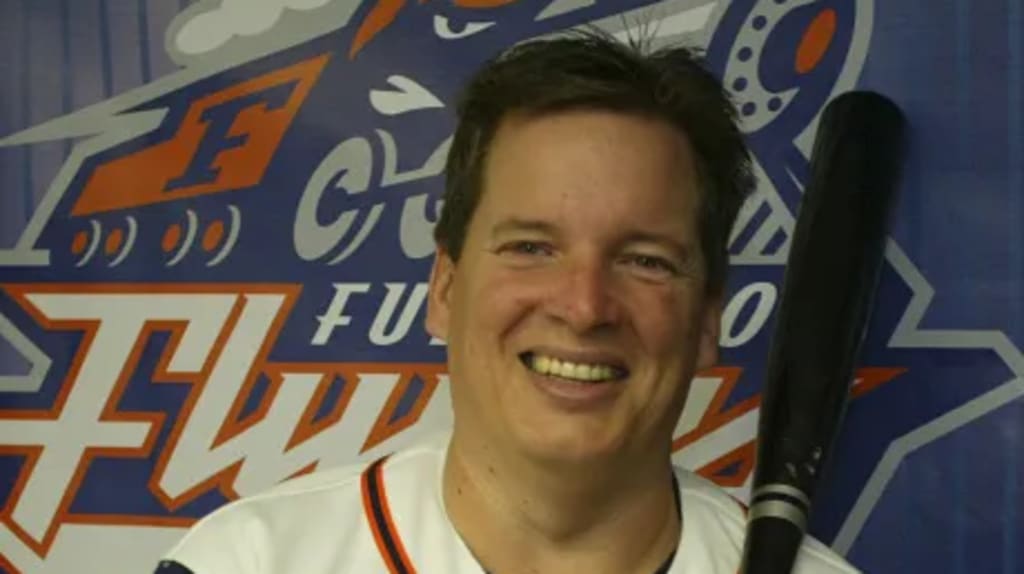
Ed's wife Laurie-ann was right about the money, of course. And it's also not easy to just make more in the independent leagues.
Budgets are small, there are Major and Minor League teams with better talent usually right nearby and, well, there are just other fun things to do.
"There's just so much competition," Hart said. "In Fullerton, we're five minutes from Disneyland and 30 minutes from the beach."
So, in these leagues, you have to do things like play a game with no umpires, trade 10 pounds of catfish for a star player or have a pig delivering game balls to home plate.
You have to make headlines, you have to find ridiculous ways to get people in the seats.
In May of 2006, Fullterton's GM found his opportunity.
The commissioner of the Golden Baseball League called up Hart and informed him that Nigel Thatch was pitching in the league, for the Illinois-based Schaumburg Flyers. Thatch was, and still is, an actor -- famous for various roles, most recently as playing Malcolm X in both Selma and The Godfather of Harlem. But back then, he was famously known as Leon, the cocky athlete in the Budweiser ads who loved nothing more than himself.
Thatch, who threw in the mid-80s, was apparently, seriously trying to pursue his pro baseball dreams. He struck out the first batter he faced in his debut against the St. Paul Saints, but then proceeded to give up 22 runs in 12 1/3 innings for Schaumburg -- good for a 10.22 ERA. He wasn't cutting it at this level.
But again, trading for Thatch wasn't really trading for his skillset, it was acquiring his celebrity, his ability to attract fans to the ballpark. And Hart had the perfect trade chip, something that would garner even more ink in papers around the country and fill segments on local news channels.
60 cases of Budweiser for the most well-known Budweiser spokesman.
Schaumburg, looking for publicity stunts just as much as any other team in these leagues, was game for the idea right away.
"Yeah, to them, it was like, 'We're getting 60 cases of beer for a guy that's not gonna make our team [next year] anyway," Hart said.
Schaumburg's return in the deal went pretty smoothly.
"We contacted our distributor in Southern California, told them what we were doing and they said, 'Where do we send it?'" Hart laughed.
"Nigel really gave us a unique presence in the sports marketplace," Schaumburg owner Rich Ehrenrich told the Chicago Tribune at the time. "In the true spirit of 'Leon Time,' we'll have a cold one courtesy of Fullerton and thank Nigel for his time here."
Thatch was, well, another story.
Hart seems to recall that the actor/athlete/actor-athlete showed up before Spring Training for a conversation ... but then never showed up again. In fact, as far as Baseball-Reference shows, he never played baseball again.
"He didn't see the humor in it," Hart said. "It was very much meant to be a humorous thing. To give him a fair shake, it was like, 'Dude, come on out. If you can show us that last year's 0-3 and 10.22 ERA was an anomaly and you're better than that, we'd love to have you on the team. We want players who can win.'"
The actual reason for making the deal worked, though: If you Google 'pitcher traded for beer,' the move went viral in news outlets across the country, from the L.A. Times to the Tribune to the New York Post. And it's still being talked about 20 years later.
For Hart, the absurd trade (part of a chain of other really absurd trades), brings back memories from one of the great times in his life. A job filled with hard-working people, strong community support and getting to live out his teenage dreams of running a baseball team in his own hometown. Nothing could ever top it.
"Oh, it was so much fun," Hart told me. "I was in my early-40s, I had four kids who all worked for the team. My wife was a sports massage therapist and physical therapist who worked for the team. Every summer night, my parents were at the game. My wife and her parents were at the game. I wouldn't trade those three years in that job for anything ever."