

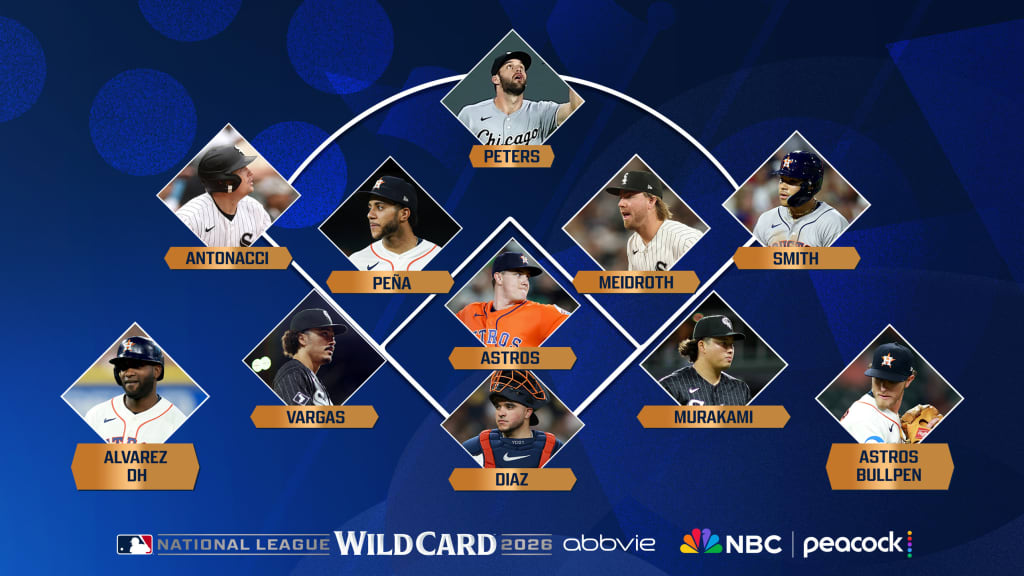
The last time the White Sox made the postseason was 2021, when they lost to the Astros in four games in the American League Division Series. Now, Chicago returns to the playoffs against the same opponent in what should be a highly entertaining AL Wild Card Series.
The Astros, champions of the AL West, are the No. 3 seed in the AL and will host the White Sox, the No. 6 seed, in each game of the best-of-three Wild Card Series at Daikin Park. Game 1 is set for Tuesday at 5 p.m. ET/4 p.m. CT on Peacock and NBCSN.
AL MVP Award favorite Yordan Alvarez powered the Astros to a division title, although it came down to the final day of the regular season on Sunday as Houston finished 81-81, just one game ahead of the Rangers. The White Sox, meanwhile, lost the AL Central to the Guardians but finished 84-78 to claim an AL Wild Card berth. A potent offense led by rookie Munetaka Murakami and third baseman Miguel Vargas has helped Chicago return to the playoffs after losing 102 games in 2025 and going 41-121 in 2024.
So, who has the edge: the Astros or the White Sox? Here's how the two teams match up, position by position.
Catcher
After an impressive rookie season in 2025, White Sox catcher Kyle Teel was limited to just 39 regular-season games due to a hamstring strain and a high ankle sprain. Teel picked things up with the bat after returning from the injured list in early September, but he finished the season batting .210 with a .697 OPS. For the Astros, meanwhile, catcher Yainer Diaz ended the regular season scorching hot, recording multiple hits in six of his final seven games to boost his batting average to .285 and his OPS to .772. Teel -- who went 4-for-6 with a double and a home run in the World Baseball Classic -- could be a big factor, but we’ll have to give the edge to the more experienced Diaz for now.
Advantage: Astros
First base
Christian Walker started 2026 strong, but a poor second half (.208 average, .645 OPS) put his season numbers around where they were during a disappointing first season with the Astros in 2025. Still, though, Walker slugged 29 home runs and produced 87 RBIs as a middle-of-the-order bat for Houston. Murakami, in his first season in MLB following a standout career in Japan, had an All-Star first half then slumped badly later in the season but righted the ship at the very end, hitting four home runs and posting a 1.062 OPS in his final 10 games. This would be a tougher call if Walker was producing like he did in Arizona, but Murakami -- even as a rookie -- has the edge.
Advantage: White Sox
Second base
Chase Meidroth had a strong season that flew mostly under the radar, batting .276 with 16 home runs and a .765 OPS while scoring 90 runs for the White Sox. Factor in his excellent defense at second base, and it’s easy to see how Meidroth accrued 4.5 FanGraphs Wins Above Replacement in 2026. And while it’s hard to pick against Jose Altuve, whose 27 postseason home runs are the second most all time, the 36-year-old appears to be on the decline. Altuve hit .250 with 16 homers -- his fewest in a full season since 2018 -- and a .701 OPS, good for 0.8 fWAR.
Advantage: White Sox
Third base
A stellar September was a perfect capper to Isaac Paredes' impressive 2026. Paredes hit .291 with a .998 OPS in 24 games in the final month, raising his season OPS to .807 and giving him 25 home runs and 94 RBIs on the year. But the White Sox have their own standout at the hot corner: Vargas, who broke out in 2026 after being acquired from the Dodgers at the 2024 Trade Deadline. Vargas proved to be a power-speed threat, slugging 33 home runs and stealing 22 bases, and his 101 walks ranked sixth in MLB. Neither third baseman is a plus defender (although Paredes is closer to league average), so Vargas’ slightly superior bat makes the difference here.
Advantage: White Sox
Shortstop
Colson Montgomery has considerable power -- his 31 home runs in 2026 led AL shortstops -- but his plate discipline is a major negative. Montgomery drew 54 walks while striking out 227 times to set a new Major League single-season record for K’s, surpassing Mark Reynolds (223) in 2009. The Astros have a clear edge here with 2022 ALCS and World Series MVP Jeremy Peña, who took a big step up at the plate in 2025 and continued his success into ’26. Peña hit .277 with 22 homers (tying his career high), 12 steals and an .802 OPS.
Advantage: Astros
Left field
When Alvarez isn’t patrolling left field for the Astros -- he made just 25 appearances there in 2026 -- Taylor Trammell, LaMonte Wade Jr. and Jorge Barrosa have been manning the position. Trammell, who started a team-high 36 games in left, batted just .192 with a .626 OPS and has yet to surpass the Mendoza Line in any season of his six-year career. Houston’s lack of a reliable left fielder gives a clear advantage to the White Sox, who have platooned utility man Sam Antonacci and righty slugger Randal Grichuk in left. Grichuk, signed as a free agent in May after being waived by the Yankees, has been excellent against left-handed pitching (.327 average, 1.026 OPS).
Advantage: White Sox
Center field
With Daulton Varsho likely out for the year due to cysts in his left wrist, the center-field job for Houston appears to fall to rookie Lucas Spence. So far, so good: Spence hit his first three MLB home runs in the same game on Thursday and homered again two days later. Although he doesn’t have all that much less experience than White Sox center fielder Tristan Peters -- who played just four games for the Rays in 2025 before being designated for assignment -- Spence hasn’t matched the production Peters had during an All-Star 2026. Peters posted a .265/.337/.437 slash line with 12 home runs, 56 RBIs and excellent defense (+9 Outs Above Average) in center.
Advantage: White Sox
Right field
With unproven young players on either side -- Braden Montgomery for the White Sox and Cam Smith for the Astros -- this position battle is closely contested. Montgomery, who made headlines when he socked a walk-off home run to beat the Braves in his Major League debut, finished his rookie year with a .226 average and a .662 OPS. Smith, meanwhile, put up a remarkably similar OPS (.669), but his power gives him the edge here. Smith socked 21 home runs in 157 games, compared to Montgomery’s six in 93 games.
Advantage: Astros
Designated hitter
It’s hard to find a bigger mismatch between these two clubs than at DH, although that’s no fault of Chicago’s Andrew Benintendi, who put up a .240/.302/.413 slash line with 15 homers and 78 RBIs. That’s perfectly fine, but it doesn’t even approximate the production of Alvarez, who finished a monster 2026 by leading MLB in batting average (.316), on base-percentage (.432), slugging percentage (.601), walks (109) and OPS (1.033). Alvarez, who hit 42 homers and drove in 109 runs, has a track record of postseason success and will be treated very carefully by White Sox pitching.
Advantage: Astros
Starting pitching
This battle will be huge in deciding who wins the series, so the Astros are fortunate to have the best option among either team’s starters in right-hander Hunter Brown. Brown missed more than two months with a right shoulder strain but returned in mid-June without missing a beat, finishing the year with a 3.19 ERA and 124 strikeouts in 109 innings. That said, Houston’s rotation as a whole has a 4.81 ERA, 27th in MLB, and the White Sox have some solid arms themselves with Anthony Kay, Davis Martin and especially Sean Burke. But with Chicago’s starters rarely going deep and Brown looming in Houston’s rotation, the Astros have a slight edge.
Advantage: Astros
Bullpen
“Which team has the better bullpen?” is the question here, but it should really be “Which team has Josh Hader?” That would be the Astros, who have enjoyed a tremendous year from the lefty closer since his early-June return from a biceps issue suffered prior to Spring Training. Hader posted a 1.01 ERA in 45 innings, striking out 55 and going a perfect 26-for-26 in save opportunities. Southpaw Sean Newcomb and hard-throwing righty Grant Taylor have been strong for the White Sox, but Chicago’s lack of an established closer hurts here.
Advantage: Astros
Prediction
We’ve given the edge to the Astros in a slight majority of positions here, including both starting and relief pitching, and yet it feels like Chicago’s offensive depth is being overlooked. While Alvarez can carry Houston’s offense, any cold streak from him might make it hard for an inconsistent Astros lineup to put up runs, while the White Sox have a number of hitters who can make an impact. And although the Astros are the home team, they’re the first division champion without a winning record, finishing three games below the White Sox. If this was a Houston team with a little more juice and a White Sox team with a little less magic, the pick would be different here.
White Sox in 3