
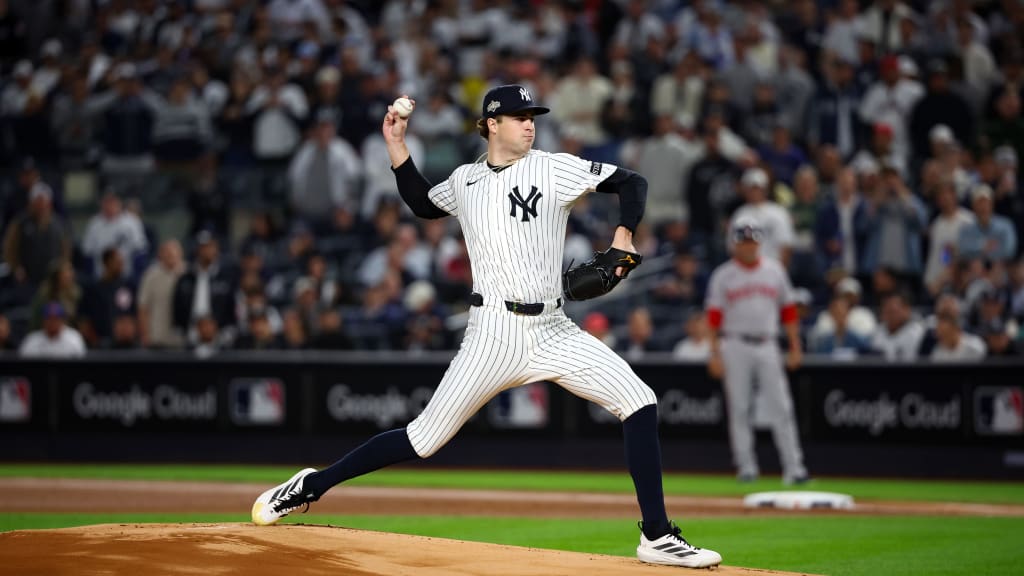
After an impressive three months in the Majors, Cam Schlittler was given the ball for the winner-take-all Game 3 of the 2025 Wild Card Series at Yankee Stadium against the Boston Red Sox. The 24-year-old rookie from Walpole, Mass., embraced the challenge of facing the team he grew up rooting for even as the Boston fan base hurled its nastiest online barbs at him and his family during the run-up to the showdown.
In the biggest game of his life, Schlittler was at his very best, giving the Yankees eight shutout innings. Not only did the 6-foot-6 right-hander come through for his teammates when it mattered most, but he also made history.
Schlittler, who went 4-3 with a 2.96 ERA in 14 starts after getting called up to the bigs in July, became the first pitcher in postseason history to toss eight scoreless innings with at least 12 strikeouts and no walks. He also set a franchise record for strikeouts in a postseason debut.
In the Yankees’ 4-0 victory -- which sent New York to the ALDS to face another division rival, Toronto -- Schlittler overpowered Red Sox hitters with an array of fastballs that regularly reached 100 mph. He gave up just five singles during the 107-pitch effort, with only one Boston hitter making it as far as second base.
During the offseason, Schlittler spoke with Yankees Magazine editor-in-chief Alfred Santasiere III about the valuable experience he gained down the stretch last season and the night in which he etched his name in Yankees lore.
Yankees Magazine: As the season went along last year, what were some of the most significant things you learned about pitching in the big leagues?
Cam Schlittler: As you’re moving up through the levels, you start to refine your approach. When you get to the big leagues, you realize that it’s a whole different game. It took a while for me to learn how to succeed up there, probably until September. So, for me, it was really just about trying to settle in and learn from the other pitchers. I watched the hitters on the teams we were playing closely, just to try to learn as much as I could about their approaches. I had some really helpful conversations with Gerrit [Cole] and Carlos [Rodón] and just tried to learn from the experience of pitching every fifth day. Feeling the pressure of trying to win games and playing in New York, there was a lot to take in, but I still felt comfortable. Being in that big spotlight in New York, it’s a whole different game, so it took about two months to learn the process.
YM: How did the cutter you added to your pitch arsenal help you get batters out?
CS: I started throwing the cutter in Double-A during the early part of the season. I think that was the pitch that got me promoted to Triple-A and ultimately to the Majors because I had so much success with it right away. It was a good addition to my arsenal because I was able to throw it in the lower part of the strike zone, and hitters were swinging over it, or in a worst-case scenario, on top of it, which resulted in a lot of ground balls. Before my last regular-season start in September, Gerrit suggested that I split up that pitch into two pitches. I started throwing the cutter harder, at about 95 mph, up in the zone. That was a big change from how I was throwing that pitch previously. Before the playoffs started, I had never elevated the cutter, but I was comfortable throwing the hard cutter up in the zone, and I had good results from that in my last regular-season start.
YM: You allowed two runs or fewer in six consecutive starts beginning in August. How thrilling was it to be pitching as well as you were so early in your big league career?
CS: The pressure of success in the Majors is high. To be able to put the team in a position to win while learning how to pitch at that level and how to read big league hitters was very satisfying. I was also starting to go deeper into games, and getting to that sixth-inning mark was very important to me. To be able to have a stretch of consistent long outings, where I wasn’t giving up a lot of runs or where I was minimizing base runners, that was a great feeling. I was happy that I was seeing some results and putting our team in a position to win.
YM: How much did your final two regular-season starts -- especially the last one, in which you tossed seven shutout innings against Baltimore -- help you going into the postseason?
CS: I had a rough start against the Twins right before that where I lost the strike zone. Carlos helped me a lot during that road trip to figure out how I could make small adjustments with my four-seam fastball. In my second-to-last start, I wasn’t great, but I was able to start locating my pitches. It was a good challenge to face the same team in back-to-back starts, especially when I was trying to get that third rotation spot for the playoffs. Using the cutter in that last start helped me to complete my arsenal and take it into the playoffs.
YM: How did you feel about all of the publicity about you being from a Boston suburb as you prepared to make the biggest start of your life against the Red Sox in that decisive Game 3 of the Wild Card Series?
CS: As a competitor, that’s something that I enjoy. I didn’t expect there to be as much talk toward me before the game. I guess, being from that area, I thought it would be a little more respectful toward my family and specifically my mom, but I found extra motivation from what was being said. It was something where I felt like I was going to pitch better just because of that situation. For me, it wasn’t upsetting; I used it as fuel. To know that the fans were talking the way they were before the game, I was excited to go out there after that. I was more locked in than I had ever been before in my entire life. Obviously, it was the biggest game I ever pitched, an elimination game. The team was relying on me to keep the season going. To go out and pitch the way I did, it was a great feeling. I was just happy that we won.
YM: How did you feel when you got to the Stadium that afternoon?
CS: I always have taken every start seriously. But the playoff game was a normal day for me. I got the best night of sleep in my life before that game. I was very confident and excited for the opportunity to pitch in that game. I didn’t really have any nerves before the game. I had a good pregame bullpen. I liked the idea that I was a rookie going into my first postseason start, and the team had my back and was confident in me. It was no different than any other start except for the fact that I had a little extra motivation, because I was facing Boston and because of all the noise coming my way from the fans up there.
YM: What was the atmosphere in Yankee Stadium like that night?
CS: It was very loud. Being able to feel the energy in the two games before that helped me understand how loud it would be when I got out to the mound. It was louder than it had ever been for me, even before the game started. It was hard to hear the PitchCom, but I love that environment. That’s one of the reasons I love New York: The fans are such a big part of every game. That’s something that I have been able to feed off of.
YM: How much of a boost was it to get through the first inning with a strikeout of All-Star third baseman Alex Bregman?
CS: The first inning is always tough; you’re facing their top three hitters. You want to set the tone for the game. You want to get momentum as quickly as possible, so it was important to get three quick outs against three good hitters. It was good to get through that one quickly.
YM: How challenging was it to get through the fifth inning after you allowed two Red Sox hitters to reach base?
CS: When we put four runs on the board in the bottom of the fourth against a good pitcher, that was a momentum booster. But as a starter, it can be hard to put together a clean inning after you get a big lead like that. I let up a few hits, but I was able to come back and strike out the side and get the third out on a check swing. I could feel the momentum shift again after that jam. Being able to put up a zero after we scored all those runs was the biggest inning in that game.
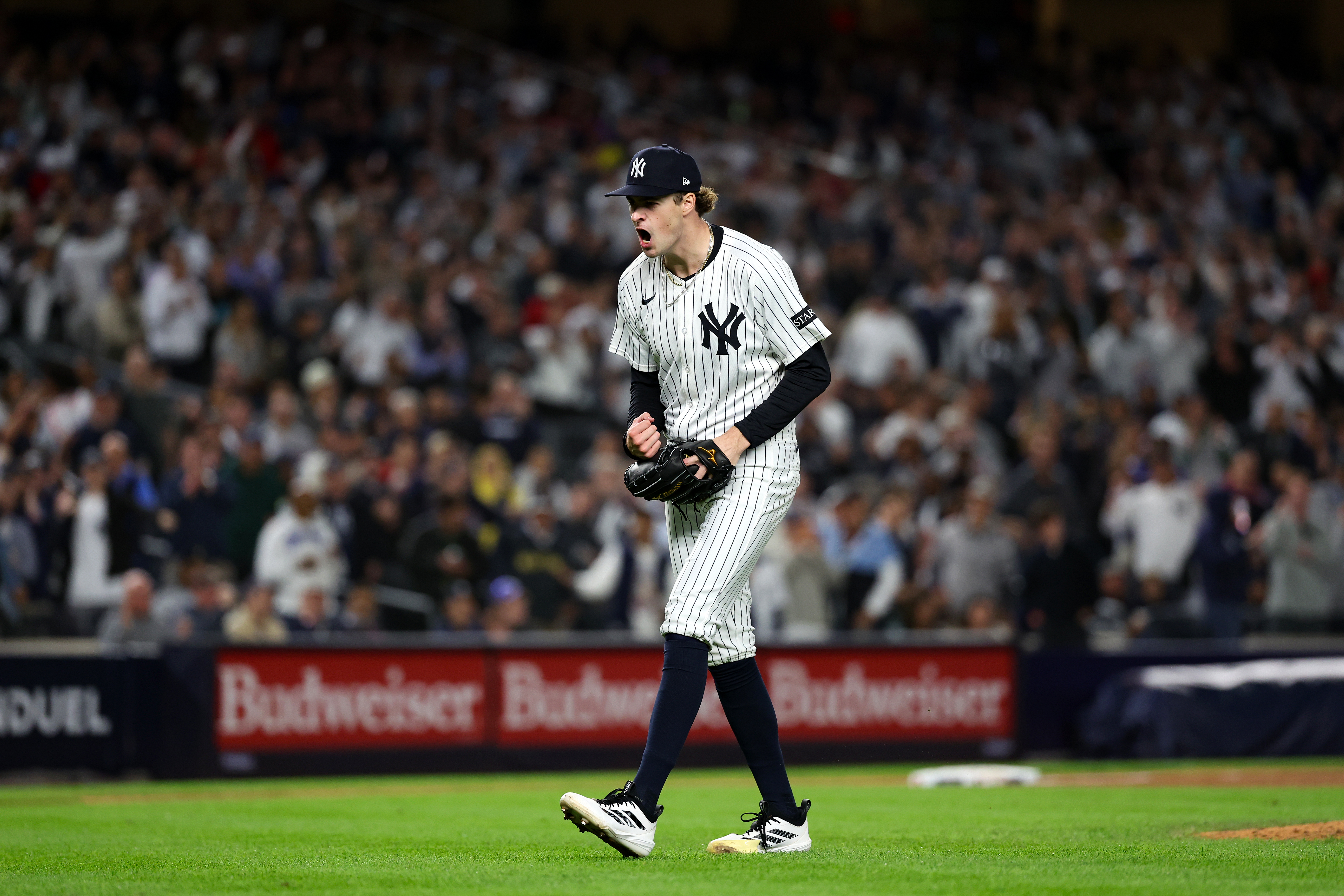
YM: Of the 29 batters you faced that night, you got ahead of 22 of them. How important was it for you to accomplish that against a tough Red Sox lineup?
CS: You’re going to see results shift depending on being ahead in counts and being behind in counts. As a starting pitcher, you want to be ahead of as many batters as possible, and that’s something that I have worked on. The results completely change from a 1-2 count to a 2-1 count. It was important for me to be ahead and to be able to challenge hitters. It was a part of my game plan, and it made it possible for me to run deep into the game.
YM: As the game went along, it seemed as if your fastball became even more effective. Was there ever a point where you thought the Boston hitters could catch up with your heater?
CS: I had three good variations of my fastball working, and I feel like I’m a good fastball pitcher. My plan was to throw a mix of four-seam and two-seam fastballs with my cutter and to see what they could do with that. I was able to get the results I was looking for every inning, so I didn’t stray away from that plan. They didn’t make an adjustment, so I was able to continue the game plan I had through eight innings.
YM: What did Aaron Boone say to you when you got back to the dugout after the seventh inning?
CS: I personally thought that I was done after the seventh. I walked in with my head down, and Aaron asked me if I was feeling good. I told him I was good, and I just kept walking down the tunnel. I was pumped that he still had that confidence in me, especially after I had faced the order three times through and had thrown more pitches than I had ever thrown in any game in my professional career. That gave me even more confidence when I ran out there for the eighth inning. I also had a memorable conversation with Aaron before the game. He told me that he had as much confidence in me as he did with the other starters, so I was pretty sure that I would get a little freedom if I was pitching the way I needed to.
YM: What stands out about the eighth inning?
CS: It was great even though I wasn’t aware of all the records I broke in that game. (Third baseman) Ryan McMahon put his body on the line in such a clutch time to catch a foul ball in the visiting dugout for the second out, and Anthony Volpe also made a great play to end the inning. We had come together as a team, and when I walked off the mound, I was just tipping my cap to how special that last inning was.
YM: When your team needed you most, you delivered one of the most clutch performances in recent history. How satisfying is that now that a few months have passed?
CS: The way that you earn people’s respect is through your performance. I feel like I was able to earn the respect of people on this team who have a lot more experience than me or are even better than me from being consistent. Then, to do what I did in the playoff game with the season on the line, to show my teammates that the pressure didn’t bother me and that I was able to pitch as well as I ever had, that was satisfying. They know that they can count on me if I’m in that situation again.
YM: When you think about all of the postseason records you set during that game, what does that mean to you?
CS: I’m not chasing those things, and I would take a championship over those records any time. But at only 24 years old and pitching in my first postseason, it was a good feeling to pitch well when the pressure was the highest. Going out there and helping the team was all that mattered.
YM: What do you make of now being a character in the long rivalry between the Yankees and the Red Sox?
CS: I always wanted to be a Yankee in terms of where I want to be in my career and an organization I want to play with. The Red Sox do not really draft guys from the Northeast; that’s not something they have ever done. That’s something that the Yankees do more of than the Sox do. I’m right where I need to be. It’s a dream to play for the Yankees. I love New York. That rivalry is fun, and I like dealing with that pressure and everything that comes with it.
This interview has been edited for clarity and length.
Alfred Santasiere III is the editor-in-chief of Yankees Magazine. This story appears in the March 2026 edition. Get more articles like this delivered to your doorstep by purchasing a subscription to Yankees Magazine at www.yankees.com/publications.