
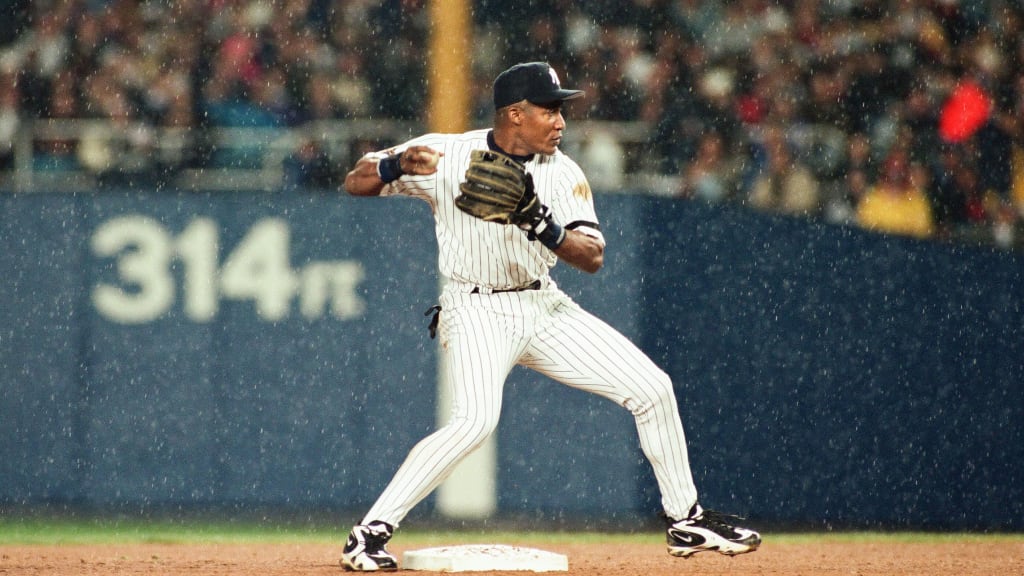
There are certain moments in every championship journey that live on forever. For the 1996 Yankees, one of those enduring memories wasn’t even authored on the field.
Sure, there were amazing pitching performances from David Cone and Andy Pettitte, and home runs that Derek Jeter and Jim Leyritz hit that changed the trajectory of the season. But there was also a quiet conversation in the home clubhouse at Yankee Stadium that produced what would become that team’s mantra.
Mariano Duncan, who was originally slated to be a utility player for the team but ended up serving as the everyday second baseman, was sitting next to Jeter, then a rookie sensation. The weather that day in New York was not good, and there was some uncertainty about the game being played.
“Hey Dunc,” Jeter said to his double-play partner. “If we play today …”
“We win today,” Duncan interjected.
“Dassit.”
From that seemingly inconsequential conversation, a quote that would define a season was born.
We play today. We win today. That’s it.
“A lot of people think the quote only came from me,” the 63-year-old Duncan said recently. “But Derek deserves as much credit for that quote as me. We repeated that quote every single day.”
For a team that had not won a championship in 18 seasons and featured a blend of young players still adjusting to life in the Majors along with several cagey veterans, Duncan’s words embodied the team’s focus.
“It meant that we had to concentrate on today, not yesterday and not tomorrow,” Duncan said. “It was all about being in the present and winning that day’s game. Every day, before the game started, I would say it a lot. It didn’t take long for everyone to follow.”
The catchphrase made its way onto a line of T-shirts that Yankees players wore underneath their jerseys, which were soon being sold at merchandise stands at Yankee Stadium and throughout New York City.
“I never thought that the quote would become so popular outside of our clubhouse,” Duncan said. “It became one of the most recognizable quotes in sports.”
Duncan’s one-day-at-a-time approach was not the only example that he set for a core group of younger players that included Mariano Rivera, Jorge Posada and Bernie Williams along with Jeter and Pettitte. Not long after the veteran free agent signed with the Yankees in December 1995, newly hired manager Joe Torre -- who was familiar with the Dominican Republic native from their respective years in the National League -- knew how important the second baseman would be in the clubhouse. Prior to signing with the Yankees, Duncan had already been in the Majors for 10 seasons, playing a key role on two teams that ascended from the cellar to the World Series.
“In Cincinnati, we were a [fifth]-place team in 1989, and we won the World Series in 1990, sweeping the mighty Oakland A’s,” Duncan said. “The same scenario happened in Philadelphia a few years later. We went from last place in 1992, and we got to the World Series in 1993.”
Although the team that Duncan was joining in New York had reached the postseason in 1995, Torre believed that Duncan’s experience and his understanding of the sometimes complicated relationship between the press corps and professional athletes would make him a perfect mentor for his Yankees teammates.
“In our first meeting, Joe Torre told me that he wanted me to be the leader,” Duncan said. “I remember talking to him about how many leaders we had on that team, guys like Wade Boggs and Tim Raines, but he wanted me to be the guy who talked to the media after every game. He wanted me to be the guy who would answer the hard questions.
“I did well at that because I understood that the media had a job to do. If we played well, they would write good things about us, but if we played bad, I didn’t expect the media to write something good. I really understood that, and Joe wanted me to impart that on the younger players. He wanted me to make sure that they were not affected by what was written, good or bad.”
When Spring Training began, the Yankees’ infield plans were quite murky. Tony Fernandez, who was the team’s shortstop in ’95, was either going to start at his normal position or, if Jeter showed enough promise to claim the shortstop position, move to second. The Yankees were also hoping that Pat Kelly, a mainstay at second base since 1992, could recover from offseason shoulder surgery in time to log significant innings in 1996.
As spring unfolded, the Yankees’ plans changed. Fernandez suffered a season-ending broken elbow toward the end of Spring Training, and Kelly encountered complications from the surgery that would ultimately keep him on the shelf until late July. In a bind, Torre turned to the 33-year-old Duncan at second and hoped that the 21-year-old Jeter could handle shortstop.
“I came to Spring Training with the attitude that whatever opportunity the Yankees gave me, I’m going to take advantage of it,” Duncan said. “Joe originally told me that I was going to be the utility guy. But when Tony Fernandez got hurt, Joe told me that they weren’t going to look for another second baseman. I was going to get the opportunity to be the starting second baseman, and Derek was going to be the shortstop. I knew that I had a big role to fill.”
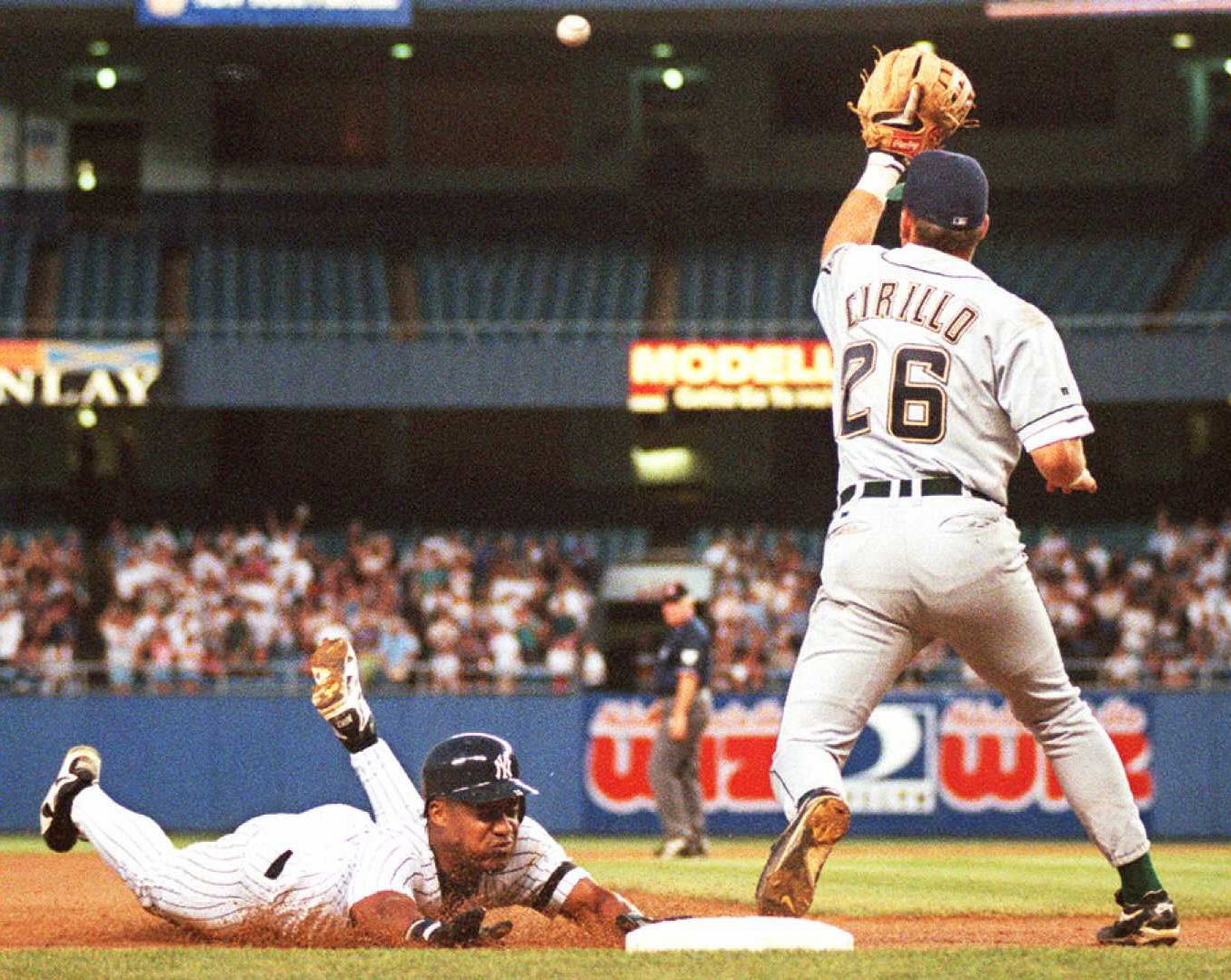
Although Duncan had played more than 1,000 games in the National League before coming to the Bronx, he felt that his newfound chance to hold a significant role for the Yankees was extra special.
“With the team that I had around me, I couldn’t wait to get to the ballpark every day,” Duncan said. “I was playing for the New York Yankees, and that felt good. I wanted to perform, and I was as motivated as I had been in a long time.”
And even if the Yankees weren’t sure that they were going to stick with Duncan at second, he never envisioned a scenario in which he would relinquish the position.
“I believed in myself,” he said. “When you see your name in the lineup every day -- especially when you didn’t expect to be in that role -- it gives you a boost.”
Duncan began the season with an 11-game hitting streak and collected eight hits over the final three games of April to finish the first month with a .360 batting average.
“I was hitting well at the beginning of the season,” he said. “That gave me a lot of confidence that I could have a great season. I had learned a lot from the experiences I had before coming to New York, and I knew that if I went to the ballpark and battled every day, good things were going to happen.”
Duncan remained consistent through the first three months, and as the Yankees began to surge in the standings, so did he. Duncan collected 12 hits in his first six games of July for a club that took a six-game lead in the American League East into the All-Star break.
“We had to deal with Boston, Baltimore and Toronto, and they were all good that season,” Duncan said. “Having all of those teams in our division was tough. When we started playing the way we did over the first half of the season, that gave us the confidence as a team that we needed. By the All-Star break, we didn’t care who we were playing; we truly felt like we could defeat anybody.”
Duncan rounded out the regular season in similar fashion, raising his batting average by 15 points in September. Over the final eight games, Duncan collected 13 hits, finishing the ’96 campaign with a .340 average to go with eight home runs and 56 RBIs. His September performance was especially important because it helped the Yankees hold on to the lead they had built in the AL East and win the division by four games over Baltimore. Personally, Duncan said his strong finish put him in a good mental space heading into the team’s American League Division Series matchup with the Texas Rangers.
“Any time you have a great stretch at the end of the regular season, you take that momentum into the postseason,” he said. “When the playoffs start, you want to compete, you want to be swinging the bat the way you are capable of. I knew that I was seeing the ball well when the playoffs started, and getting so many hits in the last part of the regular season helped a lot.”
Duncan’s confidence paid dividends. With the best-of-five ALDS tied at one game apiece, the Yankees headed to Texas for the next two games. In a pivotal Game 3, the Yankees were trailing, 2-1, in the ninth. Jeter and Raines got the inning started with back-to-back singles, and Williams tied the game with a sacrifice fly off hard-throwing relief pitcher Mike Henneman.
Then, with two outs, Tino Martinez came to the plate. Rather than going after the lefty power hitter, the right-handed Henneman intentionally walked Martinez, which brought Duncan to the plate.
“When I saw that situation, I knew exactly what was going to happen,” Duncan said. “I knew that they weren’t going to pitch to Tino, even before they walked him.”
Duncan came to the plate feeling good about the opportunity in front of him.
“It made me calmer,” Duncan said. “I felt like they walked Tino because they thought they could get me, and for some reason, that made me more comfortable. I concentrated more because I wanted to do the job.”
In choosing to pitch to Duncan, the Rangers essentially were going after a seasoned veteran whose baseball acumen allowed him to outsmart them in that at-bat.
“I knew that Henneman had a good splitter,” Duncan said. “I also felt like those guys knew that I was a good first-pitch fastball hitter, and there was no way that they were going to challenge me with a fastball. I knew that I was going to get a splitter. There was absolutely no doubt in my mind, and the first pitch that I saw was a splitter.”
Duncan lined that pitch up the middle for a base hit that plated Raines, giving the Yankees a 3-2 lead.
“I knew what was coming, and I was able to execute,” Duncan said. “When I got that hit, I was even happier than I would have been if they didn’t walk someone to get to me. I proved that I was still a dangerous player and that I did something to help my team win an important game.”
The Yankees held on to win that thriller before wrapping up the ALDS the next day with a 6-4 victory in Game 4. Duncan finished the series with five hits and a .313 average.
“Winning Game 3 was very important,” Duncan said. “It took a lot of pressure off of us. The Rangers were a really good team, and they had a big advantage when the series moved back to Texas. Winning the first game out there helped us turn things our way, and we needed that.”
With a little less drama, the Yankees took the American League Championship Series from Baltimore in five games, setting up a World Series for the ages.
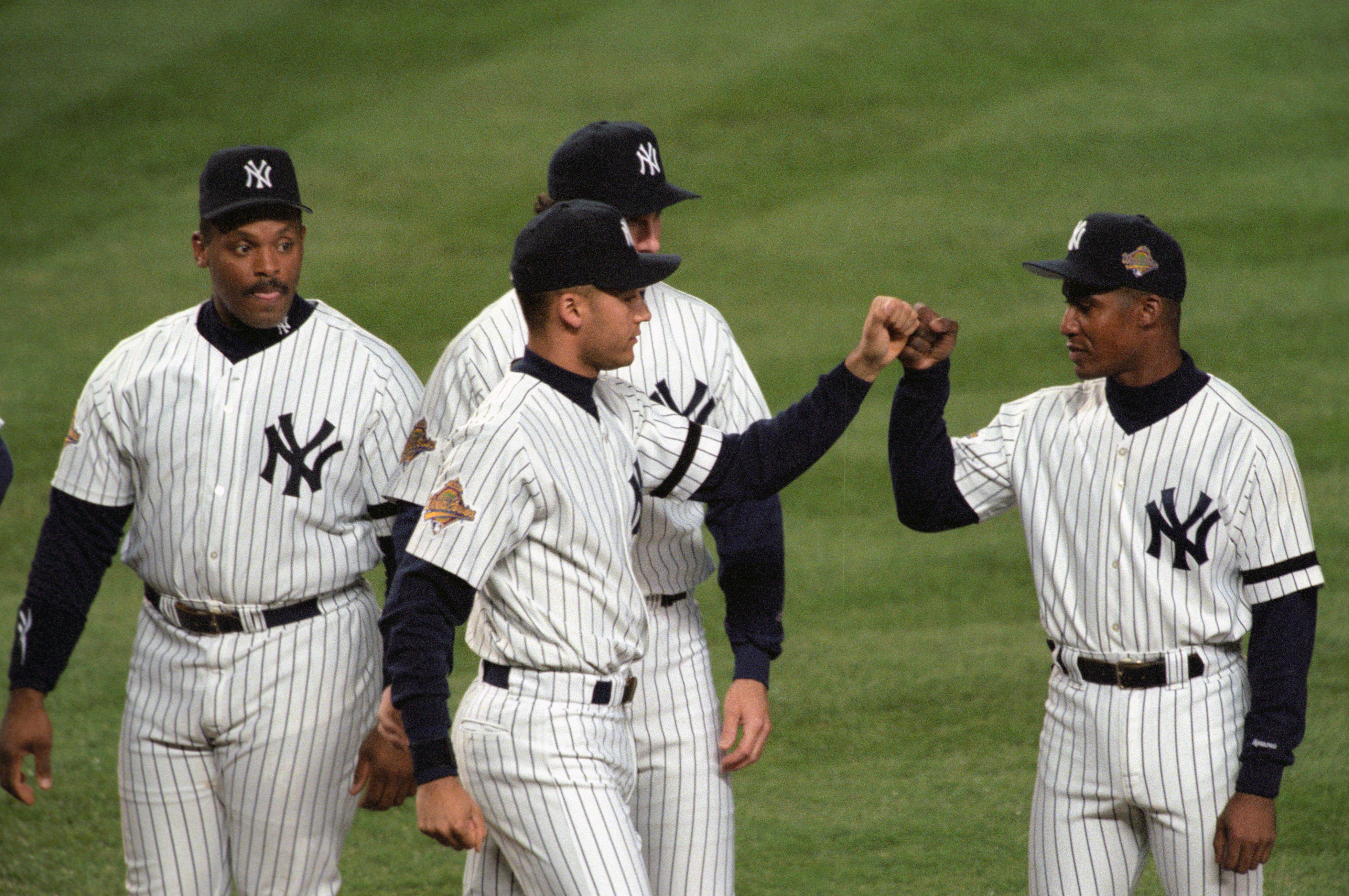
One of Duncan’s most vivid memories from that October was the atmosphere in Yankee Stadium, which he said was more electric with each game the Yankees won.
“When you walked out onto the field at the old Yankee Stadium for a playoff game, you were in heaven,” he said. “The fans were into the game from the first pitch through the last. There was nothing better than wearing the pinstripes in Yankee Stadium during that playoff run.”
When Duncan and his teammates took the field at Yankee Stadium for the first World Series game in the Bronx since 1981, the excitement was palpable. But things soured quickly as the Atlanta Braves defeated the Yankees, 12-1, in the Series opener. The Braves continued their dominant run the next night, shutting out the Yankees, 4-0, and bringing a 2-games-to-0 lead back to Atlanta.
Torre’s promise that the Yankees would win the next three games in Atlanta and then close things out in the Bronx has been well chronicled, but Duncan made a similar -- albeit less publicized -- statement to George Steinbrenner after his team lost the first two games by a total of 15 runs.
“I went to the clothing store and bought one suit with a pinstripe and a tuxedo for the trip to Atlanta,” Duncan said. “Before we left for Atlanta, George Steinbrenner walked up to me in the clubhouse and said, ‘Where do you think you’re going? You think you’re going to a party?’ I said, ‘No, George. I’m going to Atlanta to win two out of three and bring the World Series back to New York.’ He just looked at me and said, ‘We’ll see about that.’”
Although it seemed spontaneous, Duncan’s response to the Yankees’ owner was said with a purpose.
“I made that comment because when you’re losing a series 0-2, you have to do everything extremely well to come back,” Duncan said. “One of the things that we needed to do well was believe in ourselves, and that’s why I told the Boss that we were going to win. I wanted him to hear that, and I wanted all of my teammates to hear me say it.”
Duncan and his teammates remained confident as they won three straight in Atlanta, including a Game 4 thriller in which they had trailed 6-0 through five innings.
“We never stopped believing in ourselves,” he said. “Never, never, never! Not even for a second.”
After the Yankees got the Fall Classic back to the Bronx, they felt unstoppable, even though they were going up against one of the greatest starting pitchers of that era or any other in Game 6.
“We weren’t concerned about facing Greg Maddux,” Duncan said. “We felt really comfortable. We weren’t thinking about Game 7. We felt confident that we were going to close it out that night.”
As Duncan recounted the moment that the Yankees closed out the Braves on a foul popup near third base, it brought tears to his eyes.
“When I saw Charlie Hayes get under that baseball, I’m telling you …” he said before taking a brief pause. “I’m telling you, it was one of the greatest moments of my life.”
Not long after the Yankees won the game, 3-2, and clinched a 4-games-to-2 World Series triumph, Duncan found Steinbrenner in the Champagne-soaked clubhouse celebration.
“He gave me a hug, and I asked him to take a photo with me,” Duncan said. “He told me that he had never experienced any conversation like that with a player, and hearing that made me very proud.”
Duncan only played 50 games with the Yankees in 1997 before getting dealt to Toronto, where he finished his career with the Blue Jays. A lifetime .267 hitter in 12 Major League seasons, the Dominican Sports Hall of Famer currently serves as the bench coach of the New York Mets’ Double-A affiliate, the Binghamton Rumble Ponies.
Thirty years after Duncan gave the Yankees a whole lot more than they expected at the plate, while also authoring the words that galvanized a team en route to a championship, his greatest source of pride comes from the way he led his teammates.
“The biggest contributions I made were the experience and leadership that I brought to the ballclub, more so than what I did on the field,” Duncan said. “I felt like I helped us win simply by reminding my teammates of the most important thing before every game: ‘We play today. We win today. Dassit.’”
Alfred Santasiere III is the editor-in-chief of Yankees Magazine. This story appears in the September 2026 edition. Get more articles like this delivered to your doorstep by purchasing a subscription to Yankees Magazine at www.yankees.com/publications.