
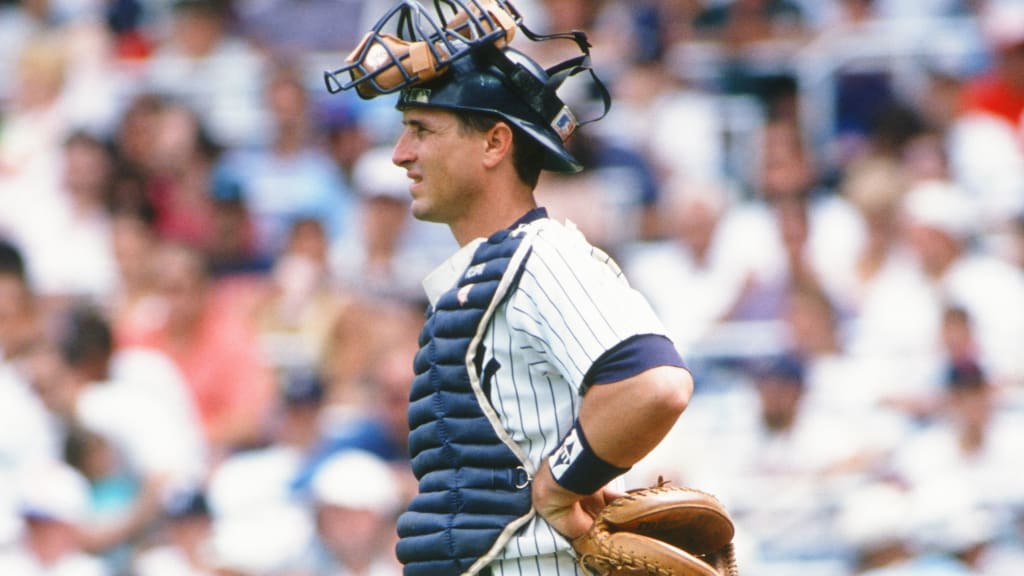
Even when he wasn’t supposed to be humble, Mike Stanley knew no alternative. As the Yankees’ catcher from 1992 through 1995 and again for a brief stint in 1997, Stanley possessed a humility and steady demeanor that impressed the Yankees faithful as much as his All-Star-caliber play. That mindset was never more evident than on a late afternoon game in the summer of 1995 when, amid his team’s efforts to end a 13-year playoff drought, Stanley authored a game for the ages.
On Aug. 10, Stanley gave that day’s starting pitcher, 25-year-old Mariano Rivera, a 3-1 lead with a solo home run off veteran ace Charles Nagy in the fifth inning. One inning later -- after Rivera gave up three runs in the sixth inning and got chased from the first game of that day’s doubleheader at the old Yankee Stadium -- Stanley came to the plate with the bases loaded.
With Nagy still on the mound, the Yanks’ No. 7 hitter that day blasted a line drive over the center-field wall for the eighth grand slam of his career. For Stanley -- who plated Paul O’Neill, Don Mattingly and Darryl Strawberry to give the Yankees a 7-5 lead -- accomplishing great things on the field at Yankee Stadium was actually the easy part. The stoic catcher knew that what came next was the more uncomfortable aspect of the experience.
With the Bronx fans unwilling to sit back down after the grand slam, Stanley couldn’t hide in the dugout for long. He had to give them the curtain call they were demanding.
“I could sense it coming as I rounded the bases,” Stanley said recently from his home in Orlando, Fla. “I knew that I had to accept the appreciation that the fans were giving me. But I think because of the upbringing that my parents gave me, I always felt like being successful on the baseball field was just part of my job, and I was taught to be humble even in situations like that. It was hard for me to even walk out of the dugout for a curtain call. I was embarrassingly tipping my cap. At the same time, it was a humbling experience to have 35,000 on their feet waiting for me to acknowledge them.”
Stanley wasn’t done yet. In the eighth inning, with Strawberry on first, the catcher took relief pitcher Jim Poole deep to right field for his third home run of the afternoon. With that blast, Stanley became the eighth Yankees player at that time to mash three home runs in one game at Yankee Stadium. He also recorded a career-high seven RBIs.
“I had success against a couple of pitchers that were on the mound for Cleveland that day, so I just felt really comfortable,” Stanley said. “It was a really cool experience. I knew that there weren’t a whole lot of guys who had hit three home runs in a game at that time.”
As Stanley scurried to get his catching gear back on, the fans made it clear that the celebration was not over. Spectators in the right-field bleachers proceeded to throw their hats onto the outfield, mimicking a tradition that hockey fans carry out when a player accomplishes a hat trick by scoring three goals. As headwear littered the grass in right field, the entire Stadium chanted the catcher’s name.
“I wasn’t even aware that fans were throwing their hats onto the field because I was trying to get ready for the next inning,” Stanley said. “All I remember about that moment is that Wade Boggs walked up to me and made sure that I realized what was going on. In a nonchalant way, he kind of just told me that all of the cheering was for me.”
With a nudge from one of the most accomplished hitters in history, Stanley climbed the dugout steps and once more reluctantly tipped his cap.
***
While that game provided a memorable moment in Stanley’s baseball career, it was far from the only milestone in a journey that began a couple hundred miles south of his present-day home in the Sunshine State.
Stanley grew up in Fort Lauderdale, Fla., where he was a two-sport star at St. Thomas Aquinas High School, long known for its rich football and baseball history. While he relished the time on the baseball diamond, playing quarterback at the prestigious Florida high school provided him the most thrilling memories from his youth.
“It’s kind of hard to beat Friday nights under the lights at St. Thomas,” he said. “If I could go back to high school, I’m going back to the football games on Friday nights. I loved Friday night football.”
As things progressed for Stanley, he began to realize that if he had a future in sports, it would be in baseball, and he happily embraced potential opportunities on the diamond.
“I knew that I was better in baseball than football, but as a quarterback, I certainly wanted to play both sports in college if I could,” he said. “I wasn’t Bo Jackson, though, and there weren’t a lot of schools that were willing to give me that opportunity. I knew that baseball was going to be a better avenue for me, and it was actually the sport I loved playing the most. So, I started figuring out which college I could get into for baseball.”
Stanley didn’t have to look outside of his home state, accepting a scholarship offer from the University of Florida. In four years with the Gators, Stanley earned All-SEC honors three times, including as a freshman in 1982. With Stanley behind the plate and also contributing at other positions, the Gators won SEC regular-season championships as well as the conference tournament in 1982 and 1984.
Stanley had a career .479 on-base percentage at Florida and is still among the Gators’ all-time RBI leaders. His play earned him induction into the school’s athletic Hall of Fame in 2014.
“We had a great group of fans, especially when we played at home,” he said. “They were relentless on the opposing team. We had a great atmosphere at home, and we got to play in so many other awesome places. Playing against the University of Miami in Coral Gables still stands out because of how vocal their fans were. I got to learn to play in some pressure situations throughout those four years.”
Besides dealing with hostile environments, Stanley also believes that getting to play several different positions at Florida laid the groundwork for an eventual 15-year career in the Majors.
“When I got to the big leagues, I played a lot of different positions,” he said. “I was able to do that effectively because I had already learned those positions in college. When I was playing first base later in my career, I didn’t feel like a fish out of water because I had played there during my entire senior year at Florida after having shoulder surgery.”
***
Stanley’s play at Florida garnered the attention of several scouts, and the Texas Rangers selected him in the 16th round of the 1985 MLB Draft.
After a little more than one season in the Minors, Stanley made his big league debut for the Rangers, playing in 15 games for the club in 1986. Over the next five seasons, he received considerably more playing time, appearing in more than 90 games three times. Across six seasons in Arlington, Stanley batted .251 with 16 home runs and 120 RBIs and also caught Nolan Ryan’s seventh career no-hitter in 1991.
Although it appeared as if he was steadily improving, Stanley was relegated to a reserve role during his time in the Lone Star State.
Longtime big league catcher Darrell Porter “was very instrumental to me when I was a young kid,” Stanley said. “He was in the latter part of his career, but he had done some great things. You always feel like maybe you should be playing more, but he always told me to just keep my mouth shut and to not burn any bridges. He told me that if I kept playing hard, I would get my opportunity. It really stuck with me. I just put my nose down and played as hard as I could.”
Even though he wanted a more stable position during his days in Texas, Stanley now believes that the perpetual uncertainty he faced with the Rangers actually helped after he moved on following the 1991 season.
“I had to make the team out of Spring Training every year that I was in Texas,” Stanley said. “Having to work as hard as I could during those six years made me tougher. I just stayed with that philosophy and my work ethic and kept going in the right direction from that point forward.”
***
Stanley’s big break would ultimately come, but not in Texas. He was not a standout behind the plate as a Ranger, and he didn’t stack up to some of the more prolific hitting catchers in the league or even on his team in the early 1990s. But there was just something about him, and legendary Yankees general manager Gene “Stick” Michael saw it.
Michael -- who had famously brought several unheralded players to the Bronx while taking the Yankees from the depths of despair at the start of the 1990s to a perennial powerhouse just a few short years later -- had set his sights on Stanley. With Buck Showalter in place as manager and Mattingly leading the way as the team’s captain, Michael was in the midst of a rebuild that would shape the future of the Yankees for decades to come.
By the winter of 1992, soon-to-be-star Bernie Williams was in the Bronx fold, and Michael had just acquired veteran leaders in O’Neill and Jimmy Key. He also drafted Derek Jeter and signed Boggs in 1992, while cultivating Minor League prospects Rivera, Andy Petttite and Jorge Posada.
The GM tried to trade for Stanley a few times but hadn’t been able to do so. But when the 30-year-old backstop reached free agency, Michael seized the moment.
“Gene Michael was in my corner,” Stanley said. “I had played well against the Yankees, and he wanted to get me on his side. He was the guy in their front office who really wanted to get me over to New York, and I didn’t have a whole lot of other options. I felt that with [eventual Hall of Fame catcher] Iván Rodríguez coming into his own in Texas, I knew that I wouldn’t be playing in front of him.”
Stanley signed a Minor League contract (with an invitation to big league camp) about a month before the Yankees began Spring Training in his hometown of Fort Lauderdale, making his first stop in pinstripes as memorable as it was pivotal.
“It was pretty special for me,” he said. “I was living at home, and my parents were able to come to a lot of those games. My father was in failing health with emphysema, and being in Fort Lauderdale allowed him to watch me play. I had friends that came out, and my old high school baseball coach was there as well.
“When I was in high school, I used to work at Yankees Fantasy Camps at that same ballpark. I remember being there with Lou Piniella and Whitey Ford. We used to get to hit in the cages after the campers left. So, to think that just a few years later, I was back in those same cages, now as a Yankees player, it was a full-circle experience.”
***
Stanley batted .310 in Spring Training and headed north with the big league club. He settled into a platoon role, sharing the catching duties with veteran Matt Nokes that year. In 68 games, Stanley batted .249 -- matching his batting average from the 1990 and 1991 seasons -- with eight home runs. Although the Yankees won just 76 games that season and finished fourth in the AL East, positive changes were taking place.
“I didn’t really see it until a couple of years later, but Buck and Stick were starting to bring in specific players that were gamers as opposed to stars who weren’t in their prime anymore,” Stanley said. “They brought in players who only cared about winning. We had a group of guys who really played well together in 1992. That’s when we started to bring in the right pieces.”
Stanley’s career was also about to take off, and a conversation with Showalter early in the 1993 season set that in motion.
“Everything changed for me when Buck told me that my playing time was going to increase,” Stanley said. “He didn’t put any parameters on it. He didn’t say that I had to do this or that. He just said that my playing time was going to increase. That was the first opportunity I had in the big leagues to be an everyday catcher. I was able to run with that just because of the confidence that Buck had in me and because he didn’t make it feel like a trial period. He just said, ‘You’re the guy now.’ I knew what that meant: My name would be on the lineup card every day.”
With a newfound confidence that Stanley hadn’t felt since his college days, he validated Showalter’s belief in him. Not long after taking over for Nokes as the everyday catcher, Stanley went on a tear, batting .342 with 18 home runs during a three-month summer stretch.
“Being from Fort Lauderdale, I liked the hot weather,” he said. “Throughout my career, July was always one of my better months. If I could just hold my own in that first cold month of the season, I could get comfortable playing once the weather got warm.”
He finished the ’93 season with a .305 average, 26 home runs and 84 RBIs in 130 games, joining Hall of Famers Yogi Berra and Bill Dickey as the only catchers in Yankees history to hit .300 or higher with at least 25 home runs in a single season. At that time, there were just 12 players in the sport who had ever accomplished the feat.
“In the last few days of that season, I was hitting .308 or .307, and Buck looked at me one day and asked, ‘Are you going to hang on to this?’” recalled Stanley, who took home the AL Silver Slugger Award for his position. “I was like, ‘Yeah, Buck, I got it.’ Buck’s confidence in me was really the biggest factor. It was different from anything I had experienced before in the big leagues.”
In addition to his vast improvement at the plate, Stanley was getting the job done behind it. In more than 1,000 innings over 122 games, Stanley led all AL catchers with a .996 fielding percentage.
As a team, the Yankees also made strides in ’93, winning 88 games and ascending to second place in the AL East behind the eventual World Series-champion Toronto Blue Jays.
***
The Yankees took the momentum from the 1993 season into 1994. With Stanley again putting up impressive numbers, the Yanks were sporting an AL-best 70-43 record on Aug. 11 and were on course to make their first postseason appearance since 1981 when the players’ strike stopped the season.
“That season comes up a lot,” said Stanley, who was batting .300 with 17 home runs and 57 RBIs when the season was suspended and ultimately canceled. “I find myself reminding people of how good we were and that there was no World Series that year. Knowing how good we were, we felt like our team was better than anyone else. We were so fired up to continue to play, and the strike just took it all in an instant.”
When baseball resumed in April 1995, the Yankees struggled to get back to where they had been the previous season, but Stanley remained one of the most effective catchers in the AL, earning his first All-Star selection. The 1995 Midsummer Classic was played in the Rangers’ new ballpark in Arlington, Texas, and the opportunity to return to the city where his career started made for another unique experience.
“It was great going back there for the All-Star Game,” Stanley said. “I had family and a lot of friends at the game, and I loved the support. It was familiar to me, and it was fun going to some of the restaurants I had gone to when I played for the Rangers.”
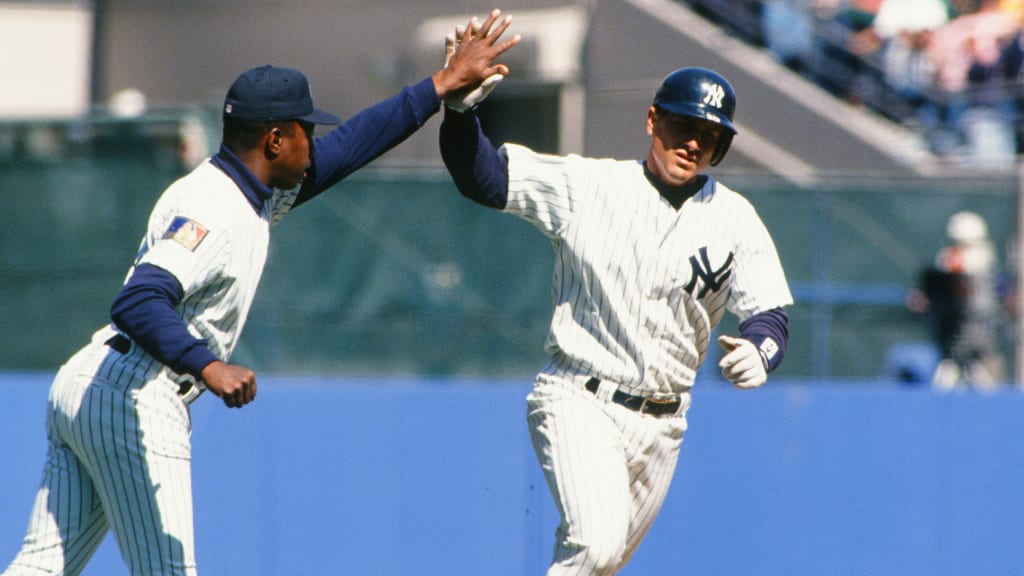
Stanley and the Yankees got to work in the second half of the season, winning 22 of their final 28 regular-season games to secure the first AL Wild Card in history. When the Yankees defeated Toronto on the last day of the regular season, the celebration matched Stanley’s mentality. The Yankees were mindful of how far they had come, but they wanted to go even further.
“Our celebration was much more subdued than what you see today when a team gets into the playoffs because we felt like we hadn’t won anything yet,” Stanley said. “We were in the playoffs, and we were proud of what we had done. But there was no Champagne or goggles. We had a few beers, and we were content to congratulate each other but not celebrate yet.”
The Yankees took an early lead in the 1995 Division Series against Seattle, winning the first two games at a raucous Yankee Stadium.
“Our fans were at a level that I had never seen before,” said Stanley, who batted .313 in the best-of-five series with one home run. “It was electric, especially for someone who had never gone to the playoffs. We were feeling really good about our chances to get to the next round at that point.”
That optimism would only last a few more days. The Yankees could not close things out in the Mariners’ ballpark, losing the best-of-five series in a heartbreaking 11th-inning Game 5 defeat.
“The Kingdome was ridiculous,” Stanley said. “I had never experienced a level of noise like that. I literally couldn’t talk to anyone in the dugout without screaming.”
***
Stanley’s first tenure with the Yankees came to a close in that classic series. Despite the progress the team had made, Showalter was replaced by Joe Torre in the dugout and Michael was reassigned to a senior scouting role, making way for the team to hire Bob Watson as general manager.
The new regime chose not to re-sign Stanley, a .285 hitter in pinstripes, instead trading for Joe Girardi. Stanley signed with the Boston Red Sox and had a productive season in 1996. He was traded back to the Yankees in 1997 but returned to Boston in 1998, where he remained through the summer of 2000.
The last five years of Stanley’s career could be described as baseball’s version of a Greek tragedy. After playing a pivotal role in the team’s rebirth, Stanley didn’t get to taste the glory of the Yankees’ World Series win in 1996. When he returned in 1997, the Yankees had their hearts broken by Cleveland in the ALDS, and Stanley then had to watch the Yankees win three straight championships from 1998 to 2000 while he was playing in other cities.
“I felt like I was going to be part of something special going forward, but it got taken away,” he said. “In 2000, I heard from some of the Yankees that they wanted me back from Boston. In the meantime, Oakland called my agent and wanted me to fly out there to take a physical. We knew New York was in the hunt, and before I got on the plane to go to Oakland, I told my agent that if New York calls before I land, I’m going there. Of course, they didn’t call, and I finished my career in Oakland.
“I’m proud that I was part of the culture that started something great in New York. But not being able to see it through with all of the championships, that’s kind of hard.”
Despite not getting to the World Series, Stanley remains a symbol of change for the Yankees, especially for fans who had weathered the drought that preceded his tenure in the Bronx. A .270 career hitter with 187 home runs and 702 RBIs during his 15 big league seasons, Stanley showed his humility more often than just his three-home run game. It was a defining characteristic for him, and it still remains intact all these years later.
“When I think back on that time, it’s pretty humbling,” said Stanley, who has four grown children with his wife, Erin. “My locker was in between Wade Boggs and Paul O’Neill. You look around the room and think about what Don Mattingly was doing and what he had done, and you get starstruck. I was just trying to do my part knowing that I had all of these great players around me. The work ethic, what you had to do not only to get to the Majors but also to maintain it, that was my focus.”
Alfred Santasiere III is the editor-in-chief of Yankees Magazine. This story appears in the June 2026 edition. Get more articles like this delivered to your doorstep by purchasing a subscription to Yankees Magazine at www.yankees.com/publications.