
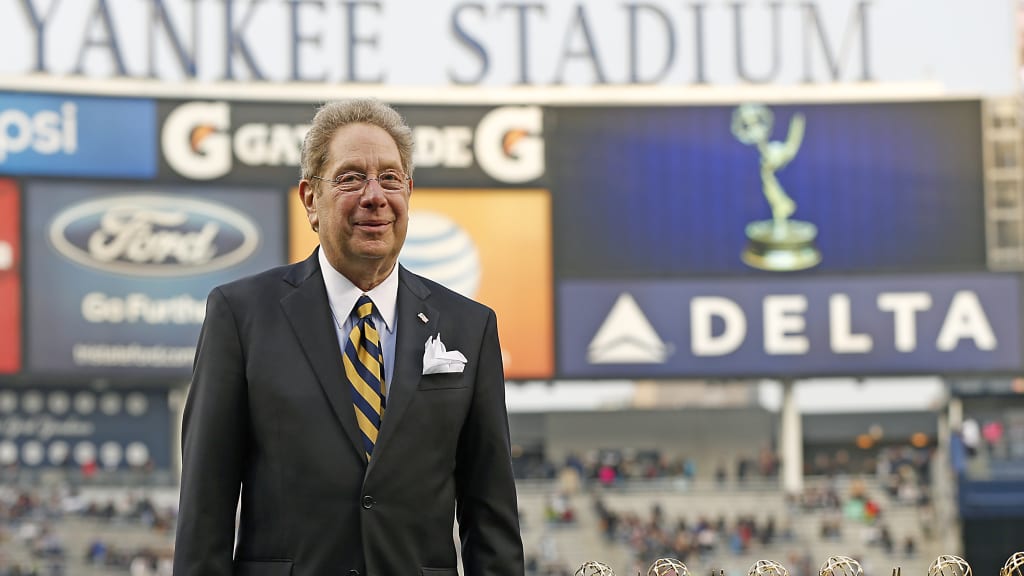
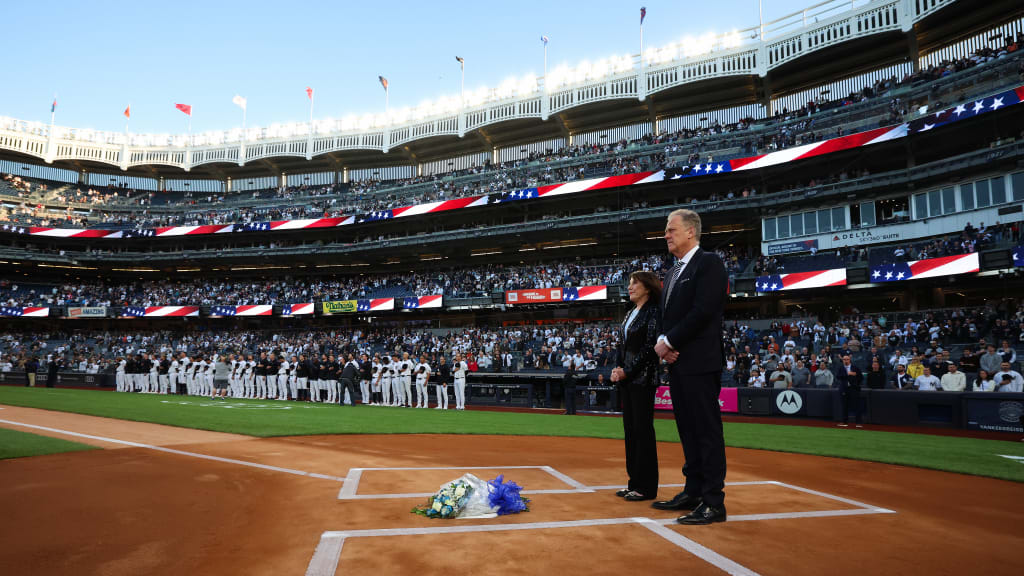
A video montage of John Sterling’s career had played at Yankee Stadium. Michael Kay and Suzyn Waldman, his familiar Yankees broadcast partners, had laid bouquets of flowers at home plate, and the massive scoreboard showed a still picture of the radio booth, empty, but for a lone microphone.
Now, there was a Monday night game to play on May 4, 2026, with the Baltimore Orioles in town. And as Kay walked into the YES Network TV booth, he already knew how he’d further honor the legendary Yankees radio voice, who had passed away that morning.
It wouldn’t take long for Yankees Universe to hear it. First inning, Aaron Judge at the plate. “Here’s the pitch. High drive, right-center field. Going back Taveras. It is high, it is far, it is … gone! Aaron Judge! A Judgian blast! Here comes the Judge!’”
Kay was going to give a basic version of Sterling’s famous “high, far, gone” home run call to the first Yankee who went deep. But he was only going to give it the full Sterling treatment if it were hit by the Yankees captain.
“John had to be pulling the strings,” Kay said later.
As he rounded the bases, even Judge wondered to himself how Sterling -- who loved home runs more than almost anything short of his family or a Cole Porter musical score -- might have called that one.
“He loved the Yankees,” said Judge, who rang the first note in a 12-1 Yankees win. “He loved this team. He loved this franchise. He loved the fans. Loved everybody he talked to on a nightly basis.”
Over that same scoreboard, Sterling’s voice was heard again a few hours later, giving his signature, trembling victory celebration.
“Yankees win! Thuuuuuuh Yankeeeeees win!”
“A nice little touch there at the end,” said Judge. “A nice tip of the cap to John and what he meant to this franchise and this fan base.”
***
What he meant to Yankees Universe across 36 seasons, five of them culminating in World Series parades, goes beyond the signature home run calls -- starting with “Bern, baby Bern” for Bernie Williams -- and the Sterling-isms that became catchphrases for generations of fans.
It was that conversational and theatrical connection, every night, for 162 games and into October.
“He understood to whom we were speaking,” said Waldman, his compañera in the WFAN radio booth for two decades and a friend for two more. “We were doing Yankees games for Yankees fans, and most of them are pretty sophisticated.”
Sterling’s incredible string of calling 5,060 consecutive Yankees games encompassed every inning of Derek Jeter’s Hall of Fame career, though Sterling felt too much was made of that streak.
Just like everyone else, he showed up for work every day -- almost always in jacket and tie -- and what’s all the fuss about?
“He’s the only person I ever met who did everything he ever wanted to do in his life, ever,” said Waldman. “He was a showman.”
Captivated by radio announcers at an early age while growing up in New York City, Sterling knew he would one day be one of those voices. And the airwaves of Sterling’s youth were filled with drama, music and sports. The year he was born, 1938, Orson Welles’ Mercury Theatre adaption of H.G. Wells’ “The War of the Worlds” caused a panic. The early ’40s brought Edward R. Murrow’s reports from London in World War II and FDR’s addresses and the big band sounds of Benny Goodman, Tommy Dorsey and Glenn Miller.
Sterling had a deep affection for that music, and for the DJs of the time, particularly WNEW’s Jack Lazare, host of a midnight to 5 a.m. program, “The Milkman’s Matinee.”
And of course, there was Red Barber calling Brooklyn Dodgers games on WOR and Mel Allen giving the Yankees play-by-play on WINS.
Sterling listened to them all and developed his own “utterly unique” broadcasting style, as former radio partner Charley Steiner once put it.
On the air, that meant tossing the baseball media guide aside and metaphorically pulling up a barstool next to someone and talking about the game.
“There aren’t but a handful of us anymore that don’t completely rely on stats and exit velo or all that,” said Steiner. “We tell a story in our unique way.”
That was Sterling’s gift, the subtle magic between those “high, far, gone” calls. Baseball on the radio “is about the other three hours,” said Steiner, “and how you keep the listener involved.” His audience was so invested that Sterling would hear fans of all ages repeat his home run calls or sometimes offer suggestions.
“He brought that New York theater to the ballpark, I think, is the best way to describe it,” said Judge.
Even the current Yankees manager was a fan. After certain games, if a big moment occurred, Aaron Boone would often seek out the highlight for one specific reason: “I’ve got to hear how John called this.”
Spending summers in Philadelphia when his father Bob Boone was the Phillies’ All-Star catcher, Aaron was “that kid who grew up loving baseball,” falling asleep with a transistor radio under the pillow while listening to Harry Kalas and Richie Ashburn.
Sterling was that connection to Boone’s youth, and “I loved his calls, the theatrical way he did things, unlike anybody else,” Boone said. “He was an original. And I ate it up.”
So much so that as soon as the final out of a Yankees victory is made, Boone will pump a fist in the dugout and shout, “Ballgame over. Yankees win. Thuuuuuuh Yankeeeees win!”
“My coaches look at me like I’m nuts,” said Boone. “I don’t even know if they know what I’m doing.”
***
Only, thuuuuuuh Yankeeeees weren’t winning so much when Sterling first arrived in the Bronx by way of Atlanta in 1989.
Kay became Sterling’s broadcast partner in 1992, and “he used to commiserate with me during those three years because he was miserable. The team was bad, and he had left Atlanta. He loved his life there, he loved the Hawks (NBA) games and the Braves. His dream was to be the Yankees’ announcer, but when he dreamed it, the Yankees were great.”
And with all that losing, “as he would say, he couldn’t do his act,” said Kay.
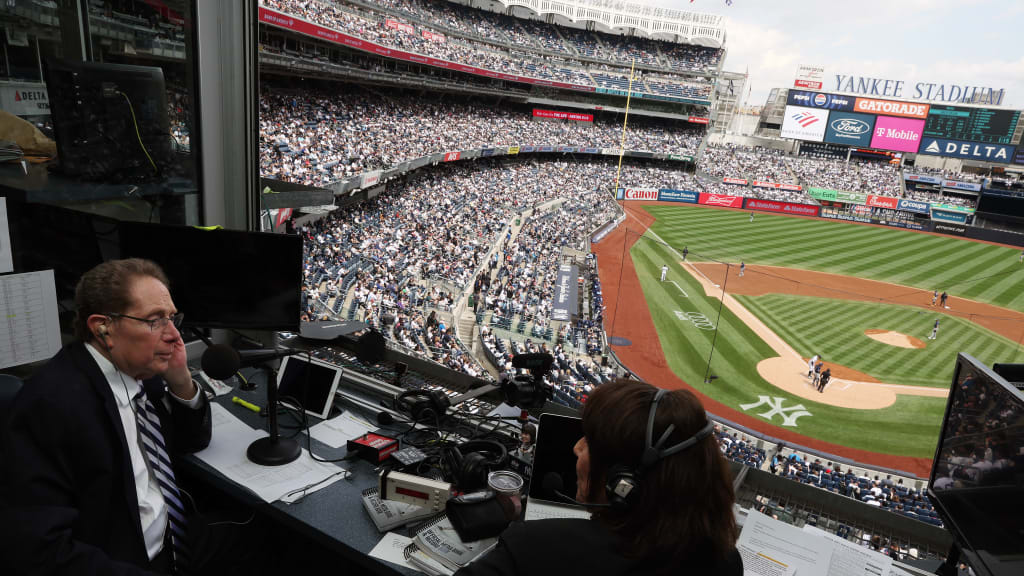
The championship seasons that soon came brought joy and memorable calls and attracted new, younger listeners. For one of them, meeting Sterling, one of his broadcasting idols, “was overwhelming in the best way possible,” said Emmanuel Berbari, a Fordham grad who works the Yankees’ pre- and postgame shows on WFAN.
“You listen to him growing up, and he’s this larger-than-life persona, one of the main reasons you want to pursue this career. You’d have cherished any opportunity to meet him, let alone work with him.”
But Berbari, like so many before him, found that meeting Sterling in person brought you into the company of someone as genuine as the voice on the radio.
“I had no idea what to say, but he makes you feel immediately comfortable and welcomed,” said Berbari, who will never forget Sterling’s support when he filled in as play-by-play man in 2023.
Kay experienced that same support 30 years earlier, when he moved from covering the Yankees as a baseball writer to the broadcast booth.
“There were so many people that wanted that job. And it came down to five people, including me, and I think the other four were ex-players,” said Kay. “The head of ABC went to John and said, ‘Which one of these five do you think would be best for you?’ He goes, ‘Well, I know who would be best with me, but I’m going to wait for you to make a choice, and I’ll tell you if we’re thinking on the same guy.’”
They were, and the Sterling-Kay chemistry blossomed from the start.
“He wanted people to eavesdrop on our conversations,” Kay said of the cocktail party vibes Sterling conveyed on air by dropping names of guests who wandered into the booth -- famous or not.
As Sterling told Kay, “I want it to seem like you’re missing something if you don’t listen.”
Waldman had first encountered Sterling in 1987, when she served as an update announcer on brand-new WFAN, and Sterling arrived as a guest talk show host.
“He cupped his ear and talked standing up for four hours, and I thought to myself, ‘This must be a very interesting person,’” said Waldman, who knew Sterling’s voice from his mid-to-late 1970s sports radio talk show on WMCA, during the decade when he called Nets and Islanders games.
As broadcast partners, Waldman and Sterling learned that “we have the same taste in music, we read the same books -- he was a voracious reader,” said Waldman. “In between innings, he would be reading. And he’d come right back into it. He could turn it off, read a couple of pages, and, ‘Now we go to the bottom of the seventh …’ It was extraordinary.”
That’s also how Waldman described Sterling’s play-by-play skill.
“Listen to him describe a play, and don’t watch it. It’s perfect,” said Waldman. “A lot of people thought he was a little flowery, that he wasn’t for New York. He was very New York … it was all from his heart.”
Looking back over the decades, Sterling’s unapologetic authenticity is what resonates loudest. “He never strayed from who he was,” said Berbari. “The common sentiment is to point out the home run calls, and that was a huge part of it for me, and I loved them. But I really loved the side quips as much -- the little John-isms, if you will. There’ll be a dribbler along the third-base line that hits the bag instead of rolling foul and goes for a double, and he’ll have a side remark: ‘Anybody who tries to predict this game ...’
“That stuff was so great and hilarious to me because it was so true. He never had to overspeak to get the point across.”
***
And doesn’t everybody have a Sterling story? Yankees’ Spanish-language play-by-play broadcaster Rickie Ricardo will never forget rescuing a soaked Sterling from his Cadillac on River Road (which had become a literal river) in Edgewater, N.J., during a 2021 flash flood after calling a game remotely at Yankee Stadium due to pandemic restrictions.
Navigating the closed streets and police blockades, “to get him to his front door, which should’ve taken three minutes, took an hour and 20 minutes,” said Ricardo. In that time, “We talked about everything.”
Kay recalled Sterling’s brief disclaimer before their very first broadcast: “Don’t ask my age on the air, and I talk to myself quite often, so don’t be alarmed.” That last part was no joke. “He would get so upset” when the Yankees were slumping, “he would talk to the invisible friend.” Kay finally asked Sterling: “Why do you care if they win or lose? The players don’t care if we don’t have a good broadcast.”
Sterling’s response?
“Michael, my boy, let me tell you why: If they start winning while we’re broadcasting, people are going to like us because we’re bringing good news to them. As great as Marv Albert was, would he be as famous if not for ’70 and ’73? He brought Knicks fans championships, so they associated him with that.”
It made sense to Kay. “People listened, and they listened for the schtick and the jokes and the conversation between the two of us,” he said. “And it was so easy because the team was so good. And when they won that championship in ’96, the whole thing spun, and everything he said was right. All of a sudden, people associated us with the winning.”
For the remainder of the 2026 season, the Yankees will wear a John Sterling sleeve patch with his name, a microphone and the interlocking NY logo, connecting a one-of-a-kind broadcast legend with the team whose legends he narrated.
“John gave us all those great calls during that time,” said Kay. “They’ll live forever.”
Pete Caldera is a contributing writer for Yankees Magazine. This story appears in the June 2026 edition. Get more articles like this delivered to your doorstep by purchasing a subscription to Yankees Magazine at www.yankees.com/publications.