
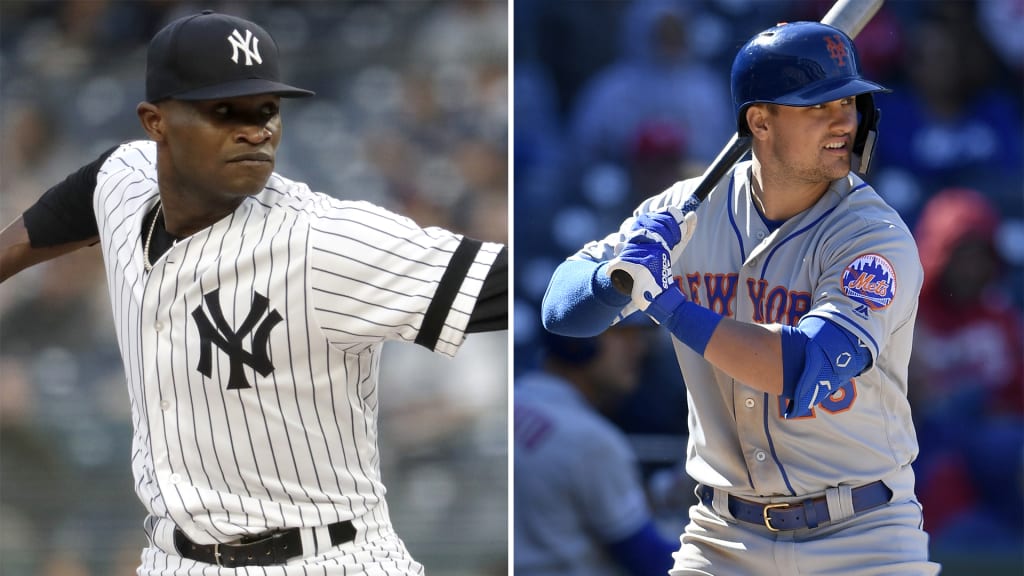
The Yankees and Mets aren’t in the same division, let alone the same league, but for obvious reasons, they will always be linked together. And right now, they are in a similar boat when it comes to their rosters. Both clubs have seen injury replacements perform much better than expected, which will force both general managers (Brian Cashman for the Yankees and Brodie Van Wagenen for the Mets) to make some really tough roster decisions in the coming weeks when the injured players return.
Let’s take a look at the dilemmas both clubs will face, starting with the Yankees.
Yankees: German, Frazier vying for full-time spots
When Luis Severino's troublesome shoulder landed him in the injured list before camp broke this spring, the whispers around the league began immediately.
“How long will it take Cash to trade for a big arm?”
“What will the Yankees have to give up for Madison Bumgarner?”
“How much money will they throw at Dallas Keuchel now?”
None of these things has happened, of course, as Cashman opted to fill the hole in his rotation from within. Based on what we’ve seen from Domingo Germán, that proved to be the right call.
German is 4-1 with a 1.75 ERA in five outings (four starts) this season, allowing a league-low 4.6 hits per nine innings and an impressive 3 1/2-to-1 strikeout-to-walk ratio.
The 26-year-old right-hander is one of the key reasons why the Yankees have been able to weather the storm despite the rash of injuries that have placed a dozen other players on the IL alongside Severino.
But what happens when Severino comes back?
Masahiro Tanaka, James Paxton, J.A. Happ and CC Sabathia appear firmly entrenched in the Yankees’ rotation, giving the Yanks a solid five-man group when Severino is healthy.
One American League executive described German’s stuff as “electric,” but wondered whether the righty is destined for a career in the bullpen despite his stellar start.
“Starting is such a tricky thing to predict; you look at delivery and arm action, and it looks more reliever-ish,” the executive said. “To me, starting is more about managing your innings, limiting damage, being able to get a strikeout when you can. People didn’t believe [Chris] Sale could start when he was in college because of body and delivery, but he manages the game so well and has maintained health, which is another key component.”
German has pitched well in his 15 career relief appearances, so the Yankees know he can handle either role. An injury to one of the other four starters would make it a moot point, and given the way the Yankees’ season is going, the next injury might always be just around the corner, but German should remain on the big league pitching staff for the entire season.
The question will then become what his future holds: starter or reliever?
“There is so much value in leverage relievers these days that I think people are too fast to move guys to the pen,” the American League exec said. “Starters still determine your fate. The move to the bullpen almost always comes with a reduction in pitch types -- most relievers are two-pitch guys -- so keeping all of a pitcher’s pitch types in play if they move to the bullpen is paramount to me if you want him to start again at some point.
“The back and forth is also really tough for players, mentally. It’s a special breed to be a starter and a different kind of special breed to be a leverage/back-end reliever -- and I don’t believe those makeups intersect. But people are quick to just move guys to the 'pen thinking you get a bump in velo, etc. There’s so much more to it.”
German’s .180 BABIP suggests that his success this season is due in part to good fortune, though he’s certainly impressed rival executives with his swing-and-miss stuff, especially with his curveball.
A second AL exec was a little less bullish on German’s upside, saying: “I think he can be a No. 5 or swing man. But he’s probably a better fit long-term in the 'pen.”
The rotation isn’t the only potential quandary the Yankees will have to face when their roster gets healthy.
Clint Frazier has been a bright spot while Giancarlo Stanton, Aaron Hicks and, most recently, Aaron Judge have been on the IL. Although Frazier joined them there Thursday with a left ankle injury, he’s expected to return before any of the others.
With Brett Gardner also in the outfield mix, what will happen with Frazier once the others are back?
“It will be tough to get Clint at-bats in that scenario, but with [Luke] Voit at first base every day, I suppose they could make it work,” the second AL exec said. “But I would lean towards sending him [to Triple-A] for everyday at-bats.”
Frazier, 24, was a key piece the Yankees got from the Indians in the Andrew Miller trade in the summer of 2016. A first-round pick in 2013, Frazier appeared to finally hit his stride this year, hitting .324/.342/.632 with 6 homers in 73 plate appearances wit the Yankees. Given his performance, it would seem hard to demote him, but he should have some more time to prove that he is for real since, as mentioned, he should be back before Judge, Stanton and Hicks.
Mets: Smith vs. Davis
The Mets have a similar roster situation brewing across the East River, as the emergence of Pete Alonso and strong play by J.D. Davis have helped minimize the effects of Jed Lowrie's absence this season. Lowrie, who signed a two-year, $20 million deal with the Mets this offseason, has been on the IL with a knee injury that cost him most of Spring Training. But on Friday, manager Mickey Callaway said that Lowrie has been playing in extended spring training games and could start a rehab assignment fairly soon.
What will the Mets do when Lowrie is ready to return to the lineup?
This much seems to be clear: Alonso, Robinson Canó and Amed Rosario are locked in as everyday players, leaving Lowrie, Davis, Todd Frazier and Dominic Smith fighting for at-bats. And that doesn’t even include Jeff McNeil, who had started six games at third base, two at second base and 14 in left field as of Thursday. He’s emerged as the team’s best hitter for average and probably isn’t going anywhere.
Smith is a clear-cut No. 2 at first base behind Alonso, but he’s appeared in all but one game this season, providing a solid lefty bat off the bench and a strong late-inning defensive replacement. Smith has thrived in the role, posting a .996 OPS in limited action, seemingly embracing his new reality.
“They’ll have to do a lot of mixing-and-matching,” a National League GM said.
That leaves third base as the spot for Lowrie, Frazier and Davis to find at-bats. Davis started 15 of the Mets’ first 24 games at the hot corner, his .865 OPS providing solid offense for a club that was outscored by 12 runs during that stretch.
When healthy, Lowrie slots in as the regular third baseman, with McNeil getting most of his reps in left field. That would leave the following six names for five bench spots: Davis, Frazier, Smith, outfielders Juan Lagares and Keon Broxton and catcher Travis d'Arnaud.
They will obviously need a backup catcher, and of the remaining names only Smith and Davis have Minor League options. So it's likely one of them will be the odd man out.
“Dom Smith should be optioned out,” the exec said. “Lowrie should be the primary third baseman vs. right-handers, work Davis all over the field. I guess Frazier platoons at third.”
Smith's one saving grace is that he is the only left-handed hitter among those six names, which could lead to them sending down Davis instead. And while “backup first baseman” isn’t really a common role in the era of a five-man bench, Smith is a strong defender there and often replaces Alonso in late innings. Davis doesn’t add much defensively at any position, and the Mets have three players (Lowrie, Frazier, and McNeil) who are better than him defensively at his primary spot, which is third base.
Bottom line: If everyone is healthy when Lowrie comes back, manager Mickey Callaway will have a lot of infield options on a daily basis. But as the first AL executive is quick to point out, health is never a certainty.
“Something will always happen to make the decision easier,” the executive said.