



Spring Training has just begun, and yet hamate bone injuries have already impacted some of the biggest names in MLB.
This week, we’ve learned that the Mets’ superstar shortstop Francisco Lindor and the Diamondbacks’ dynamic outfielder Corbin Carroll are both dealing with hamate bone injuries that could cloud their Opening Day availabilities. The Orioles announced that their young second baseman Jackson Holliday, the former No. 1 overall prospect in the game per MLB Pipeline, will have hamate bone removal surgery Thursday and is likely to miss Opening Day.
Mets manager Carlos Mendoza announced on Wednesday that Lindor would have surgery on the hamate bone in his left hand that day, necessitating a six-week recovery timetable. Carroll suffered a broken hamate bone in his right hand during a live batting practice session Tuesday and was also scheduled for surgery on Wednesday, preventing him, at minimum, from participating with Team USA in the upcoming World Baseball Classic.
So what’s the deal with this little bone that’s causing such big headaches for big leaguers?
Here’s everything you need to know about how the hamate bone applies to baseball.
What is the hamate bone?
The hamate bone is a small (typically less than an inch), wedge-shaped bone located in the wrist, on the pinky side. It has a small, hook-like projection called the “Hook of the Hamate.” Think of it like a tiny coat hook. It serves an important purpose as the attachment point for the transverse carpal ligament forming the roof of the carpal tunnel. But unfortunately, it’s very fragile.
Why are baseball players susceptible to fractured hamate bones?
Because of the way baseball players grip their bats, with the knob resting right up against that little bony protrusion, they are more susceptible to potential hamate bone breaks than the average person. The direct compression caused by thousands of swings can develop stress fractures in the bone in the lower hand (the left hand for right-handed batters and right hand for lefties), essentially weakening it over time.
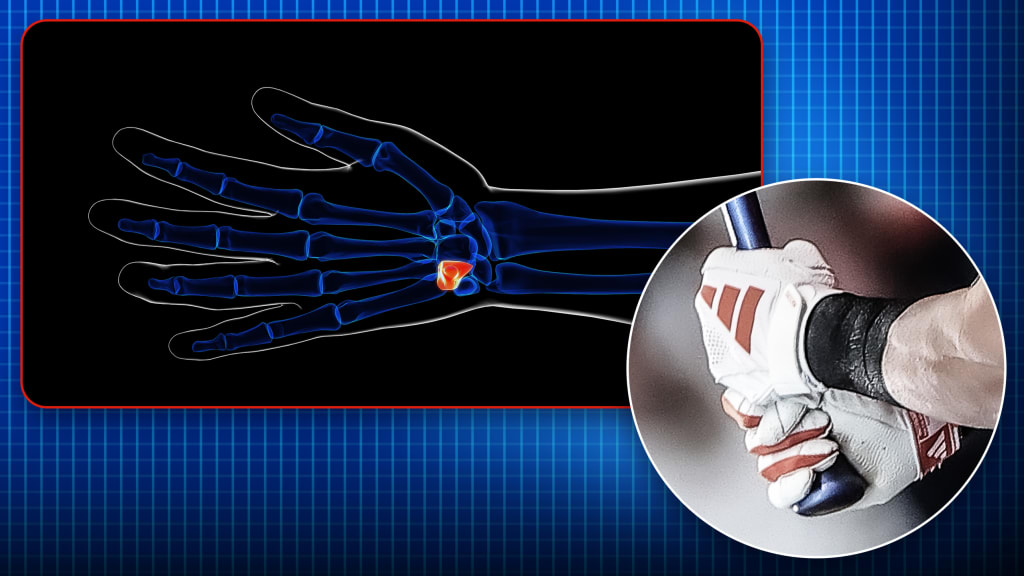
Really, any kind of contact -- be it foul tips or hard line drives -- can potentially cause an injury, because the vibration of the contact can drive directly into the area of the palm where the Hook of the Hamate is located. But it can even happen on something so simple as a checked swing, because abruptly stopping the swing can have the same effect. Actually, checked swings are considered the most common cause of these injuries.
Are hamate bone fractures easy to diagnose?
Not necessarily. They can certainly be suspected when a player is feeling pain in the palm and experiencing a weakened grip. But X-rays can be ineffective, because the size and positioning of the bone makes it difficult to get a proper image. Often, CT scans or MRIs are needed to confirm the break.
What does surgery entail?
Often, removal.
Removal? Like an appendix?
Yep. The hamate bone has a poor blood supply, so it doesn’t heal well on its own. It’s so small that attempts to fix it surgically often fail. And with time of the essence in professional sports, the path of least resistance is often to just remove the fragment of the bone completely.
Is that risky?
There is some level of risk baked into any surgery. In this case, players run the risk of nerve dysfunction or dull palm pain in that area. But a strength and conditioning program can treat these issues, and the excision is generally considered to be low-risk.
What is the recovery timetable?
Usually anywhere from four to eight weeks.
Does the surgery produce good outcomes?
For the most part, yes. A 2020 study in the American Journal of Sports Medicine included 261 professional players and found that 81 percent returned at the same or higher level.
But of course, that means some had complications in getting back to full strength. A prominent recent example of a player having post-surgical complications was Mike Trout, who suffered a broken left hamate and had surgery in early July and returned to play on Aug. 22 for just one game and then was shut down for the season because of lingering pain and soreness.
Again, though, most players have good outcomes. Giancarlo Stanton (2015), José Ramírez (2019), Matt Olson (2019) and Mookie Betts (2024) are some of the star players who have had the surgery. Heck, Ken Griffey Jr. had it in June 1996, missed about a month and still finished fourth in the AL MVP voting that year.
Hopefully this new crop of players with hurting hamates will have similar success stories.