

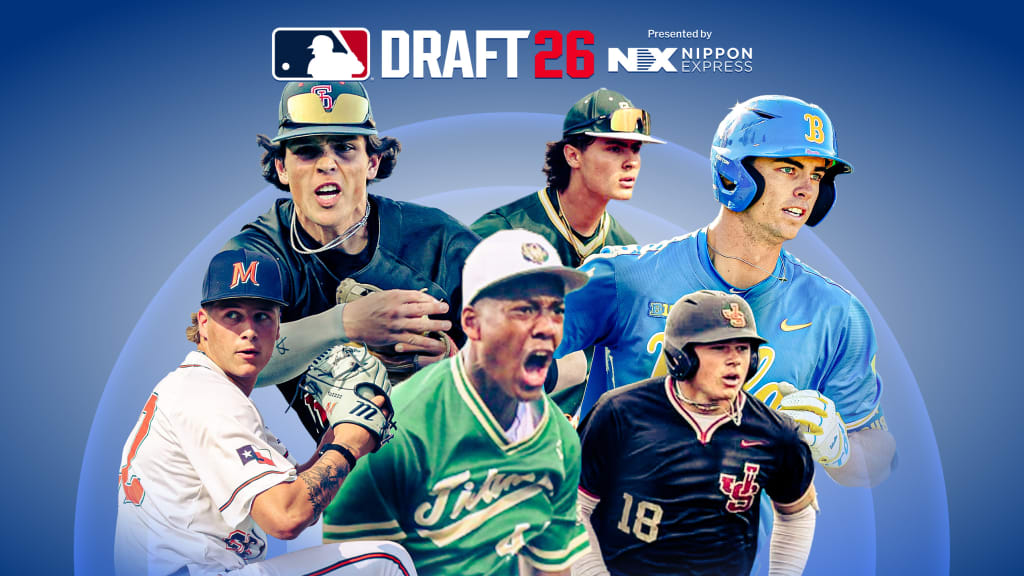
We’re only just getting going.
Day 1 of the 2026 MLB Draft brought plenty of headlines on Saturday, chief among them that the Big Three of Roch Cholowsky (White Sox), Grady Emerson (Rays) and Vahn Lackey (Twins) went first, second and third in that order. There were a few surprises too, though the adage remains true: you can’t judge a Draft class until it’s officially complete.
That’s all the more reason to pay attention to Day 2 of the Draft today as organizations finish off their 2026 hauls with Rounds 5-20 as part of All-Star Week in Philadelphia.
2026 MLB DRAFT PRESENTED BY NIPPON EXPRESS
Day 2: LIVE (Rounds 5-20)
• Round-by-round analysis
Coverage
How to watch and when
Day 2 began with the opening of the fifth round, and the entire process, all the way through to the conclusion of the 20th round, will be broadcast and streamed on MLB.com. Jacob Wilkins, Jim Callis and Jonathan Mayo are on the call from Philly.
Top prospects remaining
There is a new dynamic at play in 2026 with Day 2 beginning with the fifth round. Typically, Rounds 3-4 are when teams have historically sought out above-slot deals from high-schoolers, using the extra break from Day 1 to their advantage to find who is signable. But with Day 2 pushing back to Round 5 this year, that might be a taller task given what the bonus-pool slots are in that range.
Then again, we have seen some notable picks in this range before. A recent example was California prep outfielder Josiah Hartshorn, who went in the 2025 sixth round to the Cubs but signed for $2 million -- a record for the round and closer to early second-round money. One year later, he’s a Top 100 prospect in baseball. Among Major Leaguers, Brewers shortstop Cooper Pratt looked destined for college in 2023 before Milwaukee swooped to take him in the sixth round and signed him for $1.35 million; Pratt debuted in The Show on June 16, less than three years after his Draft Day.
Could any of these remaining talents follow similar paths to prominence? These are the top prospects still left on the board (not including players who have officially withdrawn from the Draft):
Archer Horn, SS, St. Ignatius College Prep (Calif.) HS (No. 54)
Horn showed off good bat speed and a solid ability to elevate on contact as a left-handed-hitting shortstop from Northern California, and there’s some belief that power will come as he adds strength. His arm strength is his best asset as he’s shown 93-95 mph velocity off the mound, but a lack of speed may cause him to move off the six down the line. He is committed to Stanford, like 36th overall pick Tyler Spangler is from the same region.
Blake Bowen, OF, JSerra Catholic (Calif.) HS (No. 63)
There’s a ton to like in the 6-foot-3, right-handed slugger’s profile, starting with his plus-plus raw power. Bowen has a good amount of athleticism too that leads to 60 grades for his run and arm tools, and should he eventually need to slide from center to right, he could be at least an above-average defender in the corner. However, in-zone whiff issues bring pause about his hit tool, and that could be enough to send him to his commitment at Oregon State.
Joseph Contreras, RHP, Blessed Trinity (Ga.) HS (No. 64)
All-Star José Contreras’ son is famous in baseball circles in his own right after he pitched for Brazil in the World Baseball Classic, even forcing Aaron Judge to ground into a double play. (He struggled with control by walking six over a pair of WBC appearances, but at 17 years old, he was the youngest player on a tournament roster.) Contreras works with a 92-95 mph fastball, and there’s plenty of projection in his 6-foot-4 frame. His best pitch is a 77-81 mph forkball, and he has a slider and traditional changeup that show promise. Contreras is a Vanderbilt commit.
Carson Bailey, LHP, McLennan (Texas) CC (No. 70)
Bailey tore the ACL and meniscus in his left knee on March 4, capping his season at just 23 2/3 innings for McLennan, and that limited work could be affecting his Draft status. When he was on the mound, the 6-foot-4 southpaw showed a 93-96 mph fastball with sink, an 82-85 mph breaking ball with inconsistent shape and a mid-80s changeup with good fade. He threw 53 1/3 innings for Baylor in 2025 and initially committed to Texas A&M for 2026 before switching to the JUCO route for his sophomore year, making him Draft-eligible this summer.
Ethan Bass, SS, Glenbrook North (Ill.) HS (No. 71)
Bass is an above-average runner who uses his athleticism to his benefit at shortstop. Also gifted with a plus arm, he was considered a better defender than his fellow statesman Landon Thome, who went to the White Sox with the 34th overall pick. However, Bass also comes with more offensive questions with a hit tool that grades out as average and power that will need to come as he adds strength in his late teens and 20s. He has a Wake Forest commitment if he isn’t selected on Day 2.
Will Gasparino, OF, UCLA (No. 72)
Four Bruins went on Day 1 in Roch Cholowsky, Logan Reddemann, Mulivai Levu and Roman Martin, and Gasparino, who transferred after two years at Texas, is still waiting to join them on the drafted list. He sticks out with his size at 6-foot-6, and he has the potential for plus-plus raw power from the right side. He’s also undergone stance changes in recent years to take advantage of his athleticism, but still, concerns remain about how much he chases pitches outside the zone. Establishing a more refined approach will be a priority at the next level.
Landon Brown, RHP, Iowa Colony (Texas) HS (No. 77)
Brown was seen as both a pitcher and a third baseman as a prepster, and it’s still possible he plays both ways at Mississippi State should he head to school. But pro scouts preferred his work on the mound as he showed a mid-90s fastball that could reach a new level with the right shape adjustments. A low-80s slider also flashes plus with good sweep, and there’s an upper-80s cutter as a bridge and a mid-80s splitter to kill spin. Brown could take off with a singular focus, but it will likely take a sizable overslot bonus to get him into the pros.
Denton Lord, RHP, South Walton (Fla.) HS (No. 80)
Standing 6-foot-6, Coleman Borthwick went 21st overall to the Padres. His high-school teammate Lord, who is even two inches taller, is still waiting to hear his name called or else he’ll head to Mississippi State. There’s a lot of projection to dream on in Lord’s frame, and he can already touch 97-98 mph with his fastball. His upper-70s curveball can look promising but needs more consistency with its shape, and his low-80s changeup was barely used.
Bo Holloway, LHP, Christ Presbyterian (Tenn.) Academy (No. 82)
Ironically, Holloway worked with Cy Young winner and famed knuckleballer R.A. Dickey at Christ Presbyterian but generated the most interest in his fastball after bumping it up to 100 mph and sitting 94-98 from a lowered arm slot this spring. Unlike most prep arms, the 6-foot-5 southpaw has shown more trust in his changeup than his mid-80s slider, and there is worry about what kind of breaking ball he could find. He could stay in state and head to Vanderbilt.
Kollin Ritchie, OF, Oklahoma State (No. 84)
Ritchie ranked fourth in Division I with 31 homers in 60 games this spring and finished seventh with an .804 slugging percentage. Only Golden Spikes Award finalist Landon Hairston (.860) had a higher SLG among Big 12 hitters. It can be a long swing though, and a high strikeout rate on the Cape last year called into question how the bat will play against more elevated competition. An average runner, Ritchie seems more likely to head to a corner after playing in center in Stillwater.
Draft order
The Dodgers lost out on their fifth- and sixth-round picks after signing players who had rejected the qualifying offer. Other than that, Rounds 7-20 will follow the same order:
1. Rockies
2. White Sox
3. Nationals
4. Twins
5. Pirates
6. Angels
7. Orioles
8. Athletics
9. Braves
10. Rays
11. Cardinals
12. Marlins
13. D-backs
14. Rangers
15. Giants
16. Royals
17. Mets
18. Astros
19. Reds
20. Guardians
21. Red Sox
22. Padres
23. Tigers
24. Cubs
25. Yankees
26. Phillies
27. Mariners
28. Brewers
29. Blue Jays
30. Dodgers