

From the time in the 1800s when the relationship between pitcher and batter became adversarial, arguments about balls and strikes have been baked into baseball.
So the Automated Ball-Strike (ABS) Challenge System powered by T-Mobile being implemented in MLB this year was a very long time coming.
How long, exactly?
Way back in 1939, a spread in Popular Science magazine proposed what was called an “electrical umpire,” with horizontal and vertical light beams intersecting above home plate and reporting whether the pitched ball was a ball or strike.
Alas, installing a system of mirrors and light poles and projectors near the batter’s box would have been, um, a little intrusive.
By 1950, Branch Rickey’s Brooklyn Dodgers were using Spring Training to test out a General Electric-designed contraption that used mirrors and lenses to judge balls and strikes. It didn’t really work, but at least we got a cool photo of Jackie Robinson and Duke Snider checking it out.
ABS Challenge System, powered by T-Mobile
• See what happened on the first ABS challenge
• Everything you need to know
• A visual guide to how ABS works
• Here are Major League Baseball's ABS firsts
• What does all the data mean
• Players get strike zones measured
• Player poll: Who'll be best at ABS challenges?
• ABS Challenge Dashboard
• ABS Challenge Leaderboard
Come 1960, legendary skipper Casey Stengel was noting that “they use radar and electronics for everything else; I don’t know why it can’t be done in baseball.” He was right… but just a few decades early.
Questec came along in 2001, PITCHfx in 2008, Statcast in 2015.
Today, radar is all the rage. We can use it to track anything, including, yes, balls and strikes. So MLB began testing various iterations of ABS in independent and Minor League ball.
Finally, here we are.
We’ve attempted to answer all the questions you might have about how the ABS Challenge System functions and was formed. We’ve also looked at the Triple-A data to identify statistical trends associated with ABS. And we’ve unveiled a new Baseball Savant database that will be populated with all kinds of interesting statistical nuggets, revealing which teams and players prove particularly good at this.
Now, with the Yankees and Giants set to begin the 2026 season on Wednesday Night (8 p.m. ET on Netflix), let’s take a broad look at five things baseball fans need to know about the ABS Challenge System’s expected impact on MLB.
1. The strike zone will be a little smaller.
The ABS strike zone is two-dimensional and strictly rectangular. It is set in middle of home plate -- 17 inches across (just like home plate), with the height based on the batter’s height (53.5% of his height at the top and 27% of his height at the bottom).
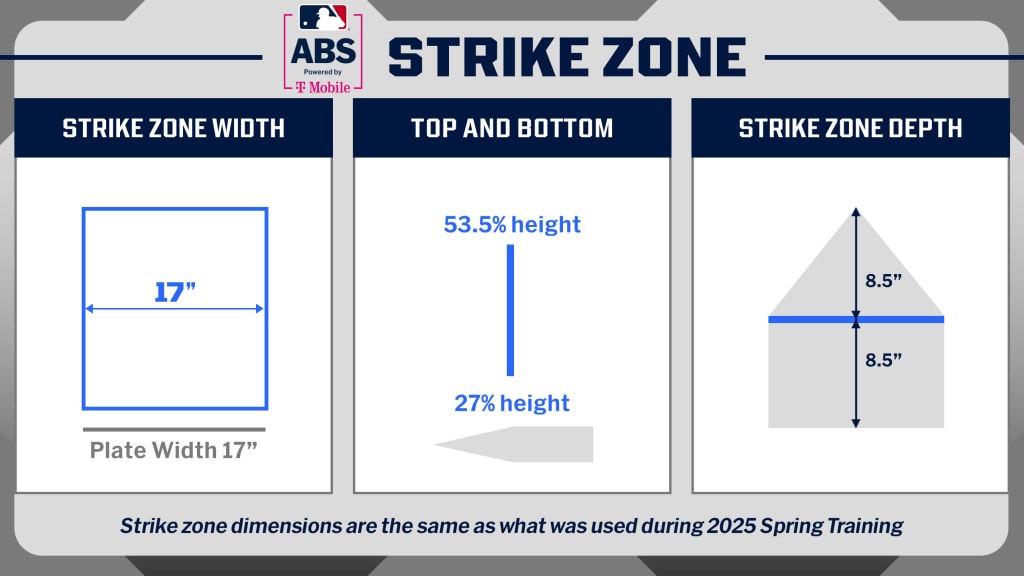
This is slightly different than the more rounded, human-ump-enforced zone of seasons past. The data shows us that the umpire-called zone has had a maximum height of 55.6% and a 24.2% minimum at the bottom.
So be it by umpire adjustment or challenges on close calls, we can expect a slightly tighter zone.
The change here won’t be dramatic, but you can expect to see a slightly reduced strikeout rate (22.2% of 2025 plate appearances ended in a strikeout, the eighth-highest mark of all-time) and a slight increase in walk rate (the 8.4% walk rate in 2025 was basically in the middle of the 7.6% low and 9.6% high observed in the last 70 years of MLB play).
A less-lenient zone could impact pitchers like the Red Sox’s Ranger Suarez and the Diamondbacks’ Merrill Kelly, who rely on guile and chase. It could reward pitchers like the Twins’ Joe Ryan and the Mets’ Freddy Peralta, who are less-reliant on chase and more reliant on whiffs in the zone.
One other note here: How a player stands in the box impacts his perception of the zone. Because each player’s individual strike zone is measured by his height and not his specific stance, a batter who squats down a bit more will feel like the top and bottom of the zone are higher than he is accustomed to, while a batter who is more upright will feel like those boundaries are lower than he is used to.
2. There will be a new layer of strategy within MLB games.
Teams get two challenges per nine-inning game. They keep the ones they get right and lose the ones they get wrong.
So ideally, you would only challenge a call in the game’s highest-leverage moments. But of course, knowing which moments will prove to be high-leverage while in the course of a given game is an inexact science. Heck, sometimes the biggest pitches turn out to be in the first inning, not the ninth.
Still, guardrails can be helpful. Some teams in the Minor Leagues imposed voluntary restraints, be it not allowing their players to issue challenges in the first inning or only letting catchers, not pitchers, issue challenge on the defensive side.
Indeed, several MLB teams have already instituted an in-house, no-pitcher-challenges policy, preferring to rely on the backstops’ better/closer view.
Blowout games are going to happen, of course. But generally speaking, the last thing a team wants is to get to the late innings and get caught with its proverbial pants down, with no challenges available for an important pitch.
Little wonder that, in Triple-A last year, the number of challenges was much higher in the last five innings than in the first four.
3. There’s a lot less to argue about.
You probably could have guessed that balls and strikes are the root cause of most MLB ejections but – like pretty much everything else in this game – we can put a number to it.
According to a study of Retrosheet data prior to the 2022 season, ball/strike arguments had led to about 43% of all tracked ejections (7,969 of 18,554) historically. But the advent and expansion of instant replay greatly eroded the number of non-ball/strike calls that created controversy. Last season, 63.2% of ejections (110 of 174) were about balls and strikes.
Now, we’ll have the ABS Challenge System eating into that total, too.
That doesn’t mean ball/strike arguments leading to ejections are going to go away completely. There will likely be plenty of moments in which a team out of challenges objects to a call. There also exists the possibility of arguments over disallowed challenges when players take too long to request one or perhaps when umpires rule that they enlisted help from others on or off the field.
But generally speaking, the ball/strike bickering -- the kind of stuff that has Yankees skipper Aaron Boone in the top 30 all-time in managerial ejections in only eight seasons on the job – won’t be what it was. And managers and players are likely to save a heck of a lot of money on fines now that the ABS Challenge System is in use.
If you’re attracted to the whole argument thing, you’ll have to focus your attention on disputed checked swings (though MLB has experimented with a camera-oriented challenge system for these, too), foul tips, balks, interference, obstruction, intentional hit by pitches, unruly behavior and other assorted shenanigans.
4. The broadcast zones will be more consistent.
Though you, the home viewer, won’t have the ability to appeal balls and strikes (sorry), your experience watching the games will be impacted ever so slightly by the introduction of ABS.
The strike zone box shown on broadcasts had, in the past, come from different sources for different networks. Sometimes, therefore, it differed from the zone you might find on Gameday.
That will no longer be the case. Be it on Gameday, the in-park scoreboard or the broadcast, the data sources -- based on actual player heights -- for the ABS zone will be consistent.
And while some broadcasts in the past would indicate within the strike zone box graphic whether a pitch was a ball or a strike (such as using a filled-in circle for a strike and a hollow circle for a ball), now they will be leaving it up to viewers to make that determination for themselves. The reason for this change is to combat the potential for players on the field to be relayed information about pitch location.
5. This is a big change but not a technological Trojan Horse.
As technology evolves, sports evolve. We’ve seen that with instant replay in MLB, which began only on disputed home run calls and has had multiple modifications in the years since to greatly expand the population of plays that is considered reviewable.
There might be temptation, then, to assume that this ABS Challenge System is merely a precursor to “full ABS,” or robot umps. But nothing we have seen or heard, to date, indicates that is the case.
MLB extensively tested full ABS and found it to be unpopular with both fans and personnel alike. It led to more walks and a slower pace, and it took away much of the nuance that is baked into baseball, including the art of catcher framing that so many players value.
A 2023 survey of Triple-A players and coaches found that 60% preferred the game format with the ABS Challenge System, versus 24% preferring a zone enforced entirely by human umps and only 16% preferring full ABS.
Life will teach you to never, ever say never (ever). But the Challenge System has a ton of support and is seen as a happy medium between the human and robot worlds.