

SAN FRANCISCO – For more than a century, each pitch thrown in a Major League game has been judged by one set of eyes: those belonging to the home-plate umpire.
That officially changed on Opening Night.
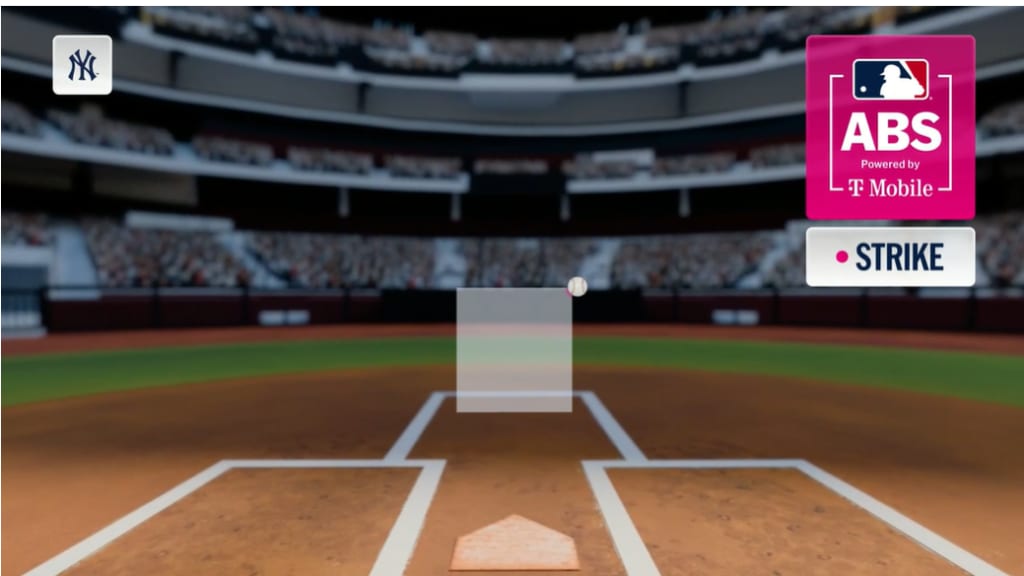
Yankees shortstop José Caballero triggered the first Automated Ball-Strike (ABS) challenge powered by T-Mobile in a big league game, tapping his helmet in the fourth inning Wednesday in New York's 7-0 win over San Francisco at Oracle Park.
ABS Challenge System, powered by T-Mobile
• See what happened on the first ABS challenge
• Everything you need to know
• A visual guide to how ABS works
• Here are Major League Baseball's ABS firsts
• What does all the data mean
• Players get strike zones measured
• Player poll: Who'll be best at ABS challenges?
• ABS Challenge Dashboard
• ABS Challenge Leaderboard
Caballero challenged home-plate umpire Bill Miller’s strike call on Giants starter Logan Webb's sinker on the high-and-inside part of the plate, and the call was upheld.
“I wanted to go for it,” Caballero said. “I thought it was a little higher than what it showed, but at least it was close.”
Said Webb: “It felt like a strike. First one of the year, so I’m glad it went our way.”
While ABS is new to MLB, it’s already familiar to many fans and players. The system has been tested in the Minor Leagues since 2022, and it was used in Major League Spring Training in ‘25 and ‘26 before gaining approval from the Joint Competition Committee last September.
The ABS Challenge System tracks the precise location of each pitch, relative to the specific batter’s zone, which is calibrated to his height and measured to the fraction of an inch.
It represents a hybrid model, preserving human umpires for the vast majority of pitches while offering a mechanism to correct the most obvious misses.
“I think it’s going to be really good,” Caballero said. “We have a lot of guys that know the zone really well. We’re going to be aggressive with it and try to get the calls that we want.”
A pitcher, catcher or batter can challenge a ball or strike call by tapping his hat or helmet immediately after the pitch. There is no input from the dugout.
Within seconds, the result is displayed on the stadium video board and broadcast to viewers. How quickly does the process work? Ask Giants manager Tony Vitello, who missed Caballero’s challenge.
“I only used the restroom one time tonight, and it happened to be the time I was supposed to be doing a Netflix interview,” Vitello said. “I was a little more concerned with the score being 5-0 at the time. I was trying to make sure my belt was buckled. I sounded dumber than usual during that thing. So as I returned, that's when it had happened."
Each team is allotted two challenges per game and retains them if successful, introducing a new layer of in-game strategy.
Caballero said the Yankees have been discussing challenge scenarios for weeks. Manager Aaron Boone said he “didn’t have an issue with” Caballero challenging the pitch in that spot.
“It was really close,” Boone said.