

Earlier this week, Padres pitching coach Ruben Niebla referred to Mason Miller as the best pitcher in baseball. That may incite debate, but Miller certainly belongs in the conversation -- his early-season dominance (including a 0.79 ERA and a 51.7% strikeout rate) already has us wondering about his potential Cy Young candidacy.
Here is something less debatable: Miller is baseball’s hardest-throwing reliever. His average fastball velocity is 101.3 mph, which clears the second-place qualifier, Edgardo Henriquez, by more than a full mph (100.2). If we include starting pitchers, only Jacob Misiorowski has thrown more pitches 102+ mph than Miller this season, and he’s taken over 500 more pitches to do so. The Miz is the only player to hold a candle to Miller’s heat. Otherwise, in an era where everyone is training for velocity, Miller laps the field.
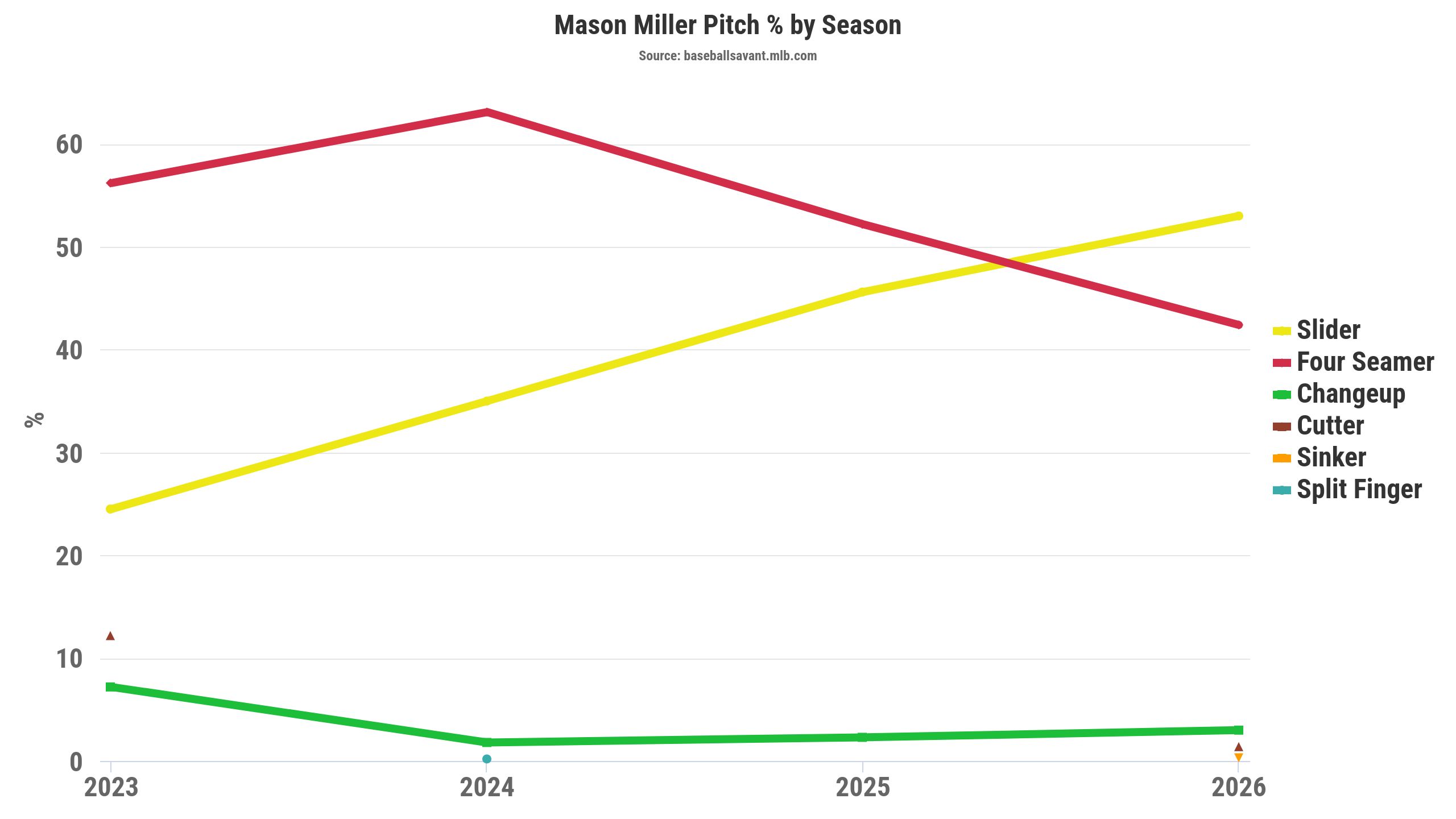
Yes, Miller can throw a baseball comically fast. That is not news. But here’s where things get weird: He’s using his heater less than ever before. Entering play on Saturday, Miller is throwing his four-seam fastball just 42% of the time. That’s down from 52% last season and 63% in 2024; since joining the Padres at the Deadline last August, Miller’s 4-seam usage rate is 45.4%.
If anything, Miller is late to a trend that has swept across baseball over the last several years. Pitchers continue to throw harder than they have before -- the average fastball (4-seamer or sinker) thrown by a Major League pitcher in 2026 is 94.4 mph, which would be the hardest of any year in the pitch-tracking era (since 2008). But pitchers are also throwing fewer fastballs. We’ve seen entire pitching staffs overhaul their approach to de-emphasize “bad” fastballs. This season, the league is throwing fastballs just 46.7% of the time, a rate that’s nearly 10% less than what it was a decade ago.
But why Miller? He certainly doesn’t fit in the “bad fastball” group. His fastball sizzles to the plate, and he’s had plenty of success relying on it. In 2024, when he threw his 4-seamer nearly two-thirds of the time, he posted a 2.63 ERA and struck out 104 batters in 61 2/3 innings.
So, why the change?
“The biggest thing is the slider zaps damage,” Miller told MLB.com’s AJ Cassavell. “... The fastball in a vacuum is a good pitch. But metrically, or analytically, offspeed are generally better-performing pitches than the fastball. If you look at the big scope of data, most of the damage is done on four-seam fastballs.”
For as good as the fastball is -- the opposition is hitting .185 off it with a 42% whiff rate -- the slider is even better. Batters are 5-for-47 with 32 strikeouts against Miller’s slider. They’ve come up empty 52 times on 82 swings. When they do make contact, it’s not pretty. Miller has not allowed an extra-base hit off his slider since Aug. 27, 2024, when now-Padres teammate Ty France legged out a hustle double.
Part of this is because Miller’s slider is absolutely nasty. Stuff+ grades it as one of the best slider shapes in baseball. But its success is also predicated on Miller’s triple-digit heat. The two pitches work in tandem. Even though he’s using his fastball less often than he has in the past, the mere threat of it makes the slider better.
“If you go soft, go soft, then you go heater, it’s kind of putting a guy in a really hard situation to succeed,” Miller said. “If you’re not able to take your A-swing because you have to respect another pitch, I think that probably helps.”
That mindset represents a trend that we’re seeing among some of baseball’s hardest-throwing relief pitchers. A number of high-leverage arms who wield triple-digit fastballs are still using their fastball as a weapon. But it is no longer the weapon of choice.
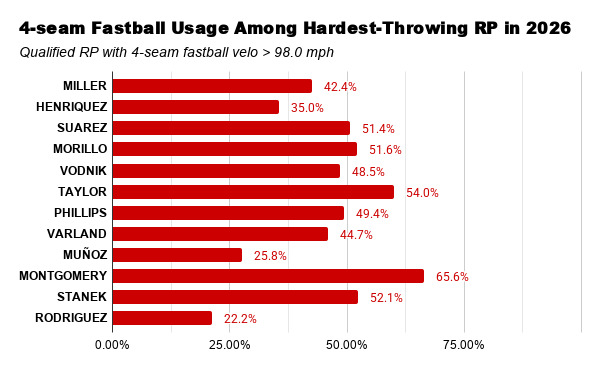
Pitchers who throw hard are beginning to use their fastball less, too. Seven of the above relievers have cut their 4-seam usage from 2025 to 2026.
“I think it’s a lot easier to cheat on a fastball,” said Padres manager Craig Stammen. “When guys are facing guys with that type of stuff, it’s easier to pick the fastball than to pick the slider as what you want to swing at. So pitchers are combatting that by: ‘I’m going to show you a fastball, but then you’re getting something else that’s moving a lot.’”
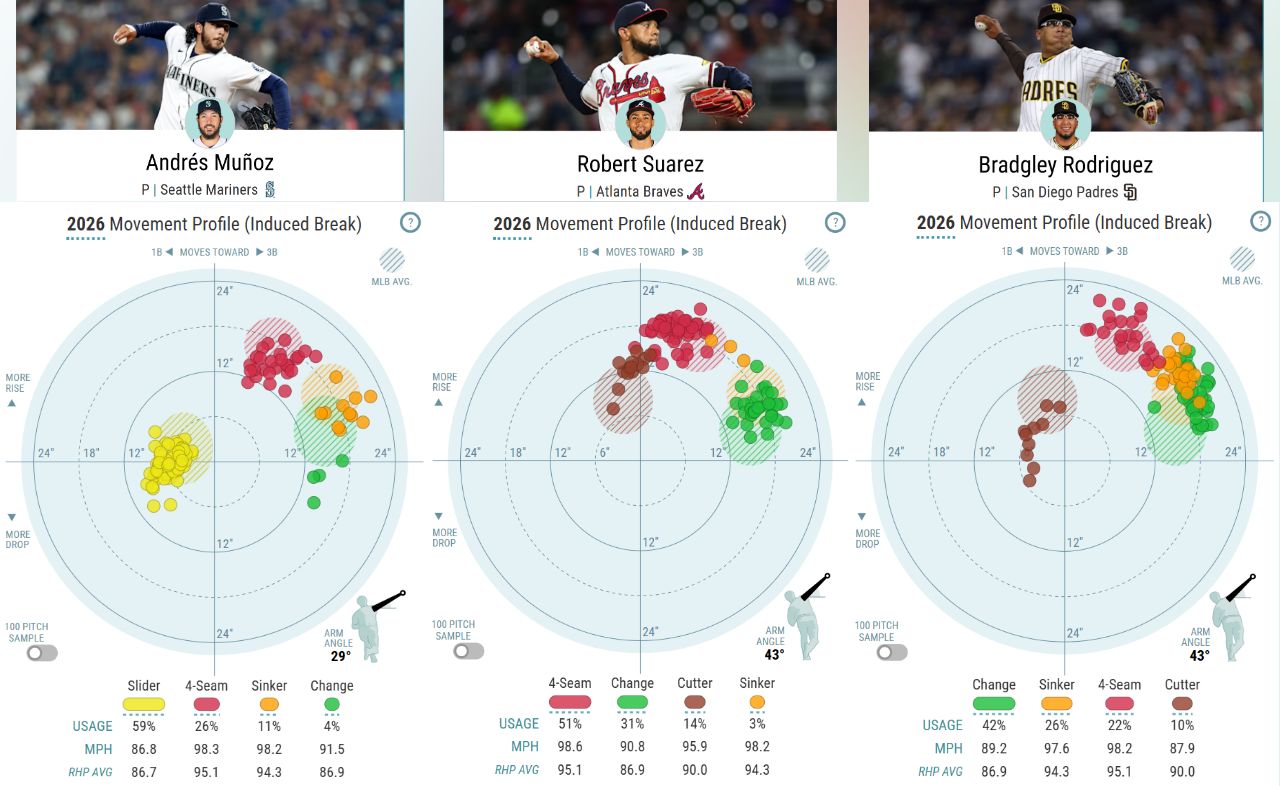
For some, that’s simply another fastball. Nine of the 12 qualified relievers who average 98.0 mph or better with their 4-seamer also have a second fastball shape. Some, like Braves closer Robert Suarez, have three -- Suarez slashed his 4-seam usage by 12% from ‘25 to ‘26 while restoring an old cutter. Mariners closer Andrés Muñoz broke into the Majors in 2019 and used his heater two-thirds of the time. Since then, he’s added a two-seamer and a kick-changeup while making his slider his primary pitch. His 27% usage rate on his 4-seamer this season would be a career low.
(Of note, the list doesn’t include Miller’s teammate, Adrian Morejon, whose primary fastball is a 99.4 mph sinker. This year, Morejon has cut his sinker usage by 14% while bumping his 4-seam usage.)
This is another evolution in the cat-and-mouse game between pitchers and hitters. In some ways, it is also preemptive. Velocity remains king. Batters are posting a .212 BA and .313 SLG in plate appearances that have ended on pitches thrown 98+ mph this season. It is supremely difficult to hit. But everyone throws hard now. Already this season, 180 pitchers have thrown a pitch 98 mph or faster. Ten years ago, in 2016, only 159 pitchers reached that threshold all season. The novelty is gone.
“I remember eight years ago, it was just some guy coming out of the bullpen,” said Rangers outfielder Andrew McCutchen. “I’d ask, ‘How hard does this guy throw?’ ‘Oh, he throws 98 to 100.’ My eyes would blow up and I would go, ‘Jesus, that guy throws that hard?’ Now, if someone comes in, he’s 96 to 98, 98 to 100. It’s like, ‘OK.’ It gets to a point, it’s a commonality in the game now. You kind of get used to it.”
McCutchen has endured the velocity revolution from the other side. As a rookie with the Pirates in 2009, McCutchen saw six pitches 98 mph or faster all season. A year later, Pittsburgh faced Aroldis Chapman during the left-hander’s second week in the Majors. McCutchen’s first at-bat against Chapman came the following season. At the time, Chapman’s fastball was a unicorn pitch, because no one threw that hard, and no one came close from the left-hand side. In his third year in the Majors, in 2012, Chapman threw his 4-seamer 87.6% of the time. There was no reason not to.
“You knew you were going to get a fastball,” McCutchen said. “It was just a matter of where it was going to be. It could be down the middle or it could be in your ribs. But you knew it was going to be a fastball. You had to shrink up your swing and your zone and just try to be prepared to hit it.”
That’s what happened next: Batters learned to train for velo, figuring out how to get their A-swing off against premium heat. Advancements in technology gave players a wealth of options. Some use Blast Motion technology to track new-age hitting metrics like attack angles, vertical bat angles and bat speed on every swing. Others hit off foam-ball machines that are designed to simulate a plus fastball. Some work on developing quick hands. Some use weighted bats to build up bat speed, so that they can catch up to faster pitches. Anything to stay on plane and on time.
This is all part of a hitter’s nomenclature these days. That wasn’t always the case, even just a few years ago.
Tigers rookie Kevin McGonigle -- who is hitting .317 against fastballs -- only incorporated a weighted bat routine to train for bat speed last offseason. He didn’t see consistent velocity until high school travel ball. That was around the same time that Rangers infielder Jake Burger had a rude awakening against Carlos Rodón at the White Sox alternate site in 2020.
“I used to have an Arenado-like stepback move with my swing, and he absolutely blew me up with three heaters,” Burger said. “I was like, ‘OK, we’ve got to make an adjustment.’”
It’s what hitters have always done.
“You adjust, or you go home,” McCutchen told me with a laugh.
Across the league, hitters are searching for answers to what Mets second baseman Marcus Semien calls “the golden ticket to hitting” -- being ready for velocity while having enough restraint to lay off sharper pitches out of the zone. It’s not a new problem, but it may be more pressing, thanks to pitch usage trends from Miller and other hard throwers.
“It’s never going to be easy with guys throwing that hard,” Semien said.
Technology offers some answers, particularly via the Trajekt Arc, a pitch-replication robot that simulates exactly what the hitter will see in the game, mimicking velocity and spin from the pitcher’s release point. Pregame scouting reports also distill information about a pitcher’s count-based usage, allowing hitters to anticipate a fastball or breaking ball in certain counts. It helped Mets outfielder Tyrone Taylor launch a three-run homer off a first-pitch curveball from Yankees closer David Bednar, who is throwing his 95.8 mph 4-seamer a career-low 39% of the time.
Other hitters stick to an old-school approach. Orioles outfielder Taylor Ward hits curveballs before the game, a tactic he learned from Albert Pujols and Mike Trout while the three were teammates with the Angels. Ward prefers to stand in on a pitcher’s bullpen to see a live arm, rather than a simulation.
“It starts with the first video you watched of the guy you’re about to face,” Burger said. “Once an at-bat, I think, they’re going to throw a fastball. That conviction helps you lay off some of their nastier offspeed stuff and get to a count where you can get a fastball.”
When facing the game’s hardest throwers, that used to be a given. It is less so nowadays. Hitters are adjusting, which suits them. That’s always defined what being a hitter is all about.
“It’s just the way the game’s evolved,” Ward said. “It’s funny how the cycle goes. Every year, it’s something different. The biggest thing with us is just preparing. You hope you get your fastball. But maybe it’s the evolution, if we get better at hitting offspeed, they’ll go back to more fastballs. It’s the teeter-totter of the game.”