

Through the first four-plus months of this season, St. Louis first baseman Alec Burleson has recorded nearly 1,000 putouts. That sounds like a lot of work, and it is; it’s the largest figure of any player in the Majors in 2026. That number, however, encompasses two very different parts of his job.
Approximately 25% of that total is fielding batted balls, at which Burleson, who had spent much of his time in the outfield in his previous three seasons before becoming St. Louis’ primary first baseman in 2026, has been a work-in-progress. His minus-4 Outs Above Average this year is adequate, but mildly below average.
The remaining 75% of those putouts, then, are about a first baseman’s other big responsibility – catching throws from his infield mates. Given the massive difference in opportunities, that would seem to be a far more important skill, yet even that has a necessary breakdown within it. Some large portions of that figure, one would assume, are fairly typical on-the-money throws that any semi-competent professional first sacker would be able to receive easily.
We haven’t really known, though. This aspect of a first baseman’s life has been a blind spot in public Statcast data, and while other sites do publish some information about ‘scoops,’ that’s only the number of successful ones, and even then that’s only a small portion of the throws a first baseman has to haul in, despite the outsized importance they receive.
That, then, is the point of the latest Statcast metric at Baseball Savant, which evaluates the performance of a first baseman at receiving the ball. It’s about scoops, sure, but it’s a lot more than that. It’s about the hundreds of throws a first baseman has to handle, and it’s about realizing which one of them actually means much of anything.
The way this works is like most other Statcast metrics, which is to say that it’s not just, “Did you make the play?” but also “... and how difficult was that opportunity expected to be?” In the same way that a sinking liner in the gap is much harder for an outfielder than a lazy can-of-corn pop fly, a throw you have to catch on a short hop or well wide of the bag shouldn’t be considered the same as an on-target no-brainer.
Put those expectations on every play, accumulated over the course of the season, and you’ll find out that the best receiving first baseman this year is Burleson, who has added +6 Outs Above Average simply via being good at collecting throws from JJ Wetherholt, Masyn Wynn, Blaze Jordan, and all the rest.
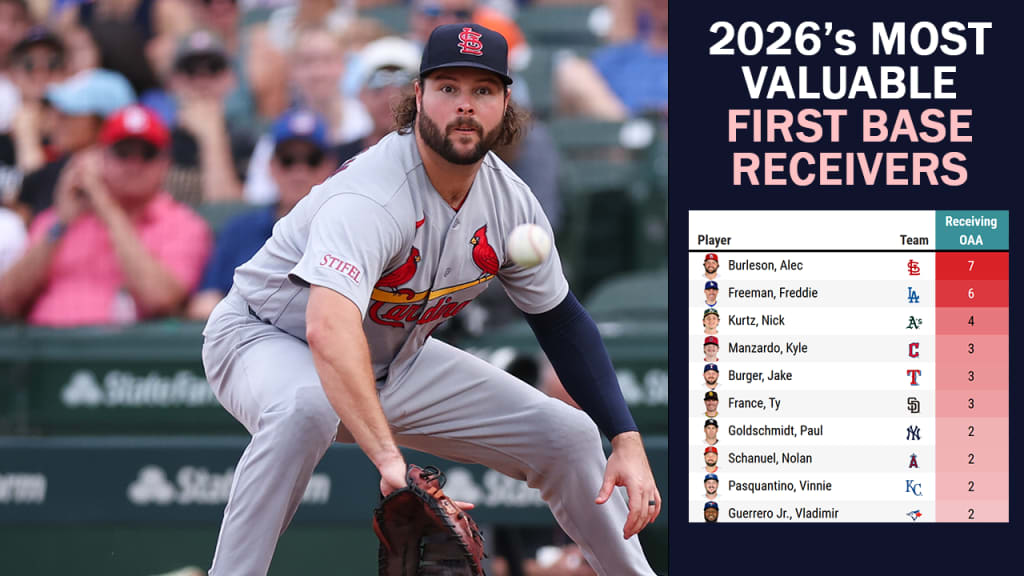
This data is available going back to 2021, and there's a pair of extremely satisfying names atop that cumulative list.
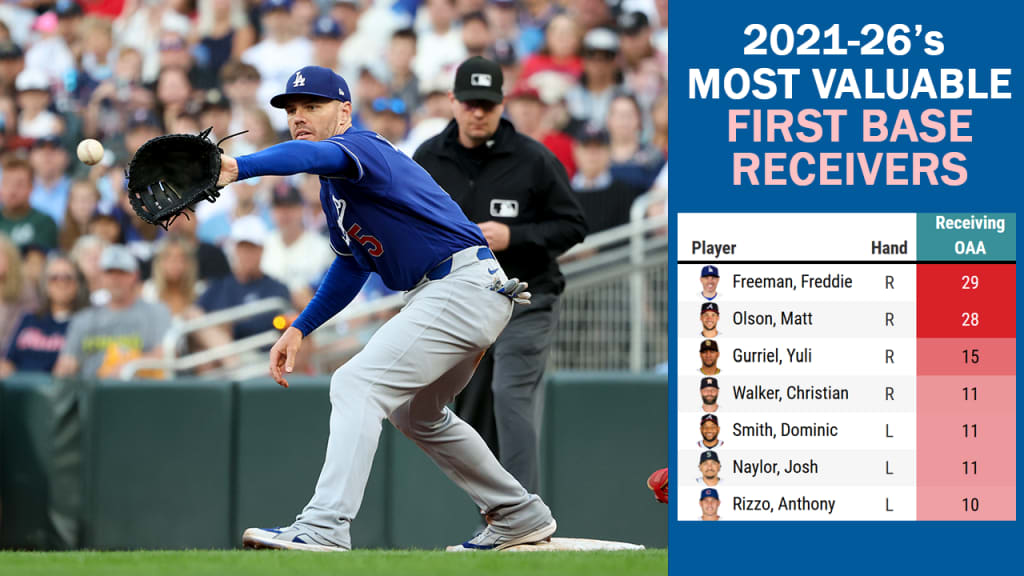
It’s true that Matt Olson and Freddie Freeman have played the most games of any first basemen since 2021. It’s also almost certainly true that when thinking about first basemen with the most shining defensive reputations over the last decade, you’d think of that pair nearly immediately.
So: How does this work? The method is explained in more detail by MLB.com Senior Data Architect Tom Tango here, but simply put: On each throw, the location of the throw is accounted for, as well as the speed and location of the batter running to first. Based on those inputs, we can see how often that opportunity gets turned into an out. (That last part is important, because if a runner is far away from first base, then a first baseman has more chance to recover and get back to the bag. It's not all about the throw.)
That’s all taken into account at the moment the first baseman can actually do anything about it, which is not the time the throw is unleashed, but the time that the ball reaches an eight-foot perimeter around the first base bag, which is roughly the stretching radius of an outstretched player. This is entirely about, “What does the first baseman do with the opportunity he gets near the bag?”
For Burleson, those hundreds and hundreds of throws look like this:
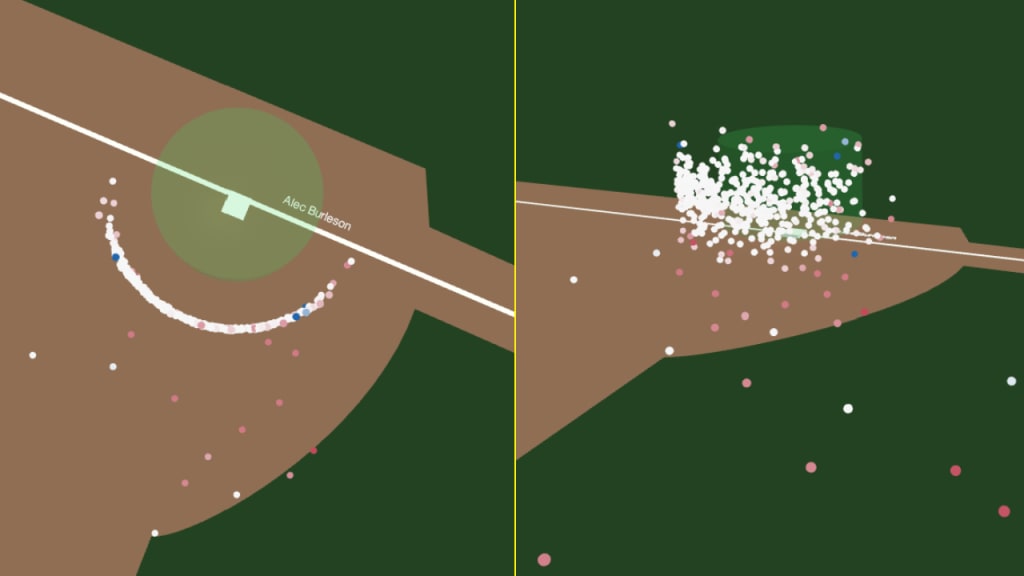
In Burleson’s case, more than 80% of those throw chances have indeed been those on-target, on-the-money ones, the kind like this that you’d generally never pay attention to. He’s had 420 on-target chances, and 414 of those have turned into outs. That's nearly 99%, but it collects him all of +2 OAA for all of that effort.
If that doesn't seem like much, it shouldn't. After all, you’re endlessly doing things like this, fielding a lightly-tossed throw where the runner is more than 30 feet away from the base at the time it comes to you. It’s hard to compile that much value on doing that.
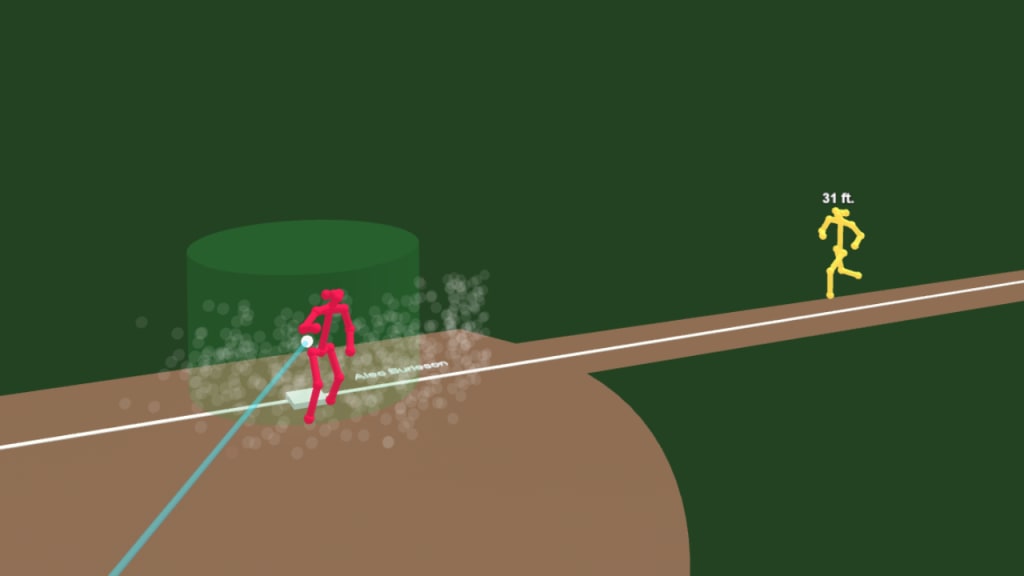
The end result of that is a billion throws that look like this (which gain a first baseman +0.01 out, or basically nothing) …
… and many fewer that look like this (in which Burleson earned nearly +0.25 an out, since other first basemen failed to convert this opportunity about a quarter of the time)
If you go further and break down throws into high, low, wide, on-target, scoops, and bounces, you can get really granular about who does what.
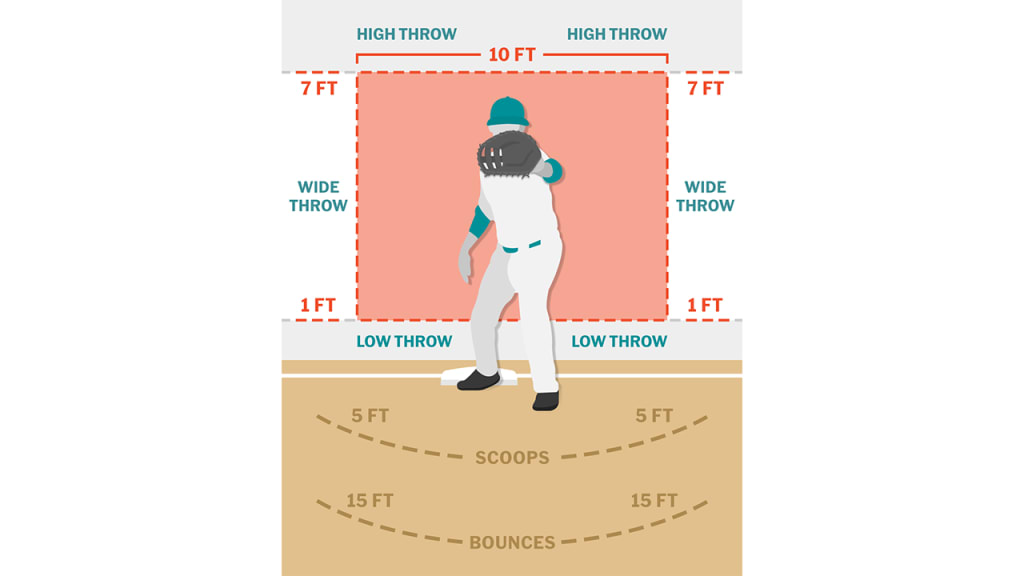
It turns out, Yuli Gurriel was the best at scoops and bounces dating back to 2021, and the long-limbed Freeman is the best at corralling both high and wide throws. For just 2026, it's Houston's Christian Walker who has the most scoops, at 10. Some of them look extremely smooth.
Thanks to that breakdown, we can bucket out every throw opportunity a first baseman has received since the start of this data in 2021, and you’ll see how few opportunities there really are for a first baseman to distinguish himself.
Where are the throws that a first baseman has to receive?
- On Target 82%
- High 5%
- Wide 5%
- Low 3%
- Bounce 3%
- Scoops 2%
Eight of 10 throws, in another words, should overwhelmingly become outs. (And they are: 98% of on-target throws become on-target outs. Only two-thirds of scoops do, but again scoops are much less frequent.)
This is mostly why scoops, as exciting as they are, don’t carry as much value as you’d think – because they rarely ever happen. Pete Alonso has had the most scoop opportunities of any first baseman this year, for example, but even that is only 15, or fewer than once per week. (Remember that scoops and bounces are separated here, because they’re different kinds of plays.)
Burleson, in the midst of a breakout hitting season, spoke about how he approaches receiving throws in a video for Cardinals.com back in April.
"It's an art,” Burleson told Jim Hayes. “You can say it's an art. [You need] soft hands for sure, and there's not any pick that's the same as the last. Depends on the runners, depends on who's throwing it, depends on where it's coming from in the infield. You just take as many reps as you can in practice."
“You're reading the throw,” he also added. “You know who is running, so you know how much time the infielder has, whether he's going to catch and go – or [if] he's going to have a little bit of time.”
Which is great, because that kind of context is basically exactly what the metric is looking for.
Back in the first month of 2025, when Alonso was getting all sorts of praise for this skill, then-Mets manager Carlos Mendoza issued a very high compliment. "He’s probably the best in the game at it, to be honest with you,” as told to Anthony DiComo. That, by this metric in 2024, was exactly right. He was the best at it -- though it hasn't quite sustained since.
Interestingly, while Burleson is in his first year as a full-time first baseman and is excelling, we find that on the other end of this are three defenders who arrived in the Majors at other positions.
- -8 Bryce Harper
- -7 Luis Arraez
- -7 Rafael Devers
Arraez famously declared his intent to stay at second base this year, which has worked out for him; his 5’10” height, as you’ll shortly see, may have been working against him. Devers is barely more than a calendar year into his transition to first base.
Harper, who famously moved from the outfield to first in 2023 (to initially good reviews) was having a down year on defense even before this was incorporated. While he's been fine at scoops, it's been more about the non-scooping aspect of this.
A lot of it seems to be that he doesn't always hold the bag on throws that aren't perfectly made, like this:
Sometimes, it’s just something weird, like the time earlier this year when he failed to corral a perfect throw because, apparently, the ball went right through his glove. Nothing we can do about that – the out wasn’t made, and he was indeed charged with an E3 – but it’s kind of a bad beat, too.
All this lets us ask some pretty fascinating questions, like these.
Does being tall matter?
When the Phillies moved Harper to the outfield earlier this month, shortstop Trea Turner had some interesting thoughts about replacing the 6’1” Harper with the 6’4” Alec Bohm.
“(Bryce) picked the ball great for us this year, and he did a good job,” Turner said. “But sometimes a bigger target just makes you feel a little better. And then it feels like you make better throws just because you know you have so much room for error. Where there’s not like, ‘I have to throw this one perfect,’ or, ‘I have to do this.’ So, yeah. It can definitely help sometimes. Especially on high throws, too, where you’re like, ‘Oh, I kind of let that one go up a little bit.’ He can kind of stay on the base and stay on those.”
The stats back that up. Harper was +1 on bounces and scoops, but -4 on high throws, the weakest first baseman in the Majors at that.
So, what about it? Does being tall help here? Overall, maybe a very little, but less than you'd think. We looked at the 30 first basemen who had 1,000 throw chances over the last six years, and it's only because of the presence of the 6’4” Freeman and Olson that makes this look like a trend at all. Without that pair, there's basically no relationship at all -- as shown by the relatively shorter Gurriel (6’0”), Josh Naylor (5’10”), and Walker (5’11”), who all rate well.
Call this a loose relationship, but probably not a terribly strong one – you can be short and play a good first base.
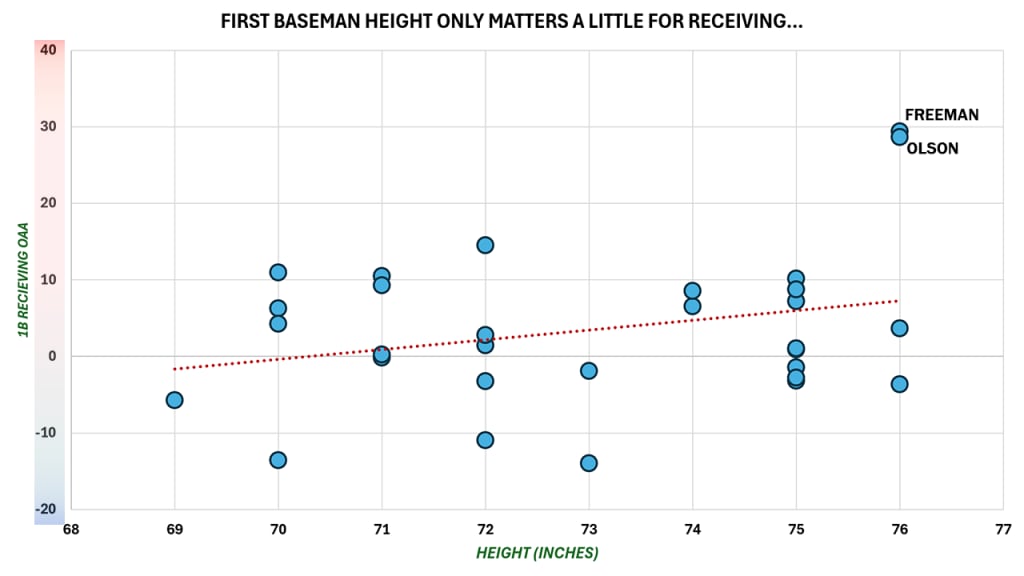
But for high throws, shorter first baseman are at a more notable disadvantage. Of the top 10 fielders at getting high throws, only Michael Busch (5’11”) is shorter than six feet tall. Of the eight weakest at high throws, every single once is 6’1” or shorter.
How to explain the disconnect, that tall first basemen are better at high throws, but not better overall? It might be that taller first basemen have a more difficult time on bounce throws, the ones that impact the grass more than 15 feet away.
That knowledge, then, leads to some outcomes that might be confusing at first glance.
Last summer, Cincinnati shortstop Elly De La Cruz was charged, understandably, with an error on this high throw in Arizona. But first baseman Spencer Steer also eats some negative receiving value here, even if when you watch it, you think there was no way he could have come down with this. The reason why? We’re comparing first basemen not to themselves, but to all others, and at 5’9”, Steer had to leap for a ball that a taller first baseman might have caught easily.
Height, in other words, is a skill here – one you have or you don’t.
Which infielders have been helped or hurt by first base receiving?
While this isn’t a grading tool to evaluate throwing accuracy, you can, at least, see which fielders have been saved by good first basemen – or the opposite.
Over the six years of this metric, no infielder has been helped more by excellent first base receiving than Ozzie Albies (whose 1Bs earned +9 outs on his throws) which makes a great deal of sense; Albies has been throwing to Freeman and then Olson his entire career.
On the other end, no infielder has been hurt more than De La Cruz, at -12 Receiving OAA, which also makes sense, as Cincinnati first basemen (mostly Steer, Sal Stewart, and Christian Encarnacion-Strand) have been tied for baseball’s weakest over De La Cruz’s four-season career.
How much does this matter?
That’s the tricky part. As we said: 80% or so of throws a first baseman gets are the receiving equivalent of the can of corn. It's nearly impossible to separate yourself from others on those. That just doesn’t leave a lot of room for value, though that’s certainly not the same thing as not having value. This does have value.
But how much? Statcast assigns everything a run value, in order to put disperate things such as catcher framing, blocking, outfield throwing arms, and first base receiving on the same scale. One OAA in this skill is given the same value as one OAA for a fielder collecting batted balls, so it’s worth 0.75 of a run.
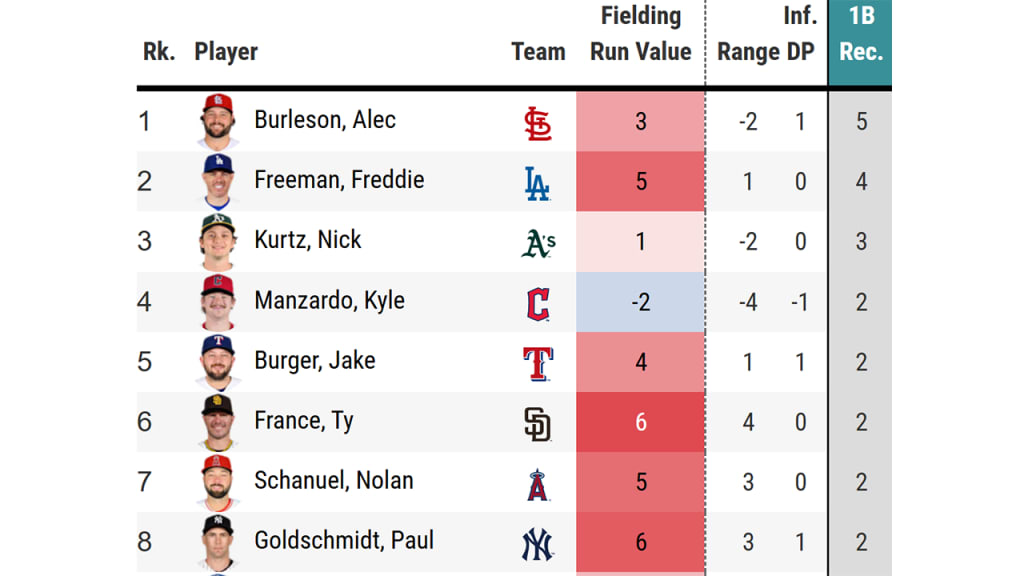
For someone like Burleson, that matters a lot. Take the minus-2 Fielding Runs he’s at for collecting batted balls, add the +5 Fielding Runs he’s going to add here for receiving, include some previously accounted for value for getting double plays turned, and it definitely changes the perception of how you view him defensively. He goes from below-average (-2 Fielding Run) to above (+3).
But in another sense, it’s just never going to match up to things that happen so much more often. The most valuable receiving year we have over the last six seasons was Olson in 2021, who earned +7 runs just from receiving. That’s a lot of value for an infrequent thing – and yet it pales in comparison to the value added by this year’s best hitters (Yordan Alvarez, +48 batting runs), pitchers (Jacob Misiorowski, +42), or defenders overall (Pete Crow-Armstrong, +24).
Which, we think, is exactly what was expected at the start. It matters a little. Little things add up to a lot. It’s just hard to stand out without the chances to do so. Now, at least, we’ll know a little more about who excels at this generally underappreciated skill.
It’s not a huge thing. It’s not nothing, either. All the little things in baseball add up to victory. This one does, too.