

In the new world of ABS, one thing has been clear from the very start: Every challenge isn’t created equally. It can’t be. Leverage and situation are everything. Challenging the first pitch of the game, as Zach Neto did last week in Cincinnati, can’t possibly be as important as turning a walk into a strikeout (or vice versa) -- as we’ve seen more than 250 times already -- or even more valuable, taking or removing a run from the scoreboard.
ABS Challenge System, powered by T-Mobile
• See what happened on the first ABS challenge
• Everything you need to know
• A visual guide to how ABS works
• Here are Major League Baseball's ABS firsts
• What does all the data mean
• Players get strike zones measured
• Player poll: Who'll be best at ABS challenges?
• ABS Challenge Dashboard
• ABS Challenge Leaderboard
That being the case, while it’s been enjoyable to watch balls and strikes flipped and overturned here and there, what we’ve really been waiting for is the one where it really feels like the outcome of the game hangs in the balance. While we’ve seen game-ending overturns already, the Orioles were up 8-3 in the ninth when they did that, so the challenge could only be so weighty no matter which way it went.
We’ve gotten close. We’ve seen a pair of full-count bases-loaded walks get turned into strike threes, when Cal Raleigh did it to Yainer Diaz on April 11, and when Carson Kelly did it to Oneil Cruz on April 12. We’ve seen it once from the batter’s side, too, when Logan O’Hoppe turned a bases-loaded third strike into an RBI walk on April 8.
Those were close, but they didn’t quite scratch the itch, because they came early on in the game, all somehow coming in the second inning.
No, what we wanted to see finally happened on Thursday afternoon in Chicago, from a most unlikely source: White Sox backstop Edgar Quero, who had ironically entered the day as baseball’s least effective challenging catcher, had the best day any catcher has had so far, overturning three different bases-loaded ball calls -- in part because he had the critical ninth-inning moment we’ve been waiting weeks to see.
Let’s set the stage. It’s the ninth inning. The Rays and White Sox are tied, 3-3. The bases are loaded with one out for new pitcher Lucas Sims, having come in to replace Seranthony Domínguez, who’d blown the 3-2 lead Chicago had held entering the inning. Rays outfielder Jake Fraley worked the count full, fouling off two of the first six pitches.
The 3-2 pitch is a sweeper, low. Fraley lays off. The umpire signals ball four. Fraley jogs to first with the go-ahead run, and the scoreboard did indeed note that the Rays had gone ahead 4-3. They did, until they didn’t. Quero requested the review, prompting an “uh oh” from the Rays broadcast, correct to worry that the run wasn’t actually going to count.
It didn’t. While it wasn’t a strike by much -- you can easily see why the umpire called ball on this one -- it clipped the bottom of the zone. A run-scoring ball four became a third strike, keeping the score tied.
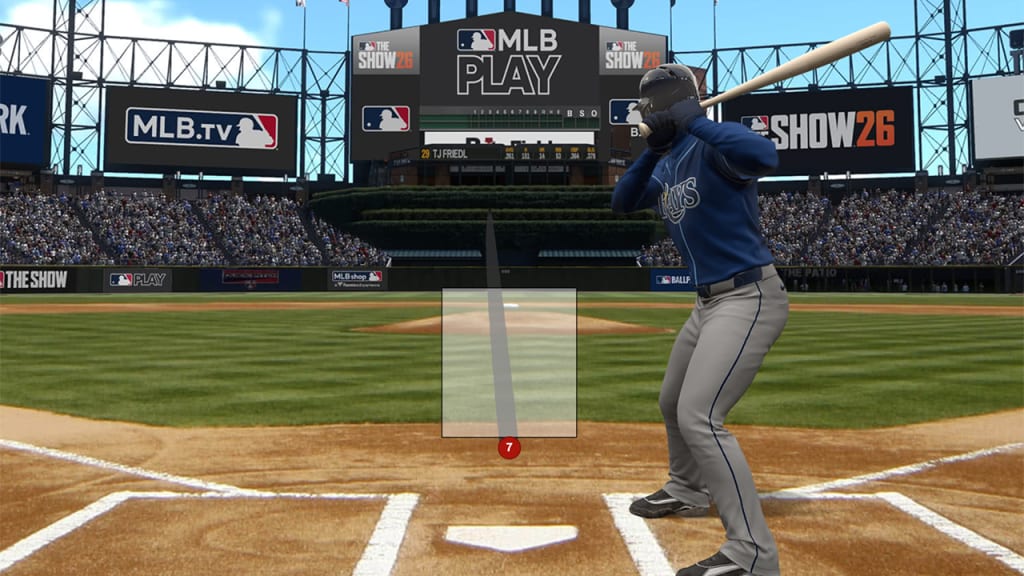
Now, none of this stopped Sims from walking in the next two batters or the White Sox from ultimately losing 5-3. There’s only so much that one pitch can do. But for the purposes of “just that pitch,” this went down as being worth +1.8 challenge runs for Quero, tied with the three examples above for the most valuable overturn of the season -- with a ninth-inning caveat we’ll get to.
Of course, this was just a capper to a great day. Quero, earlier in the game, had challenged back-to-back pitches on Yandy Díaz with the bases loaded. Neither would have pushed a run in, coming on 2-0 and 2-1 counts, but there’s of course considerable value in saving his pitcher from going to a three-ball count. The three wins here helped him a lot more than the two losses hurt.
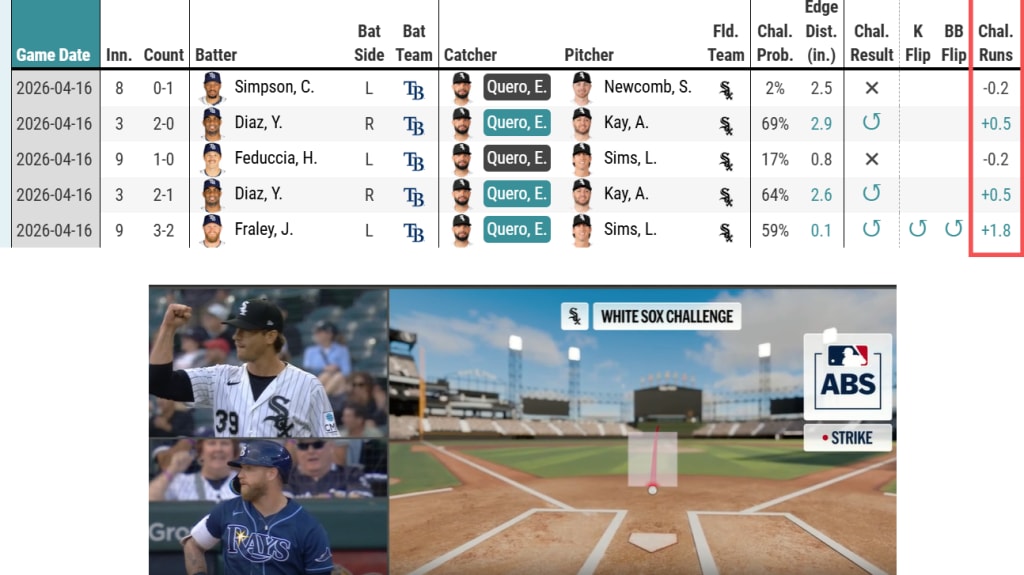
Combining the pluses and minuses together here, and Quero saved his team +2.4 runs worth of value -- which now gives him the most valuable ABS game a catcher has had, topping Kelly’s +1.9 runs from that April 12 game.
So: how do we get to those figures?
The math here gets complicated, but we can try simplify. This all works off of run expectancy, or how many runs a team scores on average given the situation it's in. (That is, you’d expect a lot more runs with the bases loaded and no out, 2.43 on average, than you would with the bases empty and two out, 0.10. That’s just putting numbers to what everyone with eyes can see.)
With Baseball Savant’s Game Strategy Explorer, you can see how the numbers net out. With the bases loaded and one out, in a full count, the Rays were in a situation where on average, they’d be expected to score 1.7 runs. There’s two outcomes from there, based on this pitch.
- A run-scoring walk: +1 real run and starting a new plate appearance at +1.6 expected, so +2.6 of total run value
- A run-preventing strikeout: no run scored, and starting a new plate appearance at .8 expected, thanks to two outs
That gap -- not only keeping the run off the board, but putting the Rays in a worse spot by hitting with two outs rather than one -- between the 2.6 runs via the walk and the .8 runs via the whiff gets you that 1.8 runs worth of value. Had this come with two outs and ended the inning, it actually wouldn’t have changed things all that much, because the Rays would have started in a less valuable position (the .8 we mentioned, being two outs with the bases loaded, plus the +1 via the walk) and gone to zero -- which is also a gap of 1.8 runs.
We said it was complicated, but it’s the only way to grade these things for context. When Neto challenged that first pitch of the game in Cincinnati, and lost, it gained the Reds only +0.2 runs worth of value, because going from a 1-0 count with no runners on and no outs to a 0-1 count in that situation is nice, but not terribly world-changing.
The real-world run-scoring aspect here is key. When Reds slugger Eugenio Suárez correctly challenged back-to-back bases-loaded strike threes on March 28, it first took him to 2-2 and then to 3-2. What it didn’t do was force in a run, and Suárez eventually grounded out. So he gained, on the more valuable one, +0.8 challenge runs, not more.
So, in terms of how much value you can add on a single challenge, this is essentially it. We can break the tie, though.
Remember when we noted that all three of the previous bases loaded, full count overturns had come in the second inning, in games that weren’t tied? Because of that, the Win Probability Added -- which does take into account the inning and score -- shows that Quero gained +20.6 percentage points for his team, which is the difference between the Rays having a one-run ninth-inning lead with the bases loaded and one out (74.5% Win Probability) and the score remaining tied with bases loaded and two outs (53.9% Win Probability).
Again, we know the Rays did end up losing, but that challenge turned it from a situation where they were in a very bad spot, down a run with the bases loaded, and into one that was more of a coin flip.
That, so far, is the most valuable overturn a catcher has been able to provide.
Quero, as we said above, hasn’t rated terribly strong here, following up a 3-1 performance on Opening Day by being incorrect on 14 of his next 21 tries. He’s still, on the season, a mild negative behind the plate. But for one afternoon in Chicago, he had the most valuable day of the early season. He saved his pitcher something like the most damaging outcome a pitcher can have. He was, in this new skill, a star.