

DENVER -- Hideo Nomo is remembered most for his unorthodox windup, which was dubbed “The Tornado” because of its whirling, twisting motion that generated tremendous torque and a devastating fastball/forkball combination that baffled opposing batters.
But on a cold, wet evening in the shadow of the Rocky Mountains 30 years ago, the enigmatic right-hander from Japan found it more comfortable to go from the stretch.
That turned out to be a very good decision.
Following a two-hour rain delay to his start for the Dodgers against the Rockies at Coors Field on Sept. 17, 1996, Nomo threw what is regarded by many as the most improbable no-hitter in baseball history.
It was a feat legendary Dodgers broadcaster Vin Scully noted was thought to be “impossible” at the most hitter-friendly ballpark in Major League history. And it’s something no one else has matched in the three decades and nearly 4,800 team games at Coors Field since.
How did Nomo do it? It took a historic confluence of factors that included unusual weather conditions and a pitch that was simply unhittable.
But it began with an unflappable disposition.
Poise amid the noise
Nomo’s ability to withstand external pressure, such as the kind he faced as he flirted with history at the hitter's paradise of Coors Field on that remarkable night, can be traced back to the very first time he took the mound in a Major League game.
Nomo’s arrival in the United States after he spent the first five seasons of his professional career pitching for the Kintetsu Buffaloes of Nippon Professional Baseball was followed with great fanfare in his native Japan and great intrigue among MLB fans.
But before “Nomomania” took hold in Los Angeles and elsewhere around the baseball world, the 26-year-old with the corkscrew windup nearly didn’t make it out of the first inning in his big league debut.
That was on May 2, 1995, when Nomo got himself into some early trouble against the Giants on a mild, sun-splashed day at Candlestick Park. Dave Wallace, then the Dodgers’ pitching coach, went to the mound with Nomo’s interpreter after Nomo got the first two outs of the first inning but then walked the bases loaded.
That mound meeting was the first indication for Wallace and the Dodgers that this guy was the real deal, particularly when it came to poise under pressure.
With hundreds of Japanese press on hand and the eyes of two nations fixed squarely on Nomo’s every move after he had minutes earlier become the first Japanese-born player to appear in a Major League game in 30 years, Wallace didn’t hesitate.
“Just out of instinct, when I got to the mound, I asked him,” Wallace remembers. “¿Cómo está?”
Dodgers catcher Mike Piazza was incredulous.
“Hey Dave,” Piazza said. “He’s Japanese, not Spanish.”
Nomo got the gist of it. He nodded with a one-word response, one that would perfectly encapsulate his ability to block out the noise:
“Good.”
And he was. After a long battle with Royce Clayton, Nomo struck him out to extinguish the threat. And from there, he yielded just two baserunners over the next four innings against a lineup that featured three-time National League MVP Barry Bonds and the previous year’s home run leader, Matt Williams.
Some 16 months later, Nomo again found himself in a bit of a first-inning jam, this time on a cold and cloudy night at Coors Field. Beginning the game out of the windup, he walked the second batter he faced, Quinton McCracken, before McCracken stole second and moved to third on a flyout.
But the ever-stoic Nomo then struck out Dante Bichette with his patented forkball to escape unscathed. It was the first of three times Nomo would strike out Bichette -- the runner-up in NL MVP voting the year before -- on the night.
It was just the first inning of a late-season contest that would become remembered for much more than its already significant importance with the Dodgers and Padres battling for a division title.
But Nomo’s signature calm portended things to come, proving to be key in completing one of the greatest single-game pitching performances in baseball history.
“After that first at-bat, it was like, ‘OK, he’s got good stuff,’” Bichette said. “But no big deal.”
Unbeknownst to Bichette, Nomo, Wallace or anyone else, it would become a very big deal.
Effectively wild
When Nomo journeyed across the Pacific to challenge himself against the best baseball players in the world, he brought with him one of the most effective pitches of his era. It was his forkball -- or splitter, if you prefer -- which emerged out of his complex windup looking like a fastball before falling off the table after the batter had already committed to swinging.
With the ball hidden as Nomo turned his back to the batter during his unusual delivery, it became visible out of his hand late and his arm action was virtually identical whether he was throwing his forkball or his fastball.
The deceptive windup, arm action and pitch tunneling not only fooled hitters based on the movement of each pitch, but it also altered the batter’s perception with effective velocity -- a 95 mph fastball following a 78 mph forkball made the fastball seem even quicker.
The result? Whiffs. A lot of them.
“Nomo’s forkball was a pitch with such depth,” Wallace said. “I’m sure the metrics today would show you that. That vertical movement was probably crazy. With a pitch like Nomo’s, where the grass meets the dirt out in front of home plate, it still looks like a fastball for a strike. It’s incredibly difficult to lay off.
“And the forkball was really two pitches. He would throw it for a called strike and then he’d get a chase.”
Tom Candiotti, a knuckleballer who pitched in the Majors from 1983-99, and was a teammate of Nomo’s from 1995-97, is now a color commentator for D-backs telecasts. He’s seen a lot of pitches in his life, both as one who threw them and one who describes them.
He’s never seen another splitter like Nomo’s.
“Those Rockies never saw a split-finger like he threw,” Candiotti said. “These guys now, there are guys with good splitters. But they’re not like Nomo’s splitter. Not even close. That thing was just incredible. Unreal.”
But along with the incredible forkball, Nomo was known to walk a batter or three. His walk rate in 1996 was 9.1%.
After issuing a free pass to McCracken in the first inning on Sept. 17, Nomo walked Andres Galarraga to open the second. But then he struck out the next two batters -- Vinny Castilla and Steve Decker -- before getting Neifi Perez to pop out in foul territory.
Nomo would issue two more walks in the contest. But that was Nomo -- it was part of the electric package, an element that was often a feature rather than a bug as he enticed futile swings with pitches diving out of the zone.
The stretch
Nomo’s signature windup was the most distinctive feature of his pitching brilliance. But on this night, with a wet mound and sloppy conditions, he did something he had never done before in the Majors.
“It was cold,” Candiotti said, referring to a first-pitch temperature of 46 degrees. “And it wasn’t just a nice, friendly rain. It was cold. I remember Nomo going back out and coming back in, and before the third inning, it looked like he was taking some tosses with his windup from the mound and he didn’t like it.
“And he went right to the stretch. And he pitched the rest of the game from the stretch.”
After calling the audible, Nomo retired the Rockies in order in the bottom of the third. As he returned to the dugout, Wallace told him to do what felt right.
“He said how comfortable he was in the stretch,” Wallace said. “And I said, ‘Well, go ahead and do it.’ With a guy like that, you have to engage him and give him some latitude. Especially someone as successful as he was. So I said, ‘Yeah, go ahead. Let it go.’”
Not only was Nomo’s M.O. altered by the weather, but the weather that night was also an ally because it made hitting more difficult -- even at Coors.
With the higher relative humidity due to the thunderstorms that had just passed through, the baseball absorbed more moisture, deadening it somewhat -- even in the thin air of Denver.
“The weather really helped,” Wallace said. “The humidity, the delay. It was wet, it was cold. The hitters were uncomfortable, I’m sure. If it’s a dry night and 78 or 80 degrees, you’re not gonna get the same effect.”
Then again, the Dodgers did score nine runs on 14 hits.
In any case, going to the stretch was a key factor in Nomo’s success. Candiotti, who often had lunch with him and said Nomo was “so funny” that he would “crack up all the time,” later asked him why he didn’t do that more often.
Nomo’s answer?
“I make too much money off my windup,” he said.
The most dangerous home lineup in baseball history
The 1996 Rockies tied an NL record by belting 221 home runs, 149 of which came at home. That shattered the previous record for homers at home in a season -- 134 -- which was held by the previous year’s club.
The ’96 Rockies also hit an absurd .343 at home. They became the first NL squad in more than 40 years to score 900 or more runs (961), and 658 of those came at Coors Field -- the highest single-season home total by any team in MLB history.
Pitchers who had the unfortunate duty of taking the mound at Coors that year posted a 7.06 ERA. That is the highest ERA in any venue in any season in MLB history.
Today, Coors Field has a humidor. Back then, it didn’t. And this was the era of the “Blake Street Bombers” -- Bichette, Castilla, Galarraga, Ellis Burks and Larry Walker (who was sidelined by injury and not in the lineup on the night Nomo made history) constituted a colossal quintet of Colorado sluggers who terrorized opposing pitchers like few groups of teammates have.
This was what Nomo was up against. And he already had his share of Coors horror stories.
In his previous appearance in the Mile High City, on June 30 of that season, Nomo surrendered nine runs over five innings in what some consider the wildest game in Major League history. His other start at Coors was five days after his big league debut in San Francisco the year before -- he gave up seven runs in 4 2/3 innings.
But Nomo had a short memory.
“He had the unique ability to just flush that bad stuff down,” Wallace said. “This is a new day.”
It was a new day. And after walking Burks to open the bottom of the fourth, Nomo had to face Burks’ Blake Street Bomber brethren in succession -- Bichette, Galarraga and Castilla were next.
Nomo struck out Bichette. Then, a “game of inches” moment.
Galarraga hit a sharp ground ball toward the hole between shortstop and third base. Greg Gagne, who was playing short, snared it with a sliding back-handed play, and from a knee threw to second to get the force out on Burks.
The no-hitter had been preserved, for the moment -- and nearly for only that moment.
Castilla was next, and he belted a 3-0 fastball to deep right field.
“It wasn’t a no-doubter,” Castilla said of how it felt off the bat. “But I hit it pretty good.”
It drove right fielder Raul Mondesi back to the wall, and just in front of the fence, he made the catch.
In the fifth, Nomo retired the side in order -- he got Decker to fly out to right, Perez then lined out to third and Nomo’s counterpart, Bill Swift, struck out.
Nomo was through five hitless innings at Coors Field. It was impressive, but it was certainly not anything to get excited about -- especially given the lineup he was facing.
Blown away
The corkscrew motion in Nomo’s windup earned it -- and him -- a nickname: “the Tornado.”
As he brought both arms straight up until his hands met far above his head, then rotated his upper body around his right leg -- resulting in his name and number from the back of his uniform becoming fully visible to the batter -- “the Tornado” was touching down.
Next came the separation of the baseball from glove hand to pitch hand, with the latter extending back and down toward the mound near his back foot. At this point, “the Tornado” was reaching its maximum wind speed and intensity.
Finally, as Nomo would unwind and turn back toward home plate -- the dissipation stage of “the Tornado” -- a brief spike in intensity would register as his pitch was released.
During all of this, however, Nomo was more like a hurricane internally -- a hurricane’s eye, to be precise. The eye is calm, clear and quiet while chaos generating a prodigious amount of energy surrounds it.
That relative serenity was a core component of Nomo’s success, especially on Sept. 17, 1996.
Only one individual had some understanding of what Nomo went through as he made the jump from NPB to MLB -- and therefore a unique appreciation of what Nomo was trying to accomplish at Coors that night: the only Japanese-born player to appear in the Major Leagues before he did.
Masanori Murakami pitched for the Giants in 1964 and ’65, posting a 3.43 ERA over 89 1/3 innings for San Francisco.
“He is a quiet and reserved person, but he has a very strong inner resolve,” Murakami said of Nomo, through interpreter Yugo Hosaka. “I think the combination of his personality, his character and, of course, his ability allowed him to succeed.”
Wallace knew enough about Nomo by this point to know that he would hold it together as he crept closer to the unimaginable.
“The way he processed things baseball-wise, his intuitiveness,” Wallace said, “it was just phenomenal.”
Colorado’s lineup turned over in the sixth. Nomo walked leadoff man Eric Young. But Nomo picked him off before inducing a ground ball back to the mound off McCracken’s bat for the second out.
That brought up Burks, the reigning NL Player of the Week after he hit .643 with a pair of homers. Burks was having a career year, one in which he would lead the league in slugging while hitting 40 homers and stealing 32 bases to garner a third-place finish in NL MVP voting.
Burks hit a 2-1 fastball sharply back toward Nomo. It took a big hop and appeared to be headed over Nomo’s head and into center field. But Nomo reached up and plucked it out of the air. He threw to first to complete the out, and the sixth inning.
In the seventh, Nomo went through the heart of Colorado’s lineup. The first batter he faced was Bichette, who said what stood out to him about his final plate appearance in that game was Nomo’s fastball.
“That third at-bat, I felt like I had no chance,” Bichette said. “Third time through the lineup, typically, you’ve got a bead on a guy -- doesn’t matter who he was. But I think there’s something that kicks in for these guys who can finish these no-hitters.
“I felt blown away with the fastball.”
On the call for KTLA, Scully could see it from the booth.
“Boy, that good fastball. Whoa, did he cut one loose there,” Scully said after Bichette swung and missed for strike two. The next pitch was another heater.
“Nothing fancy here,” Scully said. “He just blew him away with a fastball right down the pike.”
The next batter, Galarraga, shot a ball to right field, but right at Mondesi for the second out. Then Castilla hit a fly ball to center and Nomo was through seven.
In the eighth, Nomo faced pinch-hitter Terry Jones, Perez and pinch-hitter extraordinaire Jon Vander Wal, who had produced a record 28 pinch hits the prior season. Jones struck out looking, Perez grounded out to second and Vander Wal popped out to third.
Nomo was three outs away.
“He was stoic and the same,” Wallace said of Nomo’s demeanor as he approached history. “He wasn’t one of these guys who was like, ‘Oh, don’t talk to me’ or something like that.
“It was just, ‘This is my job. This is the business. I’m gonna go out there and put everything on the line and live with the results.’”
What they said could not be done
Following his playing career, Murakami -- a pioneer in Japanese baseball -- became a broadcaster for NHK in Japan.
He was in attendance at Candlestick Park for Nomo’s MLB debut in May 1995 -- it was “Masanori Murakami Day.” And he was behind the microphone on this night in Denver, where history was unfolding before his eyes -- not just baseball history, but Japanese history.
It was also really cold.
“I remember my tongue going numb from the cold,” Murakami said, “to the point where I was having trouble speaking properly on the broadcast.”
As Murakami and his broadcast partner, Kenichi Fukuhara, prepared for the bottom of the ninth, the Rockies were desperate to avoid being no-hit in a setting in which they had become accustomed to bludgeoning opposing pitching.
They had the top of the lineup going up there for a fourth pass against Nomo, and it was a matter of pride for Colorado’s hitters -- they were well aware of the added significance to what was happening because of where it was happening.
“We were thinking about it,” Burks said. “We were talking about it. We were like, ‘We can’t let this guy no-hit us at home. There’s no way this is gonna happen.’”
Young stepped to the plate with Nomo on the cusp. On a 1-1 pitch, he grounded out to second. McCracken followed and wasted no time -- on the first pitch he saw, he also grounded out to second.
The moment had arrived. All that stood between Nomo and a Coors no-no was the best hitter in the most potent home lineup in the game: Burks.
With the KTLA-5 logo superimposed at the top-right of the screen on the Dodgers telecast, envisaging an imminent historic moment, Scully set the scene as only he could.
And then, for a brief interlude as the Coors Field crowd rose to its feet in anticipation, Scully let the moment speak for itself.
“And now, the picture will tell the story,” said Scully. “I shut up.”
Scully’s next words introduced the NHK Japanese broadcast, and KTLA-5 viewers, as well as those getting a live look-in on ESPN, heard Murakami and his partner painting a verbal picture that might precede a momentous occasion.
Murakami was living a moment he couldn’t have imagined when he first came to the U.S. to pitch for the Giants three decades earlier. He never could have known that he would someday be calling a no-hitter by a Japanese pitcher after he himself took the first steps toward Japanese players participating in the Major Leagues.
And given the context, it had an extraordinarily powerful impact.
“I went to the United States less than 20 years after the end of World War II,” Murakami said. “Given the historical backdrop, and with the wounds of the war still lingering, it was a time when there was still a fair amount of racial discrimination.
“It wasn’t only directed at Japanese people. The same was true for many people of color. I had heard that even Willie Mays, who was my teammate, had trouble finding a place to live. That was the kind of era it was. … Thirty years had passed since my time, and the times had changed.”
Now, tens of thousands of fans in a Major League ballpark were standing and cheering for a Japanese pitcher on the verge of doing something that hadn’t been done before and hasn’t been done since.
And Murakami was there to describe it to the people back home.
“I was absolutely delighted in that moment,” he said.
Nomo delivered the first pitch to Burks -- a ball outside. Burks fouled the next pitch at the plate. Next came a fastball taken low for a ball. Then, a forkball that Burks missed.
Even down to his last strike, and representing the last hope for the Rockies to avert the unthinkable, Burks wasn’t fazed.
“With the year I was having that year, I had the most confidence in the world,” Burks said. “I wasn’t thinking about making the last out. I was thinking about getting a hit and extending it for the hitter behind me.
“And he just overpowered me with the splitfinger.”
Nomo's 110th pitch was perhaps the best splitter he threw the entire game. And it turned out to be the most famous pitch he would ever throw.
Burks swung over the top of it for strike three.
“Hideo Nomo has done what they said could not be done -- not in the Mile High City, not in Coors Field in Denver!” Scully exclaimed. “He has not only shut out the Rockies, but he has pitched a no-hitter. And thank goodness they saw it in Japan.”
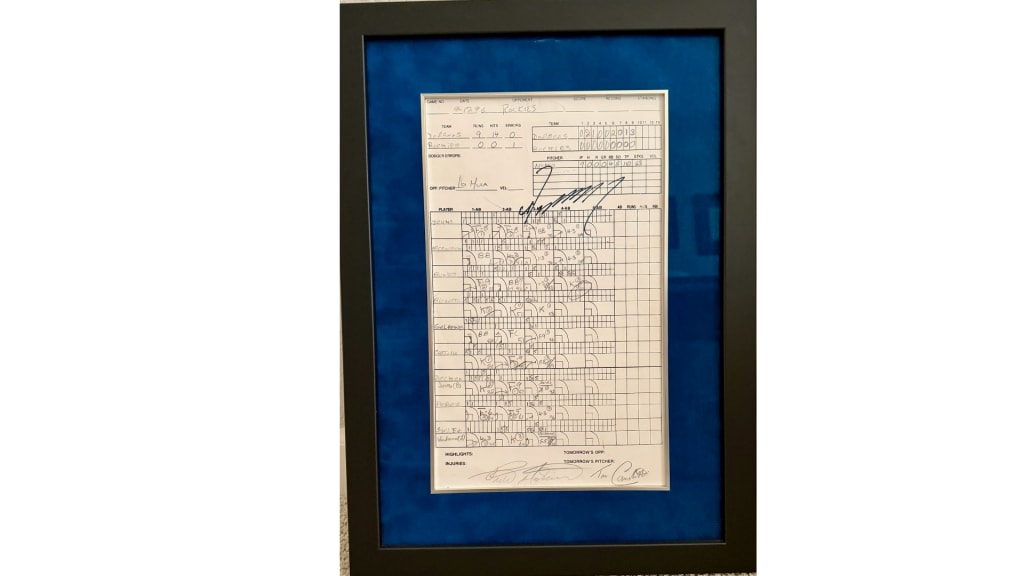
One of one
Five years later, Nomo would throw another no-hitter, this time for the Red Sox against the Orioles at Camden Yards. It, like the one he hurled in Colorado, remains the only no-hitter in that ballpark’s history.
But the no-hitter at Coors, because of the climate and the lineup against which he did it, remains one of one.
Will there ever be another no-hitter thrown at Coors Field? You’d have to think yes, though it is nonetheless hard to imagine.
As his teammates mobbed him around the mound that night in September 1996, the understated Nomo allowed himself a subtle show of emotion when he pumped his right fist in the crisp Colorado air.
After all, now the job was done. And it was good.