

All the rumors finally came to fruition Saturday night when the Tigers made a deal to send Tarik Skubal to the Dodgers ahead of Monday's Trade Deadline. There’s a reason that nearly all the conversation around this particular Deadline has swirled around one particular pitcher, and it’s for a very simple reason: This caliber of arm simply does not get moved during the season very often.
Trades and Transactions presented by CohnReznick
• Tracking every Deadline trade
• Skubal heads to Dodgers in Deadline blockbuster
• Rutschman traded to Red Sox for big prospect haul
• Phillies get 3-time batting champ Arraez, relief ace Raley
• These 7 clubs loaded up on prospects at the Deadline
• Every prospect traded before Deadline
• Ranking the 25 top prospects traded ahead of the Deadline
If that’s in some part because back-to-back Cy Young winners rarely exist in the first place, then fair enough. Only a dozen pitchers have ever pulled off that feat, and several, like Sandy Koufax, Jim Palmer and Clayton Kershaw, only ever suited up for one team in their careers.
But let’s not get hung up on the “back-to-back Cy” part of it today, because while doing that surely says you’re elite, it’s not a requirement for greatness, either. (We assume no one will begrudge Tom Seaver the fact that his three Cys all came separated by at least a year, right?)
Now that the baseball world has learned the fate of the sport’s most accomplished in-his-prime pitcher, it raises some questions: When was the last time an elite starter got moved? How often does this even happen?
If you can’t really place it, or if your mind immediately goes back to CC Sabathia going to Milwaukee in 2008, realize that was nearly 20 years ago now. Perhaps the most legendary in-season ace trade, Randy Johnson going from the Mariners to Astros in 1998, was nearly 30 years ago. Last year’s starting pitcher movers, such as Merrill Kelly, Charlie Morton, Zack Littell, Erick Fedde and (a recovering from injury) Shane Bieber don’t exactly compare.
So to answer the question, we’re going to have to set some rules, and if these very good pitchers aren’t quite as great as Skubal, so be it. Few are, or have been, and that would make for a very short list. (Which we'll show you anyway, at the end.) You can be less than Skubal and still quite good, anyway.
So: What makes for an outstanding pitcher, traded in-season? What we want to find are pitchers who were in the midst of a season when:
- They threw at least 100 innings and had at least 15 starts
- They were at least 15% better than average
- They played for multiple teams, obviously
We’re doing it this way because we’re more concerned with in-the-moment production rather than reputation. If, for example, you were to trade for injured 40-something legends Max Scherzer or Justin Verlander right now in 2026, you’d be thrilled to have them wearing your uniform and in your clubhouse around your young players. At the same time, given where they are in their careers, you might not expect a great deal of rest-of-season excellence on the mound, either.
Just looking at 100-inning seasons, we start with nearly 6,000 pitcher-seasons since 1986, when the Deadline moved from June back to July. Whittle that down to just the ones who played for multiple teams, and we get just under 500. Cut that down to pitchers who were 15% better than average that season (for simplicity’s sake, we’re using a weighted average of ERA and FIP, with a bit more weight to FIP here), and we’re now down to 43. Skubal, at 96 2/3 innings, will almost certainly become the 44th in his next start.
That’s it. In four decades, just 43 trades, of 39 pitchers. It’s not a lot.
This works, we think, because it shows there were zero qualifiers last year, the first time in a full season since 2018, when the best starters moved were a pre-stardom Kevin Gausman, a post-stardom Cole Hamels and the quite-good-but-not-quite-qualified-for-this Chris Archer, who went from Tampa Bay to Pittsburgh in one of the most infamous trades of the last decade.
Those 43 times over nearly 45 years would be slightly less than one per season, but it hasn’t quite worked out that way; it has, unexpectedly, increased. There were just four in the last four seasons of the 1980s after the Deadline moved back; then six in the '90s (the famous Johnson trade included), 11 in the first decade of this century, 14 in the 2010s, and eight in the first half of this decade – soon, obviously, to be nine.
(Perhaps 10, because Skubal isn’t the only Detroit starter having a fantastic season – with 13 1/3 more innings, Tigers teammate Casey Mize, himself a trade candidate, would qualify here too. Angels starter José Soriano, if dealt, would come very close.)
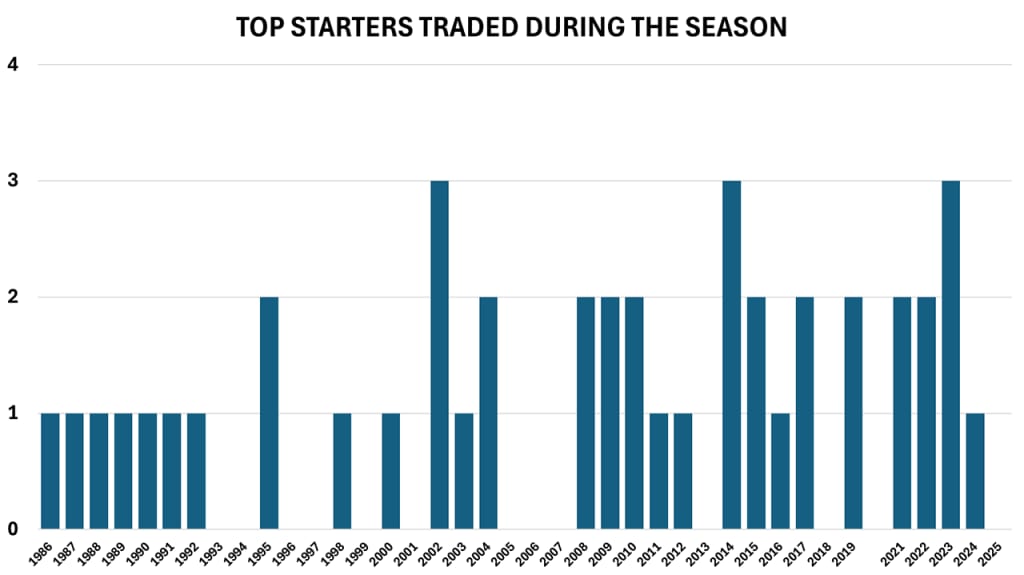
That’s probably a little because there are more teams now, the Major Leagues having added four teams in the 1990s; it’s probably a little that there are more playoff teams now, the Wild Card having expended more than once; and it’s probably a little that there are more pitchers now, because the days of things like the 1988 Dodgers having only 13 pitchers who threw 20 or more innings are long gone. (The 2025 Dodgers had 21 such arms.)
We’re talking pitchers as legendary and accomplished as Johnson, Scherzer, Sabathia and Verlander; we’re talking about some great seasons from solid hurlers like Jeff Samardzija, Luis Castillo, Yu Darvish and Bartolo Colon; we’re talking about the rare post-1986 Big June Trade in Freddy Garcia; we’re talking about the best season of Sidney Ponson’s career, and that one only barely.
The most recent "big name" moved in-season is another current Tiger in Jack Flaherty, who ended his first stint in Detroit by being traded to the Dodgers in 2024, and while he wasn’t quite as good in Los Angeles as he’d been as a Tiger, he did still end up starting five games, including Game 1 of both the NLCS and World Series, for a title-winning team.
By this reckoning, five aces have been traded in-season multiple times, at least during high-production seasons.
- David Cone (1992, 1995)
- Cliff Lee (2009, 2010)
- Zack Greinke (2012, 2019)
- David Price (2014, 2015)
- Verlander (2019, 2023)
It’s rare. But as we said above: even within this selection of very good pitchers, Skubal stands out.
If we rank all 43 of the top pitchers moved from top to bottom by our ERA/FIP blend, again looking just at that season, we’ll get this list. He figures prominently.
- 2016 Rich Hill
- 2008 Rich Harden
- 2026 Skubal
- 2015 Price
- 2010 Lee
It might be easy to forget how great Hill was at the start of his mid-career renaissance; in 2016, moving from the A’s to the Dodgers, he had a 1.83 ERA in six regular-season starts for Los Angeles, then started three postseason games. It’s even easier to forget how briefly brilliant Harden once was; in 2008, he had a 2.34 ERA for the A’s, then outdid himself by posting a 1.77 ERA for the Cubs. (That one did cost the Cubs a young Minor League catcher who would go on to hit 279 homers as one of the best third basemen of his generation: Josh Donaldson.)
Skubal, is in the midst of the third-best season by a traded starter, and if you want to say that his previous two seasons of excellence should carry enough weight to put him above Hill and Harden, so be it, but then you might have to do the same for the Johnsons, Scherzers and Verlanders of the world.
The next five seasons, in order: 2021 Scherzer (to Dodgers); 2008 Sabathia (to Brewers); 1998 Johnson (to Astros); 2019 Greinke (to Astros); 2014 Jon Lester (to A’s). That works, too; Sabathia and Johnson are the two most obvious names of the last 40 years.
It’s a great list. It’s a short list. If it feels like it’s been a few years since a pitcher this great has been looking for a new home mid-season, that’s because it has. It’s just so hard to find an ace like this, much less have them be available in a way that isn’t free agency. It’s why so many teams were interested in the AL’s reigning ace.