

With so many metrics out there in the baseball world, sometimes the hardest thing to do is to collect them, to know where to look and to see what's changed over time -- to settle arguments, or create new ones. With the new Baseball Savant Statcast Player Comparison tool, maybe that'll be a little easier, since you can compare players to others, to one another over time or even look at head-to-head pitching matchups or full-game lineups.
What kind of stories can you tell? Let's find a few interesting ones.
The ascension of Jordan Walker
Even before Walker won a thrilling Home Run Derby, he was in the midst of a true breakout year, adding the most OPS (294 points worth) from 2025 to '26 of anyone in the Majors. It’s not exactly hard to see why the Cardinals continued to believe in him over his first three years of struggle, in which he hit merely .240/.302/.378 in more than 1,000 plate appearances. It was his elite bat speed, which currently ranks as second fastest in the Majors, behind only Junior Caminero.
Yet while Walker has added bat speed since he debuted, that was always strong, even when he wasn’t producing. It’s true that he has cut his strikeout rate considerably this year compared to 2025, but it’s also true that his career-low strikeout rate came when he was a rookie and not nearly this productive. What’s really changed, then?
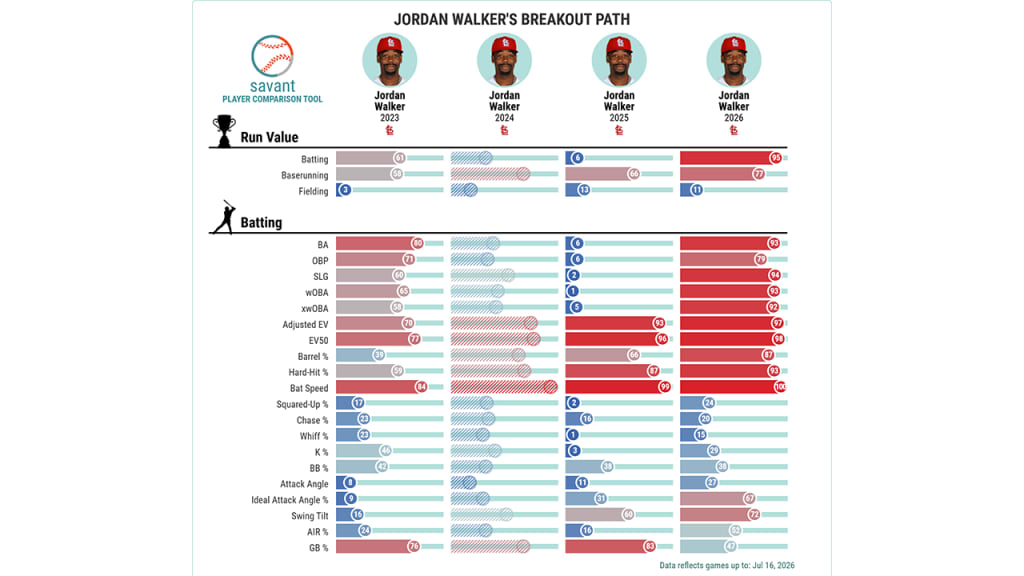
Some of the red lines have remained red: He swings hard and hits the ball hard. Some of the blue lines have remained blue: He strikes out a lot and is only OK at taking a walk.
Look, then, at what has changed, beyond the outcome stats of batting average, slugging and weighted on-base. They all come near the bottom of those charts, where you can find the metrics that tell you about the shape of his swing and the way batted balls come off his bat. While Walker swung hard and hit hard, he was hitting the ball into the ground too often. His swing tilt -- the shape of the swing on the way to the ball -- was flatter than average, until it was above average. The ideal attack angle rate has increased by a lot, and so the ground-ball rate has fallen drastically. He still strikes out a lot. It hasn’t really mattered.
These things don’t happen by accident. They take hard work.
“Walker said he ‘went into the offseason with a mission,’” wrote The Athletic last month, “and worked on his swing at Driveline Baseball and Cressey Sports Performance, hoping to take a better path to the ball and train his muscle memory to make those adjustments. The whole idea, he said, was to stop dwelling on mechanics.”
Consider that mission a massive success.
The discussion on the left side of the Yankee infield
While much of the Yankees' recent slide has been about the the fact that Aaron Judge has been injured for the last six weeks and that Cody Bellinger and Paul Goldschmidt have mostly stopped hitting, there’s also a never-ending discussion about what they should do at shortstop. Anthony Volpe’s Yankees career has largely been a disappointment, while José Caballero did a decent job handling the spot earlier this year as Volpe returned from shoulder surgery.
Since Volpe’s return in May, each player has started an even 38 games. The difference is that Volpe has made each of those at shortstop, while Caballero has started at short 15 times while also making starts at five other positions. Neither one has hit terribly well since then, with a nearly identical and moderately below-average OPS, but it’s clear what the vibes of the fanbase are, and that’s not Volpe.
Fair enough; it’s unlikely either player is the long-term solution here. But for the moment, we’re talking about 2026 here. What does that look like, beyond just the surface-level stats?
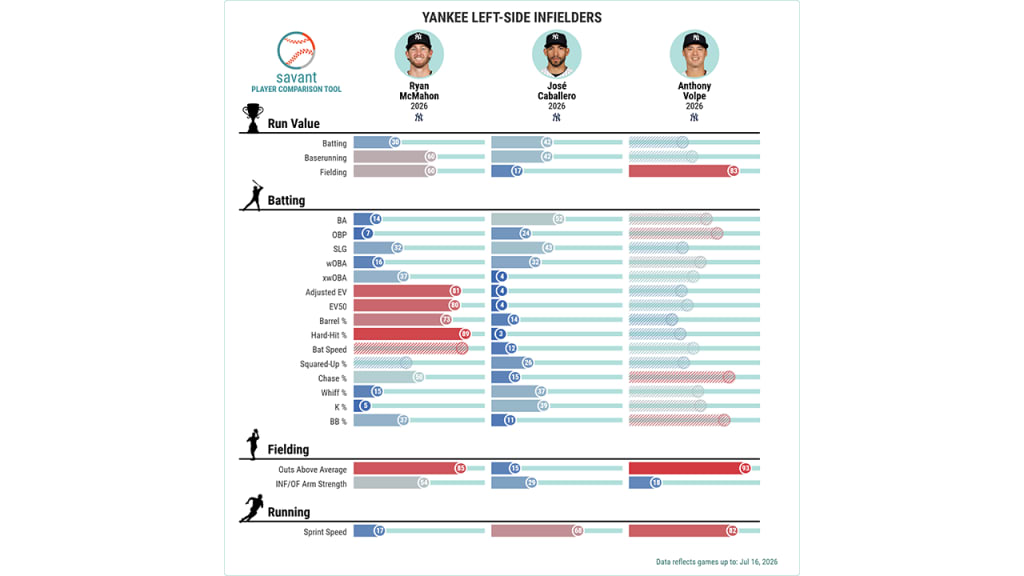
That paints a different -- and interesting -- picture. Despite the reputation, Statcast defensive metrics prefer Volpe to Caballero, despite relatively poor arm strength (which is indeed weaker than Caballero’s, but also not dissimilar to Dansby Swanson) and a persistent myth that Volpe can’t turn double plays, which isn’t held up by metrics.
Why are we including Ryan McMahon here? Because he’s largely not hit as a Yankee (84 OPS+), and Caballero’s flexibility allows him to play third base, which adds to the decision-making puzzle. Ultimately, we expect the left side to look very different in New York in 2027 -- potentially at both spots.
What’s happening with Paul Skenes?
Skenes remains an excellent pitcher, but a 3.43 ERA this year is certainly a lot higher than last year’s 1.97, and even if you’re willing to look past the Opening Day disaster that was partially fueled by poor defense behind him, it’s still 3.06 over his next 20 starts. (That we’re looking at a 3.06 ERA and we’re worried tells you a lot about how incredibly great his career has been to date.)
It is, partially, still about the poor Pittsburgh defense, as Skenes is tied with Seattle’s Luis Castillo for having received the weakest fielding support from his infielders and outfielders, but it's more than just that, too. Much of the concern has been about his four-seam fastball velocity, which has dropped from 98.2 mph to 96.9 -- a meaningful difference, even if “averaging 97” is hardly Jamie Moyer territory.
Yet when you look at his year-to-year ratings, you’ll see that most everything is as red as it usually is, though he has indeed allowed a little more hard contact while inducing somewhat fewer grounders. But breaking down the pitch types, the issue isn’t so much his fastball. It’s his offspeed pitches.
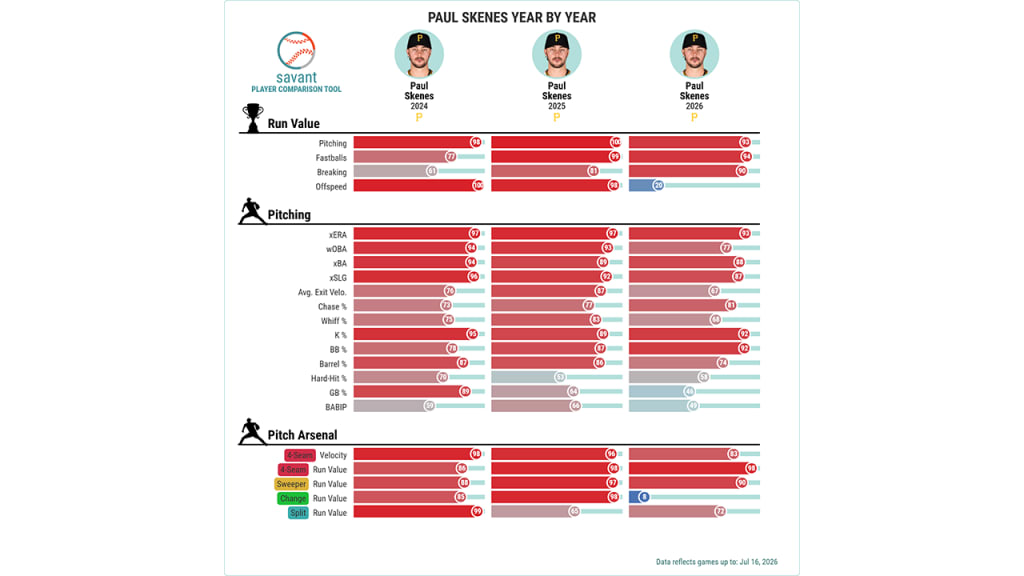
That’s mostly about his changeup, which has seen its opponent SLG go up from .125 to .388, and on which Skenes already has allowed more hits than he did in his first two seasons combined. It's also a little about his "splinker,: which has allowed 50 extra points of batting average. While there’s an obvious relationship between a changeup playing off a fastball, there have also been some differences in the way the changeup has moved, too.
Pleasingly, this is exactly how Skenes himself sees it, too, telling MLB.com over the break that “I think it’s funny [reporters] only ask [about velocity] when I don’t have a good outing. In those outings, I don’t think I really got damaged on my four-seamer.”
Quite right. Surely, Pirates fans would love to see that extra velocity come back. On the other hand, he’s still throwing harder than Tarik Skubal, Chris Sale or Gerrit Cole.
The big need in the Cubs' rotation
The Cubs came out of the All-Star break eight games over .500 and with clear intentions of claiming a Wild Card spot, except they have one massive problem: their pitching staff, particularly their rotation. The 2026 Cubs have allowed more homers in their first 96 games than any Cubs team in history. None of the other top 10 teams on that list even finished .500, much less made the playoffs.
That's due largely to injuries, as Cade Horton is out for the year, Matthew Boyd missed weeks before his recent return and Ben Brown and Edward Cabrera are each on the injured list right now. It's also in part because the pitchers we have seen simply don’t throw hard. Just 27% of Chicago fastballs have been thrown 95 mph or harder, the lowest rate in baseball, and well below the Major League average of 44%. (Seattle, by comparison, is at 73%). The Cubs went into the break with a rotation of Shota Imanaga, Boyd, Javier Assad, Colin Rea and David Peterson.
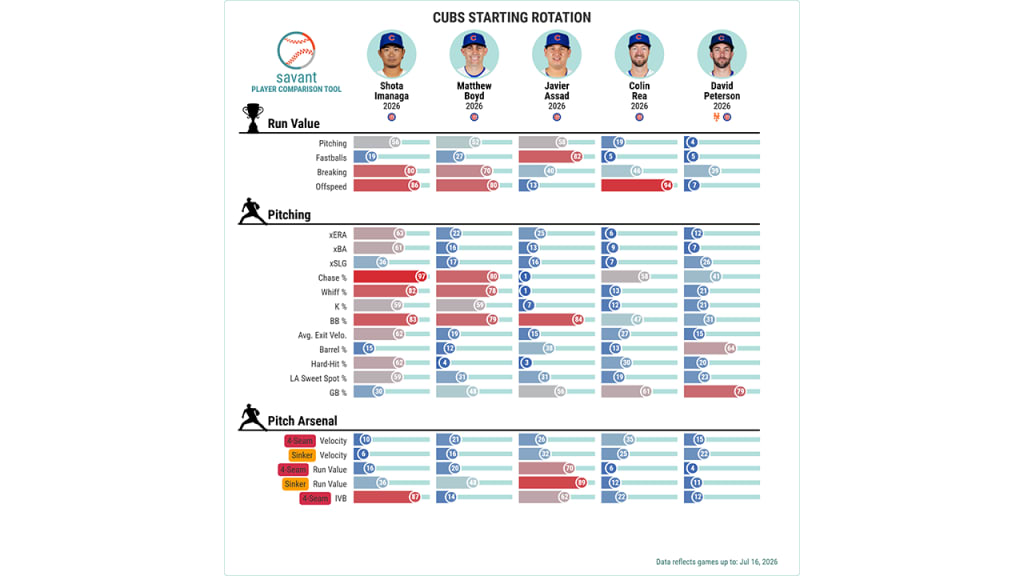
Let your eyes drift to the bottom, to the fastball velocity row. No one in this rotation has average velocity, or even comes close. That doesn’t mean they can’t be successful; Boyd has been OK, and Imanaga has put together spurts of brilliance. But it’s hard to thrive in the Majors in 2026 without some real heat on the mound. When the Cubs acquire the pitching reinforcements everyone assumes they will, expect to see some who throw really, really hard.
The NL Rookie of the Year race
Pitchers Nolan McLean and Foster Griffin will have something to say about it, too, but the best National League rookies this year are mostly on the position-player side, where NL rookies are hitting as well as they have in decades. (That's even with Pittsburgh top prospect Konnor Griffin out with a finger injury.) So: What does that race look like?
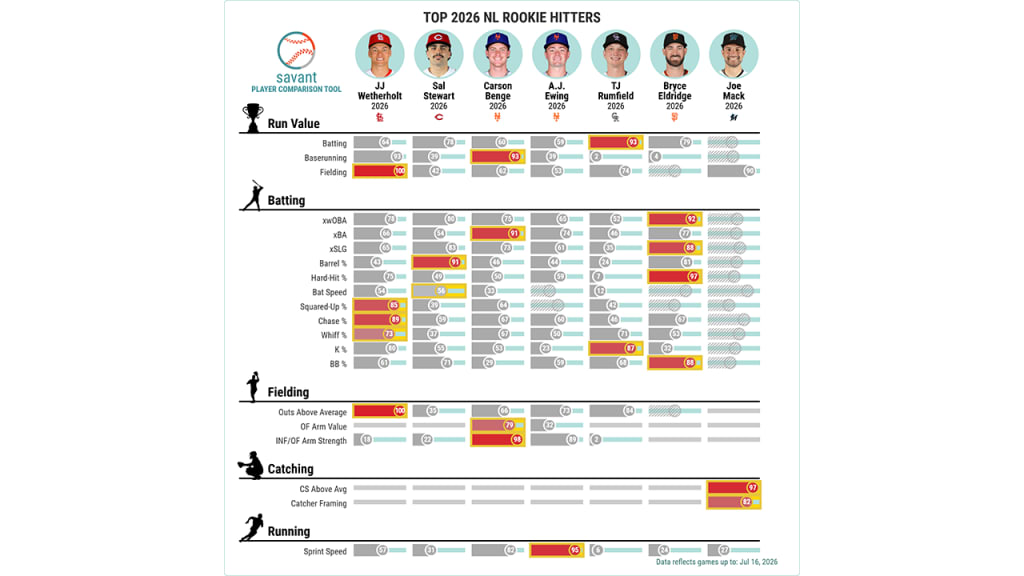
The Cardinals' JJ Wetherholt is the most well-rounded player, likely to easily win a Gold Glove Award at second base while adding a solid bat. There’s plenty to like about the Mets outfield pair of Carson Benge and A.J. Ewing, while Bryce Eldridge and Sal Stewart have the loudest bats and Joe Mack has helped transform the Miami defense. This one won't be settled for a while, but there's no shortage of good candidates.