

A .532 OPS in your rookie season tends to lower expectations, even for one of baseball’s top prospects.
But Jac Caglianone has reset them in a hurry this spring. Blasting three balls over 115 mph -- including one at 120.2 mph -- in less than a week will do that.
That’s what the Royals outfielder did early in Kansas City’s Spring Training slate, before leaving to join Team Italy at the World Baseball Classic. He's continued to mash at the WBC, helping Italy reach the semifinals with a .364/.563/.727 slash, one homer, four RBIs and five runs scored over four games.
2026 World Baseball Classic
Final presented by Capital One
• Champs! Venezuela beats USA in final
• Box score: Venezuela 3, USA 2
• Maikel Garcia named Classic MVP
• '26 Classic All-Tournament Team
• Final bracket, full results
• Complete coverage
It's a reminder of why there was so much hype around Caglianone -- the No. 6 overall Draft pick in 2024 -- before a forgettable rookie year that saw him hit just .157 with a 49 OPS+ over 232 plate appearances.
History is not kind to hitters who struggle to that extent as rookies. There have been only nine players in the divisional era (since 1969) who have gone on to become All-Stars after posting an OPS+ of 50 or lower in their rookie season (minimum 200 PAs).
The only one in that group who debuted in the past two decades was Jackie Bradley Jr., who finished with a lifetime 82 OPS+. And just one of the nine ended his career with an OPS+ above 95 -- Brett Butler (110), who didn’t earn his first All-Star selection until age 34.
But Caglianone has a chance to buck the trend, starting in 2026. Here’s why.
The raw tools are off the charts
While most stats need large sample sizes to become meaningful, a player's max exit velocity isn't one of them. You can tell a lot about a hitter from a single batted ball, because you don't reach 120 mph by accident. It takes elite bat speed, incredible strength and perfect contact.
Most hitters never get close to that range. During the Statcast era (since 2015), only seven players have hit a ball that hard in games that count, and Giancarlo Stanton and Oneil Cruz are the only hitters to do it more than once.
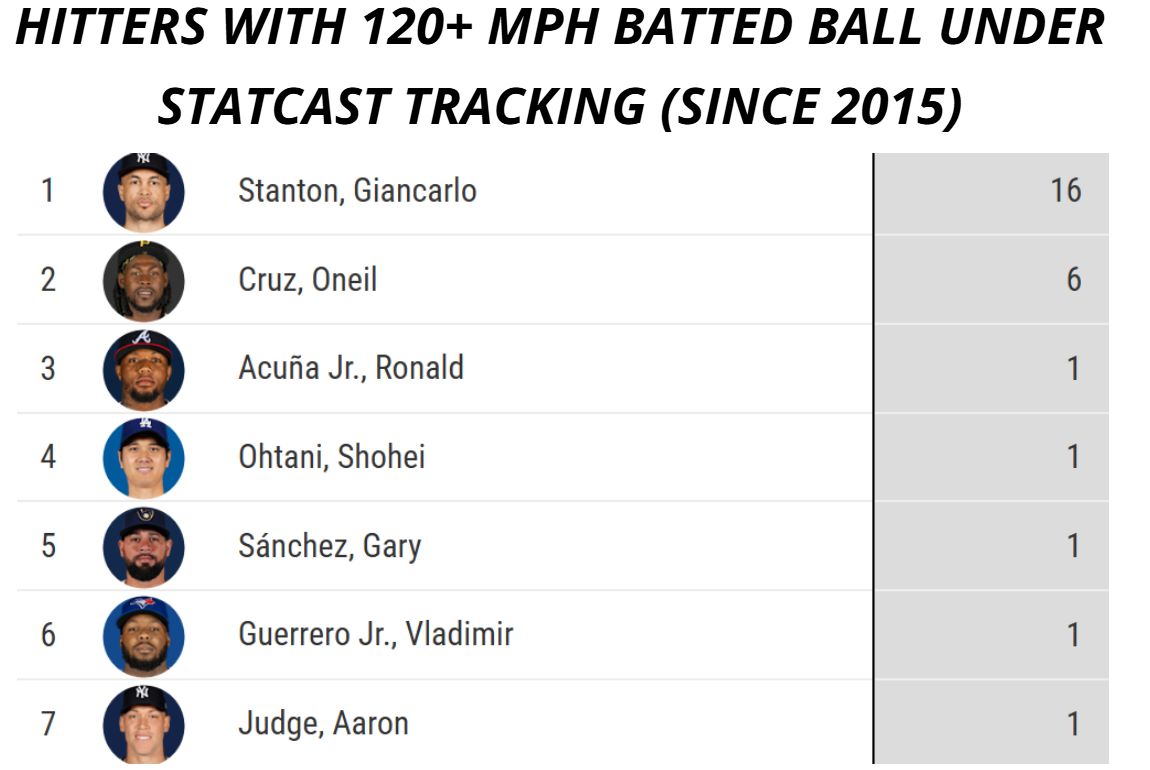
Caglianone, though, has now been tracked at that level multiple times -- he also had a 120.9 mph single for Double-A Northwest Arkansas last April, per the Trackman system at Arvest Ballpark.
For Caglianone, who is built like the prototypical power hitter -- 6-foot-4, 250 pounds -- it all starts with the swing, a violent but relatively compact cut that generates extreme bat speeds. His swing averaged 77.4 mph last season, the eighth fastest in the Majors (minimum 200 swings).
Of course, upper-echelon bat speed alone doesn't make you a good hitter. But many of the game's preeminent power hitters tend to have it. Looking at the top 15 qualifiers in terms of isolated power last season, the median player's bat speed ranked in the 88th percentile.
The foundation for a big power breakout is already there
Caglianone’s .532 OPS also belied some encouraging contact-quality numbers, beyond just a few highlight-reel batted balls.
His ground-ball rate was a bit high at 50.6%, and he chased and whiffed too often. But when he hit the ball in the air, good things tended to happen. Among those with at least 150 batted balls in 2025, just nine had a higher average exit velocity on fly balls and line drives than Caglianone.
Highest avg. exit velocity on FB/LD, 2025
Min. 150 batted balls
1. Shohei Ohtani: 100.4 mph
2. Giancarlo Stanton: 99.8 mph
3. Kyle Schwarber: 99.5 mph
4-T. Oneil Cruz: 99.4 mph
4-T. James Wood: 99.4 mph
6-T. Aaron Judge: 99.1 mph
6-T. Juan Soto: 99.1 mph
8. Roman Anthony: 98.8 mph
9. Pete Alonso: 98.4 mph
10. Jac Caglianone: 98.2 mph
Caglianone also had 19 barrels -- batted balls with an optimal combination of exit velocity and launch angle -- contributing to an overall 12% barrel rate that would have placed him around the 75th percentile if he had enough plate appearances to qualify.
That's not an elite figure, but for a 23-year-old still finding his footing in the Majors, it's a strong foundation to build on.
His rookie season wasn’t as bad as it looked
Here’s another thing about that .532 OPS -- it might have been even more misleading than we’ve let on so far.
Caglianone’s expected stats, which take quality of contact into account rather than the actual results, not only indicate he was much better than his OPS implies, they show he was one of the unluckiest hitters in the game.
In fact, he had MLB's largest unlucky gap (the difference between his expected and actual production) in all three of these categories (minimum 100 PAs):
True, expected stats don't guarantee anything, but they do suggest his rookie year shouldn't have gone as poorly as it did, which is an important distinction when the historical precedent is so bleak for hitters who struggled this much as rookies.
While the onus is on Caglianone to turn that offensive potential into production, the bigger concern for the slugger heading into '26 may actually be his defense. A converted outfielder who was a first baseman and pitcher in college, he's still learning how to play right field. No qualifying right fielder posted a larger deficit (-7 percentage points) between his estimated success rate and his actual success rate in 2025.
That said, his defensive shortcomings will be much easier to overlook if he turns into a powerhouse at the plate. He's looked the part this spring.