

Matt Olson hates the splits.
Not in the sense of, like, "platoon splits." In the gymnastics sense -- at least, insofar as a 6-foot-4 first baseman can be considered a gymnast.
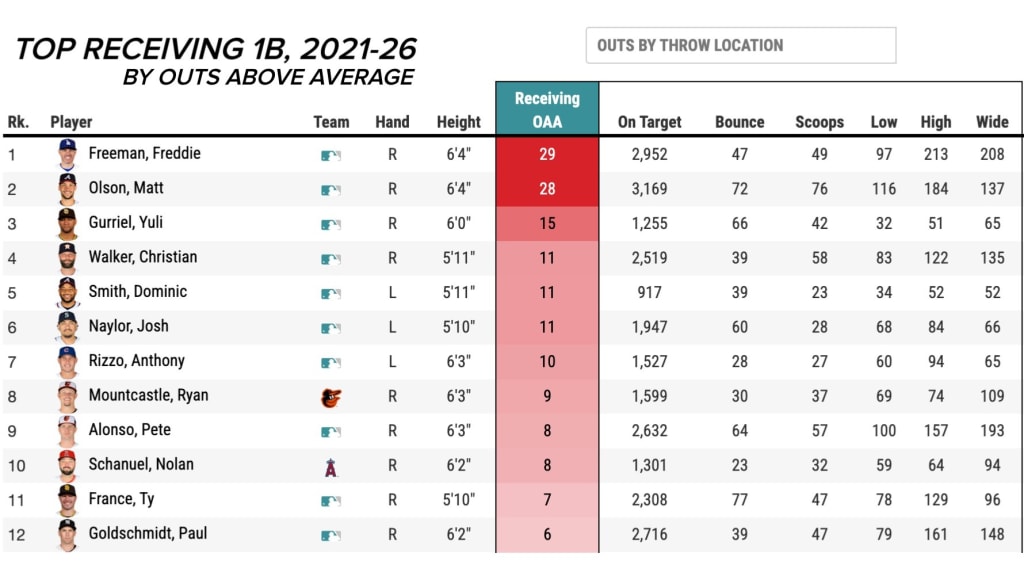
But that's what catching infield throws is: first base gymnastics. You have to get your body into the right position. You have to have the footwork. You have to be able to stretch in every direction. And Olson is one of the very best receiving first basemen in baseball. We have a whole new set of first base fielding stats on Baseball Savant to prove it.
The first base receiving and scoops leaderboard just launched today and is available back to the 2021 season. Olson and Freddie Freeman -- the two pillars of the position in Major League Baseball -- are at the very top. You love to see it.
And we got to talk to the Braves star recently about how he became a king of scoops.
"The biggest thing for me is just to go get the ball," Olson said. "Especially with how many challenges there are and how close the challenges are. See, a lot of guys, they do splits out to catch the ball. But if you do a split, you can't reach with your upper body. So for me, not getting as far with the front leg, and reaching with my upper half instead, you catch the ball further out. And hopefully, doing that, you're able to get more bang-bang plays."
Olson -- in a way that only Freddie, his predecessor in Atlanta, can rival -- really goes out and gets the ball. The way he sees it, he has no other choice. Plays at first base are too close. The ball needs to be in his mitt that split second sooner, before the batter can take that last fraction of a step, so he can steal a few extra outs for his infielders.
The way Olson does that is to shorten the distance between his glove and the baseball as much as humanly possible. That means no splits.
A first baseman doing a split to catch a throw looks awesome. It takes some real flair. But to Olson, it's not the most efficient technique to pluck the ball from the air. He feels like kicking his leg out blocks him from adjusting to the throw, and he wants to be in a more athletic stance.
"Everybody always thinks the splits are, like, 'Oh, wow, what a split!'" Olson said. "I don't think it's the best way to do it."
Olson's technique is to lean his upper body out over the top of his front knee, which lets him get his mitt way out ahead of him while still holding the bag. Think of it like a pitcher generating extension by driving down from the rubber, only if they stuck out their opposite hand.
His stretches are a thing of beauty. He's tall, he's flexible and he has long arms and incredible reach.
Here's what we mean. Watch this play from Olson, from his first season with the Braves in 2022. It's one of his best, even if it doesn't look as flashy as a dramatic scoop on a ball in the dirt. But a lot of first basemen don't get this out. See how far Olson stretches for the throw from Dansby Swanson at short. He needs every inch of his wingspan to go get the ball before Trent Grisham crosses first base.
"That's really the only thing I make a point to do," Olson said. "Once the challenges were really in play, and you see how many balls are, like, six inches from being in the mitt, and the guy's foot is getting on the base -- that just shows how important it is."
Olson has been doing this a long time. While he's played his whole big league career in the era of replay challenges, which began in 2014, he was drafted by the A's two years before that. He got to see how the system expanded as he was coming up, and he knew he had to prioritize making receiving a skill.
Once he arrived in the Majors in 2016, Olson quickly established himself as an elite defensive first baseman. He won the first of his three Gold Glove Awards in 2018, his first full season in Oakland, along with his partner in crime, Matt Chapman. We all remember how good the Chapman-to-Olson connection was, and a lot of that was Olson, saving outs for his third baseman on the back end of Chapman's highlight-reel stops at the hot corner.
We only have receiving data for the last season of the Olson-Chapman era with the A's, 2021, but it was full of plays like this:
As Chapman told the San Francisco Chronicle about Olson their first Gold Glove season together: "He can get anything. He's a great target. He moves his feet well. I love throwing to him. I think his defense goes under the radar because of how easy he makes it look."
Now Olson's doing the same thing for a new set of All-Stars like third baseman Austin Riley and second baseman Ozzie Albies in Atlanta. Olson won his third Gold Glove, his first as a Brave, last year. Finishing off your teammates' great plays does wonders for an infield's confidence, and that's Olson's specialty:
No one has scooped more balls than Olson since the 2021 season. His 76 outs on scoops -- defined here by Statcast as balls that bounce between five and 15 feet in front of the first-base bag -- are the most of any first baseman.
Most successful scoops, 2021-present
- Matt Olson: 76
- Vladimir Guerrero Jr.: 67
- Christian Walker: 58
- Pete Alonso: 57
- Spencer Torkelson: 54
So are his 264 total outs recorded on low throws (less than one foot above the ground), scoops and bounced throws (15-plus feet from the bag, outside of true "scoop" territory). In other words: Olson is at the top of the first-base class when it comes to digging out throws.
You can find examples from any season. Here's one from this June, where Olson has to lunge up the first-base line to pluck a bounced throw while avoiding the runner bearing down on him (the safe call was overturned on a challenge):
Our new stats are really just confirming what the eye test has told us for years: Olson grades out as a star with his glove, just like he does with his bat.
But thanks to the Hawk-Eye technology that lets us track exactly how players move, we get five-plus full seasons of data on which first basemen are the best at the most frequently occurring, but maybe also the most unsung, part of their game: catching the ball.
"If I get five ground balls in a day, that's a lot. I'm catching way more balls than that first," Olson said. "I think it's, like, people just assume we're gonna do it. We're kind of like the offensive linemen of baseball -- it's a 'You don't notice them unless you give up a sack' kind of deal."
The value of all those throws Olson catches adds up. Remember, he's played over 900 games in a row. That's a lot of throws whizzing across the diamond, and most of the ones that come Olson's way, he turns into outs.
"It's a bigger percentage of what we do than I think people realize," Olson said. "People notice a good scoop, but being able to have a wide catch radius … You know, I grew up playing third base. If you trust that, if it's a tough play, you can just get it over in the area of the first baseman, that matters a lot. Because maybe you don't have to take an extra shuffle, or get the perfect grip on the ball. I want to feel like they can get it in my area and we're gonna have an out."
Olson is a magnetic target for his infielders, and his receiving skill lets them play free at their own positions. They can make their stops without having to worry about finishing the play with a perfect throw. Olson will pull it down if it's anywhere in his orbit.
"I want them to have full confidence," Olson said. "Just, like, "Pick it up and throw it, dude.' That's my chance to shine."
Part of it is genetic. Being tall helps, and Olson, at 6-foot-4, is tall even for an MLB first baseman -- as is Freeman, his fellow "catch radius" poster boy. As Mike Petriello points out, the correlation between height and first base receiving ability is loose, but Olson and Freeman are particularly good at using their size to create outs, like Olson did in the 2024 play above.
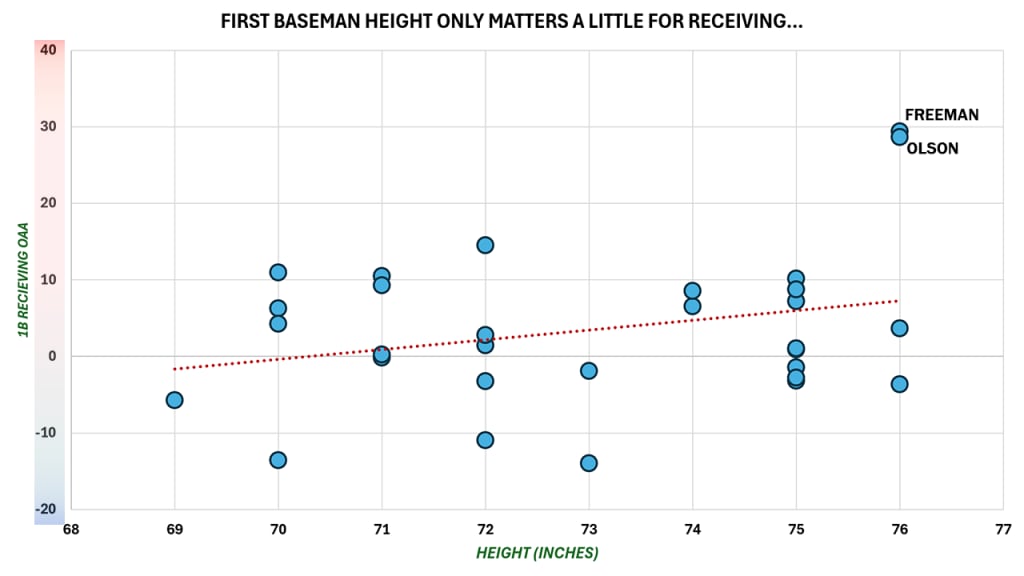
Whether they're stretching out for a throw or reaching up for a high one (Freeman is a standout at this), those two can extend farther than shorter first basemen while still keeping their foot on the base.
"Definitely a factor," Olson said. "The height is absolutely an advantage, especially with the reaching stuff that I was talking about."
He added with a laugh: "And I think most guys would agree, if I can't jump and catch a throw, it wasn't a good throw."
But height is only one part of the total package Olson brings to first base. Just being 6-foot-4 doesn't let you scoop balls like this:
Olson has been doing that for years (that play is from 2023), and there are so many more scoops, stretches and great grabs where that came from. Our defensive stats can finally reflect it. This adds a big part of first base defense to Statcast's flagship Outs Above Average metric, which means we can better reflect first basemen's true value on the diamond.
"I think people that are actually 'baseball people,' who watch and appreciate the game, understand," Olson said. "Like, that [receiving] is important. I know we get dinged right away on defensive metrics, you know, compared to shortstops or something. But somebody's got to play a position. First base is kind of separate from the other positions, and I take pride in that."