

Nolan McLean, the prized right-hander known for generating outlier horizontal movement and spinning the baseball at absurd levels, has lost his sweeper. And no one is quite sure where it went.
“It’s a little tricky whenever your pitch doesn’t move like you’re used to,” McLean said recently inside the Mets’ dugout at Citi Field. “That’s the part I’ve struggled most with this year: the sweeper shape.”
But there’s always a catch, and the catch is this: In a vacuum, McLean is not struggling. Far from it. The 25-year-old has settled in after a rocky start to his rookie season. Since the beginning of June, McLean has a 2.40 ERA -- better than all but four qualified starters -- along with a 26.6% strikeout rate and a .206 batting average against. He may very well wind up with 200 strikeouts (he’s at 168 K’s through 26 starts), and is right in the thick of a crowded NL Rookie of the Year race.
Still, his best pitch is gone.
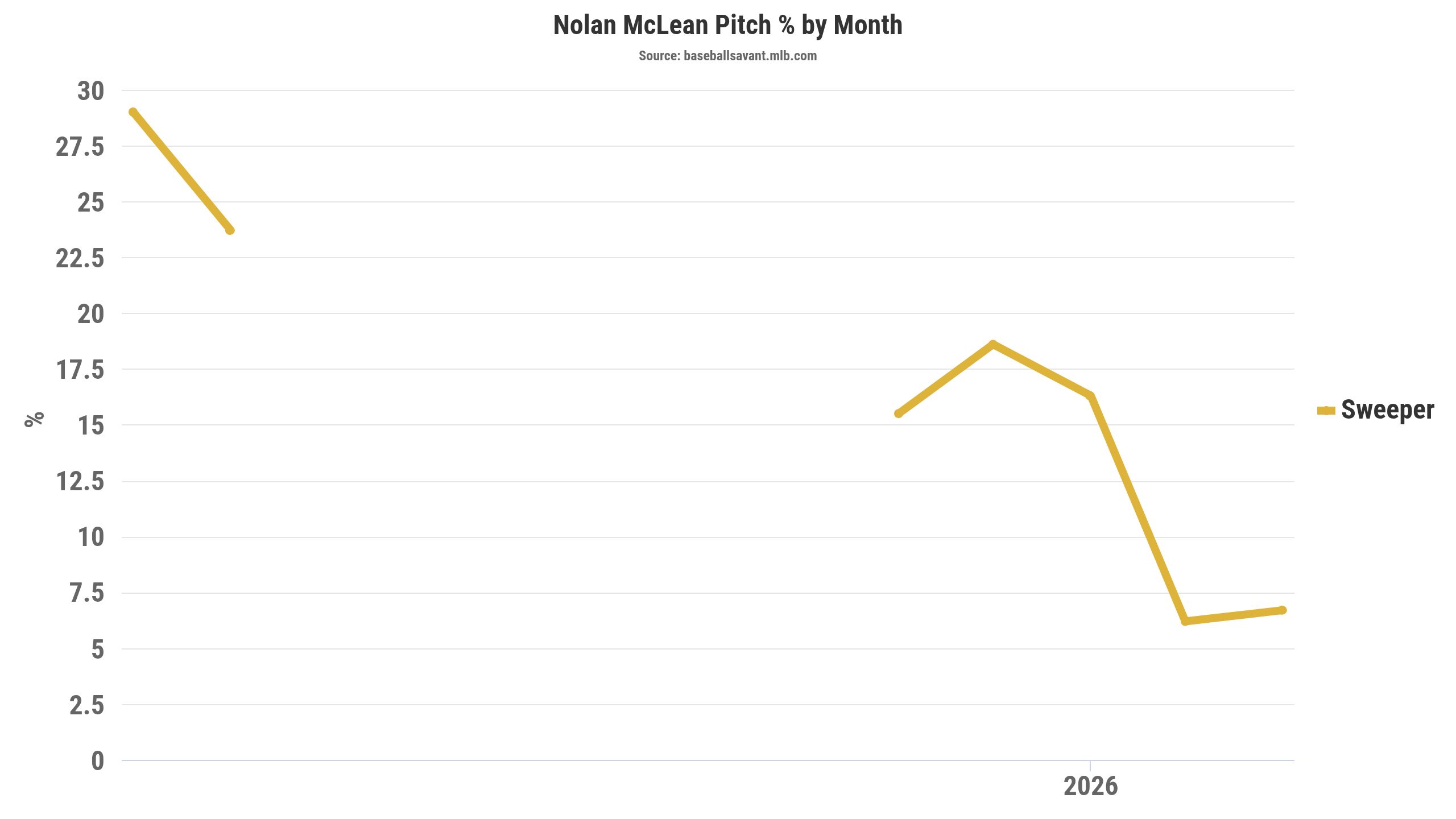
McLean spammed 33 sweepers in his much-anticipated MLB debut against the Mariners last August. He threw double-digit sweepers in 25 of his first 26 career starts. Then, on a dime, he pivoted. McLean has thrown a total of 35 sweepers in seven starts since the All-Star break, heading into his outing on Saturday afternoon against the Astros. He’s thrown three or fewer sweepers in four of his last six starts.
What in the world is happening here? Where did McLean’s sweeper go?
“I’m not getting the shape that I wanted this year,” McLean continued. “Even with the same type of metrics, I’m just not able to produce the same shape. There’s been times where I’ve shown it, but I haven’t been able to clip that pitch quite as much. It’s the constant evolution of, ‘I don’t want to dig myself in a hole and keep throwing it when I don’t really feel like I have it.’”
There’s a whole lot of cool stuff to unpack here. But let’s start with an admission: We’ve misled you a bit. McLean’s sweeper, while maybe his signature pitch, isn’t actually his best pitch.
At times, it sure looks like it. I mean, it’s not every day you see a pitch make a hitter look like this:
Or this:
But in a brilliant eight-start cameo late last season, McLean’s sweeper did not generate good results. Batters hit .361 and slugged .528 against it.
McLean knew this was a problem. Here’s what he told The Athletic about the pitch in February: “It’s kind of something I’m known for, but it’s also been the pitch I’ve given up the most damage on as well, which makes it a risk-reward thing.”
Already, the foundation for a change was in the works. In April, McLean threw his sweeper just 15.5% of the time, a steep drop-off from the 29% usage rate from his first month in the Majors last August. This time, though, the sweeper carved up the opposition, who hit just .188 without an extra-base against the pitch.
The success stopped there. Since that point, McLean’s sweeper is allowing a .500 batting average and a .792 slugging percentage. On the year, it’s accrued the second-lowest run value of any sweeper this year.
It’s no wonder he’s stopped throwing it.
Except, well, this isn’t just about results. It’s a lot to do with the fact that McLean’s sweeper -- known for its preposterous horizontal movement -- stopped sweeping.
After averaging 21 inches of horizontal break on his sweeper in April, McLean’s sweeper is generating just 15 inches of side-to-side movement in August. Two starts ago, on Aug. 11 against the Braves, his sweeper averaged 11 inches of horizontal break. That’s half the movement that his sweeper got four months earlier, in an April 9 outing against the D-backs, when it averaged 23 inches of horizontal break.
“Everything’s screaming that it should be the same pitches,” McLean said. “I’m just not getting the same shape.”
McLean is right here. A lot of the physical characteristics of the pitch are the same.
- April 2026: 84.7 mph / 3,087 rpm / 5.22 ft. vertical release point
- August 2026: 84.8 mph / 2,976 rpm / 5.10 ft. vertical release point
McLean is famous for his ability to spin the baseball. That has not changed. His sweeper has the 10th-highest spin rate in the Majors this year. But spin really only matters when it translates into production. In other words, how are you using spin to affect how the baseball moves?
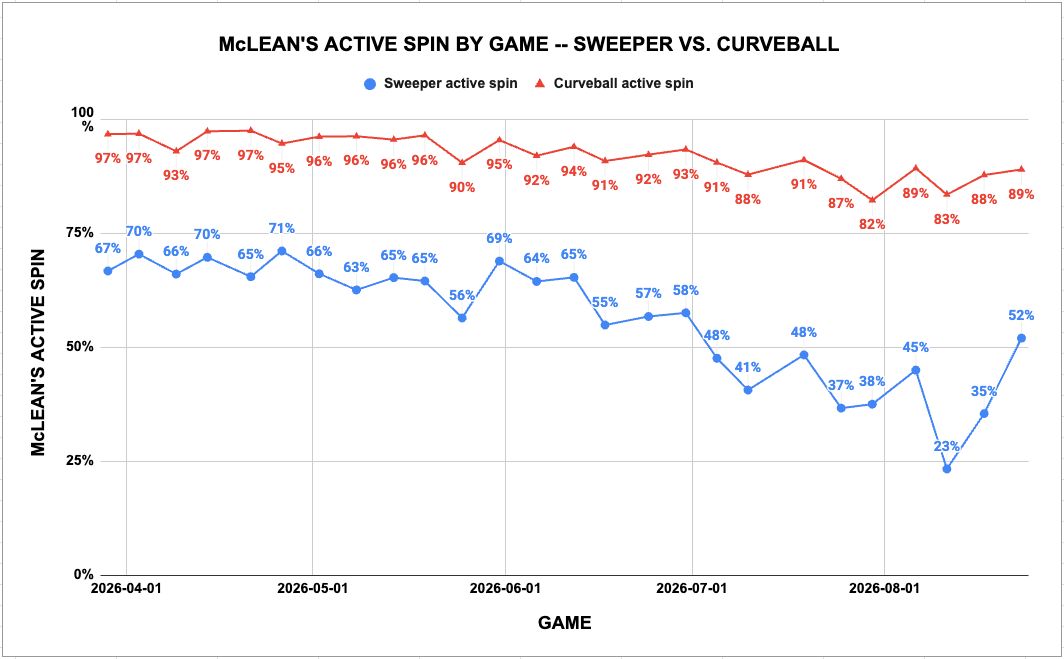
That’s where things are different for McLean. Each pitch has a theoretical maximum it can move, based on its velocity and spin rate. How much the pitch does move -- compared to how much it could possibly move -- is called active spin percentage.
Zooming in on a game-by-game basis, we can see that McLean is throwing his sweeper with less active spin than he was earlier this season. Whether intentional or inadvertent, the spin that McLean imparts on his sweeper -- those insanely high rates that he’s known for -- have stopped leading to movement. There is less active spin, and thus less horizontal break.
(By comparison, McLean's curveball -- another pitch with outrageous spin rates -- has not seen such a drop-off.)
But why is this happening? McLean isn't really sure.
“I have some ideas, but I’m not fully convinced on them yet,” he said. “I don’t know. … I haven’t been able to get the seam effects that I’ve been getting in the past, since the start of the year. So it’s been a work in progress. It’s shortened up a little bit.”
McLean is talking about seam-shifted wake, or the way the orientation of the baseball’s seams affects how it moves through the air. It’s a new-age tactic that pitchers use to create additional movement. McLean throws a seam-shifted sweeper, relying on pockets of air to catch the seams and propel it glove-side mid flight.
Seam-effects are precarious; a tiny change in the seam orientation could eliminate them completely. Grip the baseball in a slightly different way, and the ball might move differently. External factors could play a role, too.
“I guess when you’re relying on seam effects, it requires a lot of wind resistance and air,” McLean said. “Living on the outside of the baseball with the sweeper, it’s just been something I’ve had to manage.”
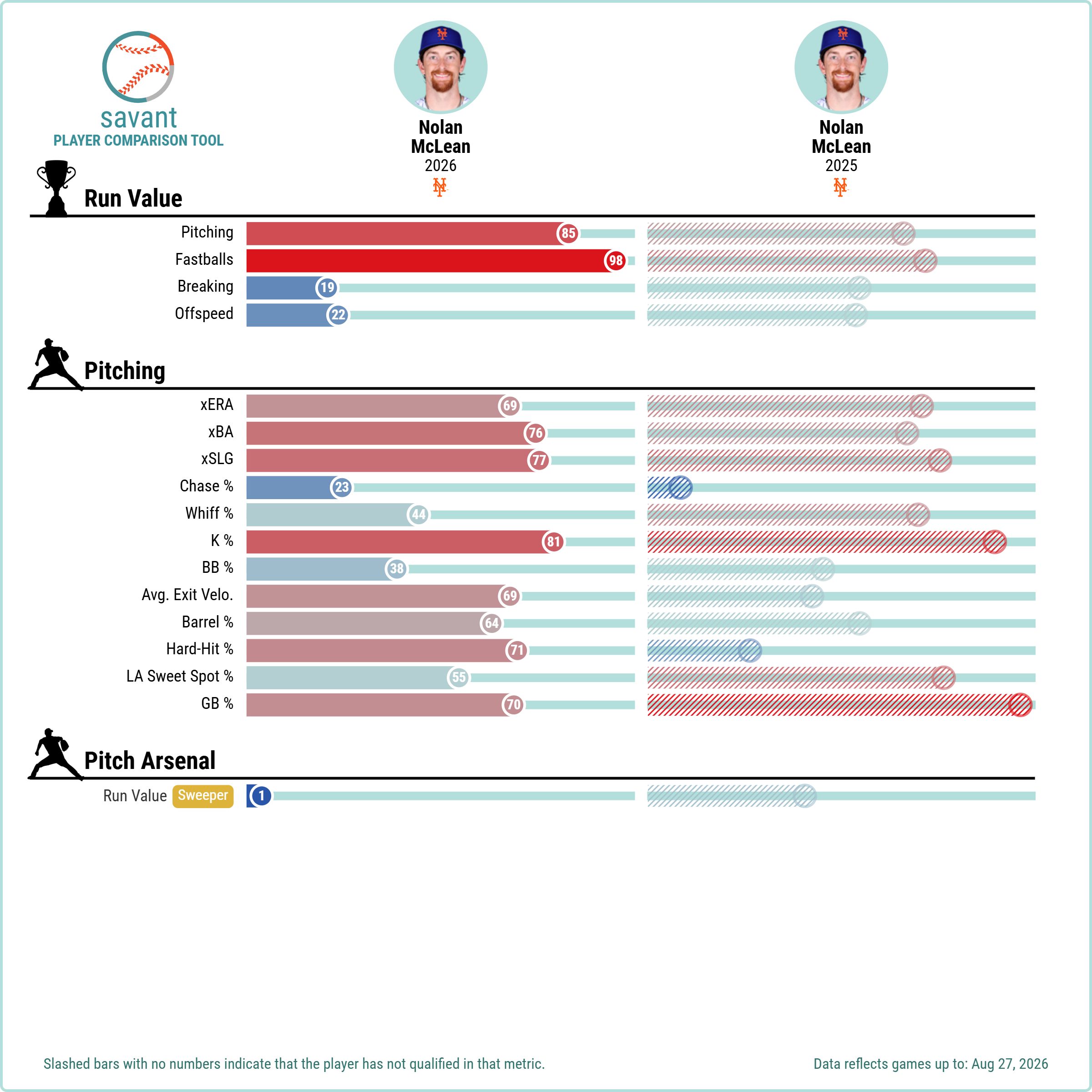
And that’s the other part of all this. Even without the pitch he’s most known for, McLean is thriving.
“I think the main thing is just dancing with the girl you brought,” McLean said. “When it comes time for the game, knowing what you’re going to have that day. Kind of testing it in the bullpen right before I go out there.”
McLean hasn't altered much about how he throws his sweeper. But the shorter movement profile has forced him to change his target line. He used to start the pitch inside to a right-handed hitter, and it would break across the entire width of the plate. Now, he sets his sight line closer to the strike zone, ensuring the baseball still ends up off the plate.
In mid-June, McLean also unveiled a slider, which he confirmed is a separate pitch from his sweeper. He uses the same grip, but manipulates the baseball to get even less horizontal movement -- 11.2 inches, on average -- with less drop, too. It’s also harder, clocking in at 86.4 mph, which is 1.5 mph faster than his average sweeper.
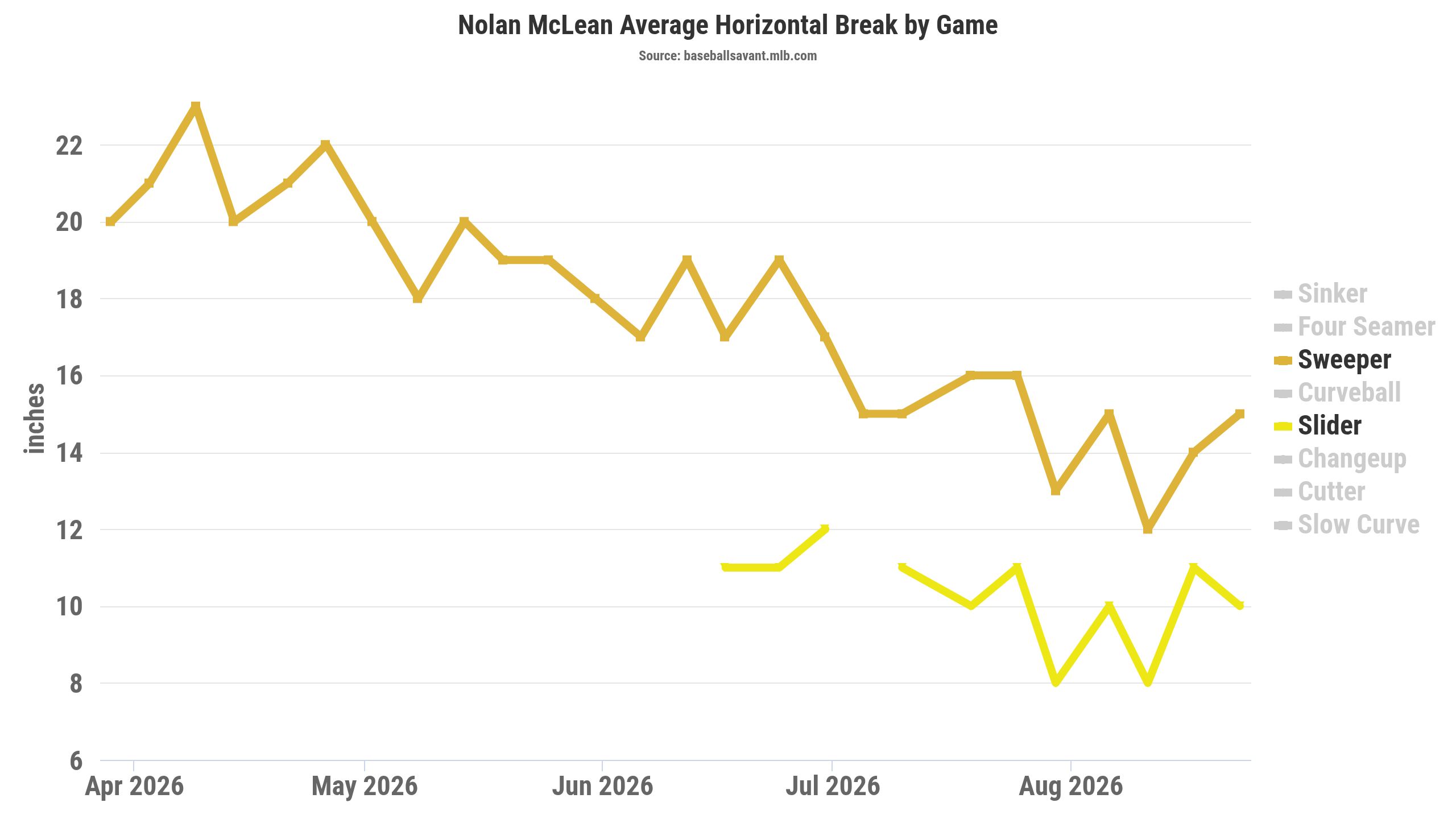
The timing of his slider development is a bit of a chicken-or-the-egg situation. Did the decline in sweeper movement compel McLean to throw a slider, or did the creation of the slider mess with the sweeper movement? We don’t have a clear answer here, but it’s worth pointing out the overlap. McLean’s sweeper averaged 19.4 inches of glove-side movement before he debuted his slider; since, it’s moving 3.5 inches less, at 15.9 inches of horizontal movement. Maybe manipulating the baseball is interfering with the seam effects. Maybe not.
In a small sample size, there’s some utility to the new pitch. The opposition is 0-for-9 in at-bats ending on a slider, which he has thrown nearly 6% of the time since debuting it on June 17. At the least, it speaks to McLean’s aptitude to hone his pitches on the fly. Although he was a two-way player as recently as two seasons ago, he still has an exceptionally diverse pitch mix.
“I think that’s the importance of trying to constantly develop your arsenal,” McLean said. “If you don’t have a sweeper one game, you might have to rely heavily on a curveball or a changeup. And if I’m not working on those in the offseason, how am I supposed to have confidence in them?
“Ideally, you want all six pitches and to go out there and dominate, but you never really have that. A lot of times, you’re working with three pitches, and you have to go out there and figure out what those are pretty early and ride them until you can.”
McLean hasn’t had his sweeper for a while now, but that hasn’t impeded his success. It helps that his sinker is one of the most-valuable pitches in baseball, and no qualified pitch is harder to hit than his curveball. That's a pretty good foundation, even without his video-game sweeper. We’ll see where all of this takes him next.