



Mets rookie right-hander Nolan McLean, who carries a career 2.23 ERA into Dodger Stadium to face Yoshinobu Yamamoto and the two-time defending champs on Tuesday night, has earned a pretty clear reputation through 11 career starts. That reputation can be summed up quite succinctly: No one spins it like he does.
That’s not hyperbole, or just a friendly scouting report. It’s more of an objective fact. McLean’s curveball has the highest spin rate in the Majors this year, just north of 3,300 RPM. It’s actually got the highest spin rate of any curveball in the decade-plus that Statcast has been tracking such things. Truly, no one spins it like he does.
That's all well and good, but spin really only matters in the sense of “how can you use it to make the baseball move?” Otherwise, it’s merely potential, not production. That’s not an issue for McLean, who’s also doing something else quite unlike anyone we’ve ever tracked has done.
Consider this: McLean’s sweeper moves 21.3 inches to his glove side, which is the most of anyone at his velocity. His sinker moves 17.6 inches to his arm side, which is excellent. That’s one pitch moving nearly two feet in one direction, and another moving a foot-and-a-half in the exact opposite direction. (No, really; the sweeper spins at 8:30 on a clock face, where 9:00 would be directly east-west, and the sinker 2:30, so precisely the opposite spin.)
When he puts them together, it looks like this.
When looking at those seasonal averages, 21.3 inches one way and nearly 18 inches the exact other way is a gap of 38.9 inches. That’s more than three feet. It’s more than the length of the average baseball bat, which is about 34 inches, which is a pretty good explainer as to why he’s so difficult to hit. The batter’s main tool is literally not wide enough to cover this distance – particularly when McLean also has four other pitches that all do their own unique things, in a four-seamer, cutter, changeup and curve.
It is, in fact, the largest horizontal gap in opposite directions by a pitcher’s pair of pitches, at least since the start of pitch tracking in 2008. (Among pitchers with a minimum of 40 breaking balls and 80 fastballs thrown.)
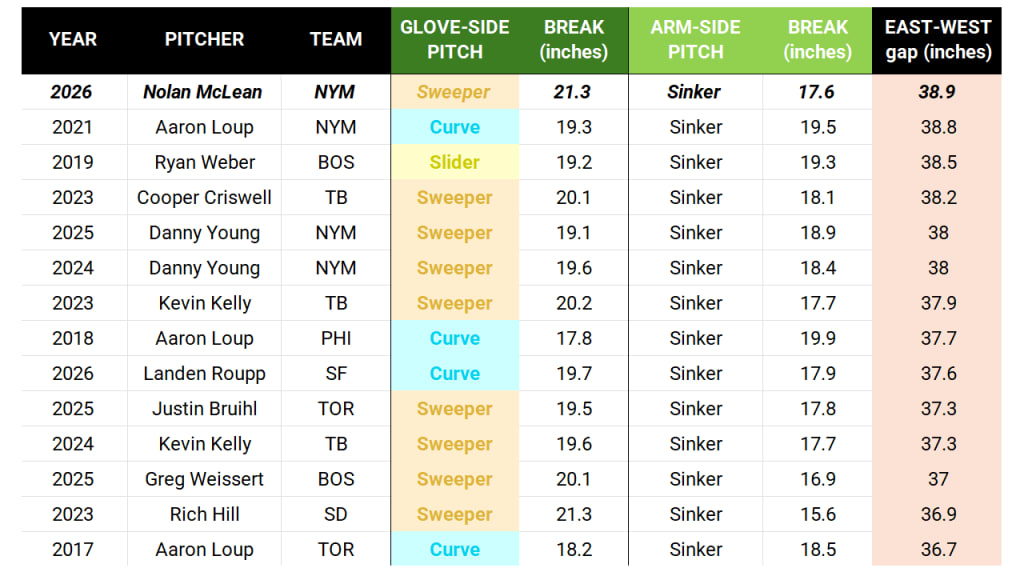
After McLean struck out eight against the D-backs last week, Mets play-by-play man Steve Gelbs noted, “I don’t know if I’ve ever seen anyone throw stuff that moves in that way," and he wasn't wrong to say it. No one else really does throw it quite like this.
Boston’s Greg Weissert comes close, because his sinker/sweeper have a similar horizontal gap to McLean’s, but he just missed our minimum-pitch cutoff – and, as a more sidearmer than McLean, gets more of that movement because of his release point (i.e., "throwing sideways," rather than using spin to create all that extra movement).
We first started thinking about this last year, noticing how McLean's pitch movement was very nearly breaking our Statcast pitch movement chart. At the time, it was merely “high on the list,” not atop it, so we filed it away for future reference. What’s changed this year? The sweeper, which has gained 5 inches of extra movement -- as though what he was throwing last year wasn’t enough. Despite throwing it 1 mph slower, he’s added 200 RPM of spin, and made it all more efficient, too (68% of spin going to movement this year, after 59%) last year.
What's also changed, at least early on, is that the sweeper has gotten better results. Over the winter, McLean accurately told The Athletic about the pitch: "It’s kind of something I’m known for, but it’s also been the pitch I’ve given up the most damage on as well, which makes it a risk-reward thing." Last year, that was true, with opponents batting .361 and slugging .528 against it. This year -- and again he's thrown it just 44 times so far -- we're looking at .222 and .222.
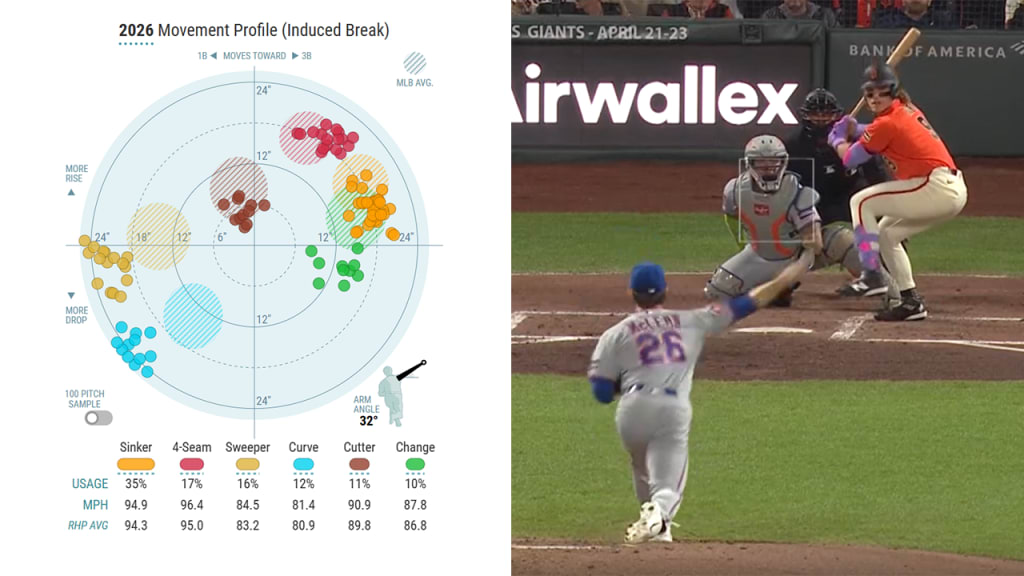
Ironically, while it’s the sinker/sweeper combination that we’re focusing on here, because we’re looking just at extreme east-west differences, it’s somehow not even McLean’s biggest combination of pitches that move the furthest from one another.
That would be either one of his fastballs and his curveball -- again, the highest-spinning curve we’ve ever seen -- which has slightly less horizontal break than the sweeper (18.3 inches) but comes with an additional foot of downward movement. As you can see on the chart above, both pitches are nowhere near the thatched "MLB average" blobs, because nothing about them is average.
But what really stands out here is what this all looks like on the way to the plate. We talk a lot about "tunneling," about making two different pitches look exactly the same for as long as possible until they diverge at the last second, making it too late for the batter to adjust.
That's not exactly what McLean's doing, at least with these two pitches. Instead, the sinker and sweeper start off at similar release points, then cross paths just a few feet in front of the plate.
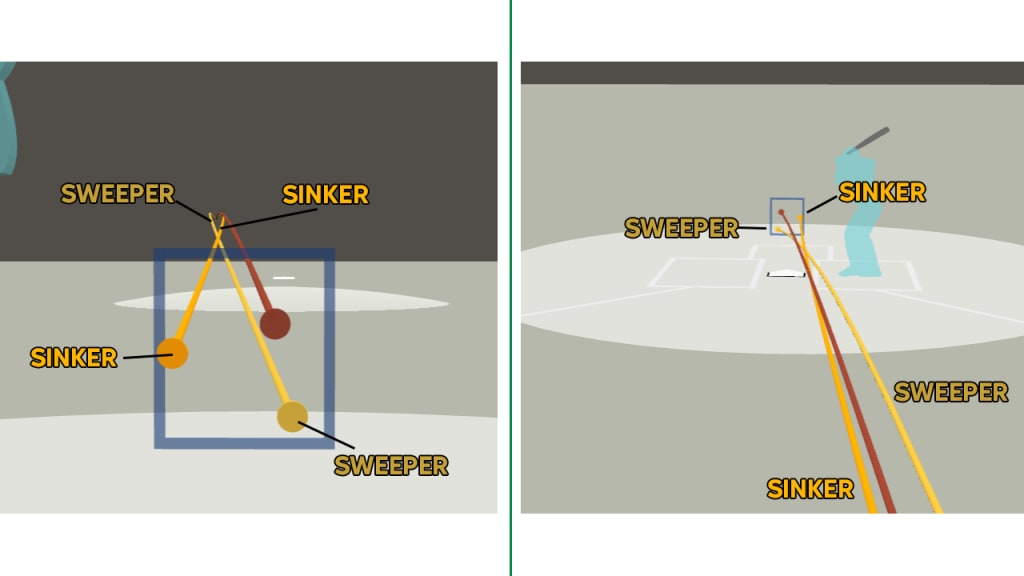
Which explains a little how San Francisco's Jerar Encarnacion managed to look like, well, this earlier this month. McLean's first pitch sweeper took a hard left turn on the way to the plate, causing Encarnacion to swing and miss. After an 0-1 sweeper missed low, McLean broke out the sinker, which broke so far in that it nearly hit him -- but still managed to become strike two because it was a foul ball.
Over the last decade of Statcast tracking, "spin rate" has become a trendy thing to look for when it comes to pitchers, but as noted above, it's more potential energy than guaranteed success. Some pitchers have great spin that they can't get to move efficiently, or in the right direction, or to land for strikes.
McLean's been able to do all of that, blessed with the highest spin rate we've really ever seen. In the midst of what's been a relatively disappointing start for the 2026 Mets, their ace is still rookie-eligible, and with the sixth-best ERA in the game since his August 2025 debut. It's extremely hard to do what he's doing, but it's not that hard to see why it's working. When you can make your pitches move more than the width of a baseball bat apart from one another, batters might just not be equipped well enough to respond.