
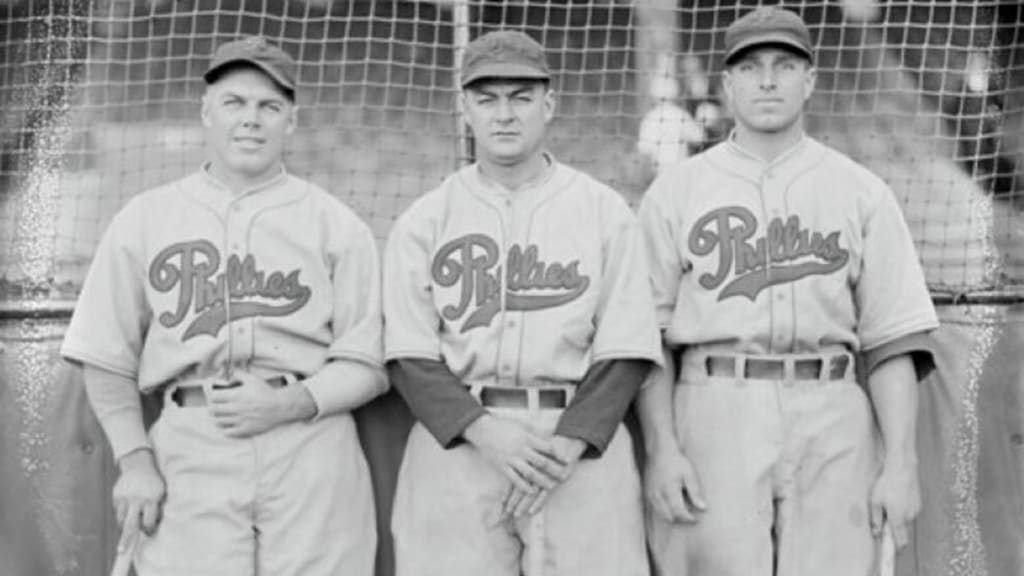
Living in the Kensington section of Philadelphia, Jimmie Wilson became a two-time All-Star catcher, a player-manager, manager, and coach with four National League clubs. His 23-year career had some unusual twists.
With the assistance of Wilson’s SABR bio by Gary Livacari here’s a peek at that career.
Born on July 23, 1900, the sixth of 10 children of Robert Wilson and Agnes Mae McCuley, who were natives of Scotland who migrated to America in 1896. At age 14, he followed his father to a local Kensington hosiery factory where he worked as an apprentice knitter. Soccer was huge in Kensington and Wilson excelled in the sport. Throughout his soccer career, he kept his interest in baseball alive, playing semiprofessionally for extra money during the soccer offseasons. He soon made a name for himself as a talented young catcher.
In 1918, Jimmie was offered a contract by Connie Mack of the Philadelphia Athletics. However, his immigrant father, who cared little for baseball, would not allow his 17-year-old son honor the contract and was not hesitant to let Connie Mack know how he felt. Speaking about the incident years later, Wilson said: “When I signed to play baseball with the Philadelphia Athletics, my old man said no boy of his was going to make a jackass of himself [playing baseball]. He went to Connie Mack and made him give me my release,” wrote Livacari.
After his 18th birthday, and out of his father’s control, he signed to play for New Haven in the Eastern League. After two seasons there, he was traded to the Phillies, February 1923, for catcher Frank Withrow and cash.
Big League Career
Phillies (1923-1928) ... St. Louis Cardinals (1928-33; World Series, 1928, 1930-31) ... Phillies (1934-38, player-manager) ... Cincinnati Reds (1939-40, player-coach) ... Chicago Cubs (1941-44, manager) ... Reds (1945-46, coach).
His 18-year career: .284 average, 32 home runs, 621 RBIs. More walks (356) than strikeout (280).
With the Cardinals, he was the National League’s starting catcher in the first All-Star game (1933). Two years later, the first Phillies catcher to start in an ASG.
Unusual Twists
May 11, 1928, the Phillies were playing a doubleheader in St. Louis. Wilson was the Phillies catcher, playing the entire first game and starting the second game. During the second inning of that game, Wilson was removed from the game as he was traded to the Cardinals. He went to the St. Louis clubhouse, put on the Cardinals uniform and sat on their bench for the rest of the game, becoming the only player in Major League history who was a member of two teams during one game.
On Nov. 15, 1933, Wilson, 33, was traded back to the Phillies to become the 14th player-manager in franchise history. Seven happened between 1883 and 1898. Wilson (1934-38) and catcher Red Dooin (1910-14) have the longest tenures. In his five seasons, he caught 77, 78, 63, 22 and one game. The Phils were pitiful finishing 7th, 7th, 8th, 7th and 8th.
He is best remembered for his role in the 1940 World Series. At age 40, while a coach for the pennant-winning Reds, he was pressed into emergency catching duty and was the unlikely hero in the decisive seventh game, bringing a World Series championship to Cincinnati. His sacrifice bunt moved a teammate into scoring position, leading to the winning run in the clinching game.
That same season (May 13), he served as a fill-in umpire at first base when the umpires were never assigned to the game.
Wilson died from a heart attack on May 31, 1947, at age 46.
He was the first Philadelphia native to appear in an All-Star Game.