
The Phillies conducted Spring Training in St. Petersburg, Fla., between 1915-18. Accommodations for the team -- paid for at a discounted rate negotiated by club president William F. Baker -- were hardly luxurious. The players were housed two to a bed (not two to a room) at the Fifth Avenue Hotel, a lodging that had long since seen its best days.
The meals were terrible. Lunches included a fried fish with its head still attached inserted between two slices of bread. The sandwiches were sent from the hotel to the ballpark wrapped in newspaper and often were cold by the time they arrived.
Dinners were not much better. The roast beef was so tough that chewing it posed a challenge for the players’ teeth. There is a story, likely apocryphal, in Frederick Lieb’s history of the Phillies that describes what pitcher Grover Cleveland Alexander did with a slice of roast beef he was served. According to Lieb, the meat was so tough that Alexander nailed it to the bottom of his shoe to use as its sole.
Near Coffee Pot Park where the Phillies trained were orange and grapefruit groves that players visited to obtain fruit to supplement their meager club-provided nourishment. Fortunately, the owner of the groves, William S. Downey, allowed the players to purloin his fruit for their consumption. One Philadelphia sportswriter observed the practice and wrote this about it in the Philadelphia Inquirer newspaper:
“Mr. Downey has generously placed his groves and the luscious fruit therein at the free disposal of the Phil players at any time they feel so inclined, and the evidence produced by those who have taken advantage of Mr. Downey’s generosity leads to the suspicion that the said Mr. Downey’s crop of oranges and grapefruit won’t be worth much in the open market when the hungry Phil athletes get through with it.”
Players also used the groves to relax from the regimen of training. Pat Moran, named manager before the 1915 season, was convinced the players had not received proper physical conditioning during previous preseason camps, which impeded their regular season performance. He was determined to rectify that shortcoming, but it didn’t mean there wasn’t some time for fun and frolicking.
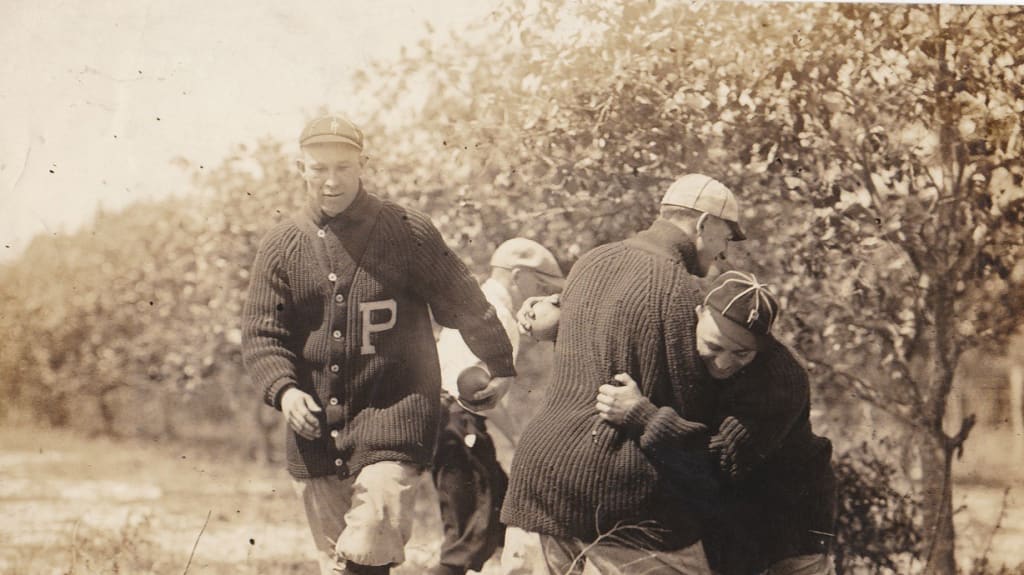
The photo shows three Phillies’ players in one of the nearby groves playing what appears to be an ersatz game of football. Those shown in the photo are (left to right) Jack Adams (reserve catcher), George Chalmers (pitcher) and Oscar Dugey (utility infielder). Both Adams and Dugey are holding an orange or grapefruit in their hands that apparently served as a substitute for actual footballs in playing the game.
The photo can be dated to 1916 based on the caps the players are wearing. They are model 1915 versions. This is obvious because one of the white vertical stripes on the cap’s front runs through the loop of the "P" and extends to where the crown meets the brim. That style was used only in 1915. In 1916, that same vertical stripe ran only to the top of the loop of the "P." Since it was common practice for players to wear the previous season’s uniform during the next season’s Spring Training, the photo was undoubtedly taken during 1916 preseason camp.
Note the players are wearing wool sweaters to stay warm. Field jackets were not introduced until the mid-1920s.
Camp took place in late March-early April. Their final exhibition game was April 10. The defending NL champion Phils opened the season two days later, a 5-4 walk-off win over the New York Giants. A two-out walk, a stolen base and back-to-back wild pitches set off a celebration.