
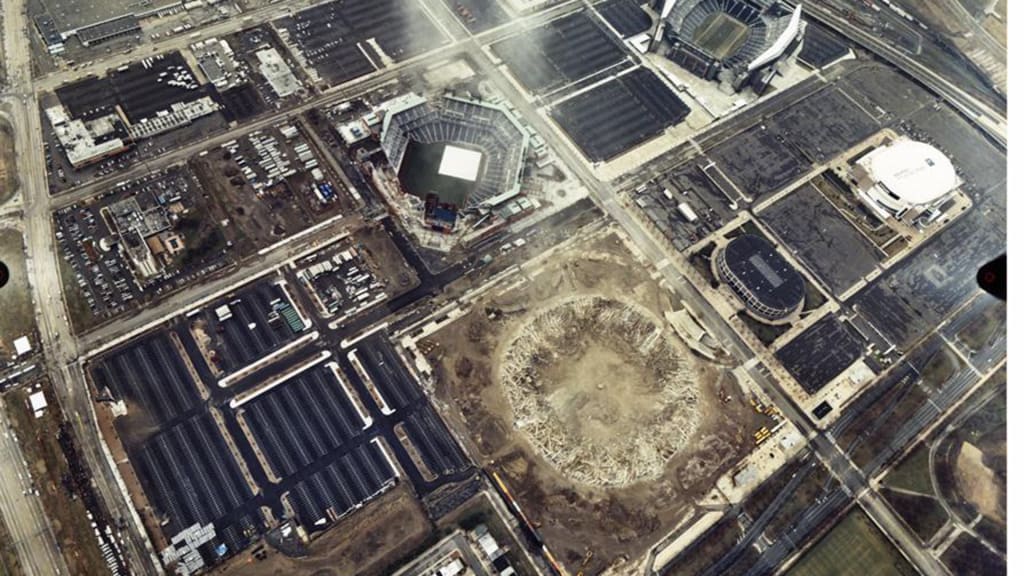
It took four years to build Veterans Stadium and 62 seconds to implode on an early Sunday morning on March 21, 2004.
I-95 and the Schuylkill Expressway were closed for the 7 a.m. implosion. Streets around the Vet were closed except for a small section of Pattison Avenue, where a stage was set up that included platforms for the media. Phillies officials, employees and families were allowed in the area. Neighbors who had the Vet in their backyards left their homes, nervous that the implosion might break windows and glassware, or worse, somehow damage their homes.
Thousands were lined on streets outside the implosion perimeter trying to get a glimpse of history.
Mayor John Street, the Phillie Phanatic, Greg Luzinski and Dan Baker, the Vet’s public address announcer, were on the stage. Frank Bardonaro, president of Philadelphia-based AmQuip Crane Rental Company, pressed the "charge" button and then he and Nicholas T. Peetros Sr., project manager for Driscoll/Hunt Construction Company, pressed the "fire" button to trigger the implosion while Luzinski and the Phanatic pressed a ceremonial plunger. Luzinski was known for his “Bull Blast” home runs.
The first sounds emulated the sound of crackling fireworks. Then, the first section came down like a giant being chopped down at his knees as over 3,000 strategically placed dynamite charges began exploding. A video camera was placed inside the Vet. It provided a few seconds of video before disintegrating.
Clockwise, the 33-year-old stadium crumbled, creating a gigantic cloud of dust. With wind from the west, the cloud eerily traveled east over Citizens Bank Park, the Phillies' new home that would open with an exhibition game on April 3.
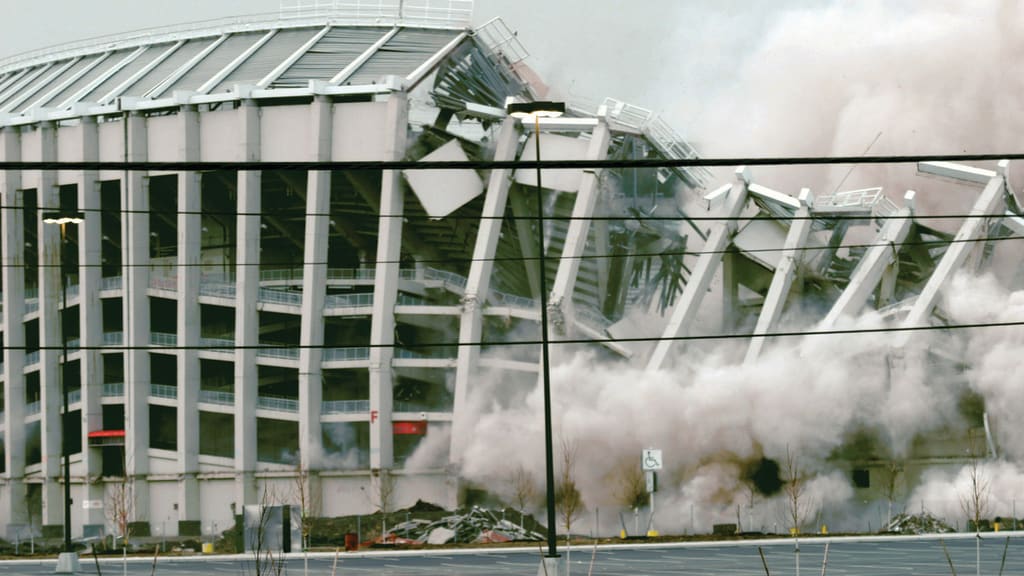
Cheers and murmurs could be heard. Tears were plentiful. People were taking photographs while holding on to spouses or family members. For generations of fans, the Vet was the only thing they experienced and knew. Now, it was a rubble of lifetime memories.
Larry Bowa got the first hit there and managed the last game. As the Phillies' manager, he was at Spring Training in Clearwater. He, general manager Ed Wade, staff, players and others were able to see the implosion via a satellite feed shown on the video board at Bright House Networks Field, the Phillies' then-new Spring Training home, which had opened 17 days earlier.
Remembering the Vet
The Eagles played their first game there on Sept. 26, 1971. Their last game was Jan. 19, 2003 . . . The Phillies opened the Vet on April 10, 1971, and there were emotional closing ceremonies following the last game on Sept. 28, 2003 . . . The four Joe Brown statues (two football, two baseball) were relocated to the outer portions of the parking lot where the stadium once stood . . . The Phillies also built a memorial to veterans on Pattison Avenue to make sure the name Veterans Stadium will live forever. The memorial was dedicated on June 6, 2005, the anniversary of World War II’s D-Day . . . White granite markers with a solid bronze medallion inlay were installed in the parking lot at the exact location of where home plate, the pitcher’s rubber, three bases and the two football goal posts once existed . . . A Pennsylvania Historical Marker was dedicated on Sept. 28, 2005.
Nuggets
Phillies' record: 1,415-1,199, 3 ties . . . Division titles: 1976-77-78; 1980-81; 1983; 1993 . . . National League pennants: 1980, 1983, 1993
World Series championship (1980) . . . 66 million fans attended Phillies games.